
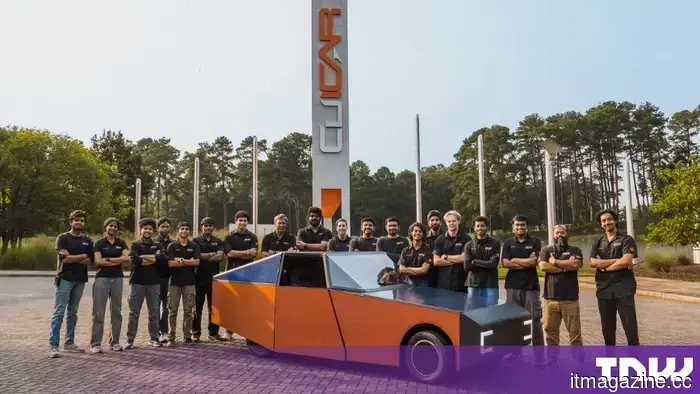
BMW tasked students with creating an electric vehicle that generates more energy than it consumes. They equipped it with 1,700 solar panels, and it is functioning successfully.
Clemson students created the Luminetta for BMW: a 1,212-pound solar electric vehicle featuring 1,700 cells that provides 31 miles of daily range, making it energy-positive for a 12-mile commute. CES 2027.
BMW tasked graduate students at Clemson University with designing an electric vehicle that generates more energy than it uses during a day of urban travel. Two years later, they have produced a working prototype. Named Deep Orange 17, or Luminetta, by BMW, this two-seat solar EV is equipped with over 1,700 photovoltaic cells developed alongside the Fraunhofer Institute for Solar Energy Systems. It has a weight of 1,212 pounds and generates enough solar energy to restore 31 miles of range each day, significantly surpassing the 12-mile daily commute the team based their calculations on.
The vehicle's shape, inspired by a box fish, is designed to optimize solar panel area. Virtually the entire exterior surface is a panel. The cells collect energy while parked, during driving, and even in traffic. The panels from Fraunhofer can also gather energy in shaded conditions. The bright orange color comes from a long-lasting protective layer over the cells. Its lightweight structure incorporates steel for the passenger compartment, along with aluminum, carbon fiber, and 3D-printed metal connections. Additionally, regenerative braking and optimized torque distribution further enhance energy efficiency beyond what is captured from the sun.
This model is a prototype rather than a market-ready product. BMW does not intend to sell a solar panel-covered car. Nonetheless, the initiative showcases that energy-positive driving is attainable with a sufficiently lightweight vehicle and a short commute. For decades, solar-powered cars have faced challenges in transitioning from concept to commercialization, as seen with companies like Lightyear and Sono Motors, which struggled to make economic viability work on a large scale. The Luminetta avoids these pitfalls by not aiming to function as a full-fledged car. Instead, it serves as a proof of concept, achieving success on that basis.
The vehicle will be shown at CES 2027 in Las Vegas. Lightyear had previously promised a solar EV capable of operating for months without recharging, only to go bankrupt. The Luminetta refrains from making commercial claims, which may explain its feasibility. For BMW, the takeaway is more specific yet significant: solar integration can substantially enhance range on lightweight platforms, even if it isn't yet a substitute for conventional charging solutions in consumer vehicles.
Other articles
 Bill Ackman shares Jeff Bezos' view that the most effective way to contribute to the world is to create something that is functional.
Ackman claims that capitalism addresses issues more effectively than philanthropy. His new Brain Research Institute employs nonprofit funding to create for-profit enterprises.
Bill Ackman shares Jeff Bezos' view that the most effective way to contribute to the world is to create something that is functional.
Ackman claims that capitalism addresses issues more effectively than philanthropy. His new Brain Research Institute employs nonprofit funding to create for-profit enterprises.
 OpenAI is delaying its upcoming model due to significant cybersecurity concerns.
OpenAI states that it "cannot eliminate the possibility" of essential cyber capabilities in its forthcoming Astra model, leading them to halt development and decelerate the model's progress because of this.
OpenAI is delaying its upcoming model due to significant cybersecurity concerns.
OpenAI states that it "cannot eliminate the possibility" of essential cyber capabilities in its forthcoming Astra model, leading them to halt development and decelerate the model's progress because of this.
 NavVis secured €73.7 million to develop the spatial data layer essential for factories to implement AI.
NavVis, located in Munich, secured €73.7 million in Series D funding to expand its spatial twin platform. The company has scanned over 1 billion square meters of industrial space. Its customer base includes BMW, VW, Toyota, Siemens, and BASF.
NavVis secured €73.7 million to develop the spatial data layer essential for factories to implement AI.
NavVis, located in Munich, secured €73.7 million in Series D funding to expand its spatial twin platform. The company has scanned over 1 billion square meters of industrial space. Its customer base includes BMW, VW, Toyota, Siemens, and BASF.
 Malicious AI capabilities transformed agents into credential theft operators on a large scale.
Zenity Labs discovered AI agent "skills" with hidden traps on Vercel's skills.sh, including one that has 1.7 million installs, which can convert agents into credential stealers.
Malicious AI capabilities transformed agents into credential theft operators on a large scale.
Zenity Labs discovered AI agent "skills" with hidden traps on Vercel's skills.sh, including one that has 1.7 million installs, which can convert agents into credential stealers.
 Cloudflare developed a browser specifically for AI agents. It utilizes seven times less memory than Chromium and operates completely on Workers.
Cloudflare introduced Kitesurf, a browser designed for AI agents that consumes 3 to 7 times less CPU and memory compared to Chromium. It operates on Workers and successfully completes over 215,000 web platform tests. It is available for free in its beta version.
Cloudflare developed a browser specifically for AI agents. It utilizes seven times less memory than Chromium and operates completely on Workers.
Cloudflare introduced Kitesurf, a browser designed for AI agents that consumes 3 to 7 times less CPU and memory compared to Chromium. It operates on Workers and successfully completes over 215,000 web platform tests. It is available for free in its beta version.
 OpenAI is delaying the release of its upcoming model due to significant cybersecurity concerns.
OpenAI states that it "cannot dismiss" essential cyber capabilities in its forthcoming Astra model, which has led to a halt in its progress and a slowdown in development.
OpenAI is delaying the release of its upcoming model due to significant cybersecurity concerns.
OpenAI states that it "cannot dismiss" essential cyber capabilities in its forthcoming Astra model, which has led to a halt in its progress and a slowdown in development.
BMW tasked students with creating an electric vehicle that generates more energy than it consumes. They equipped it with 1,700 solar panels, and it is functioning successfully.
Students at Clemson created the Luminetta, a solar electric vehicle weighing 1,212 pounds, equipped with 1,700 photovoltaic cells that produce a daily range of 31 miles solely from sunlight. The project received support from BMW.