
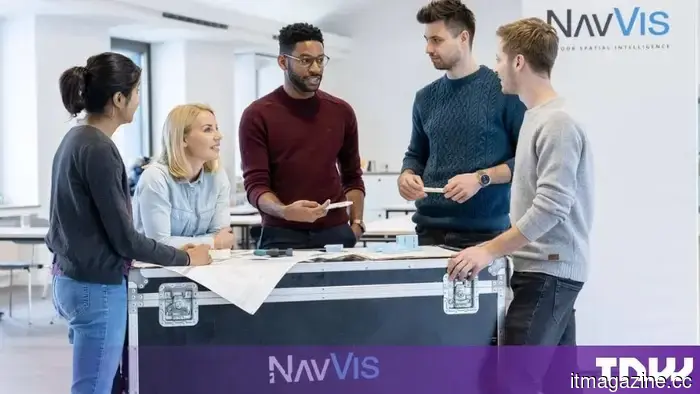
NavVis secured €73.7 million to develop the spatial data infrastructure that factories require prior to implementing AI.
NavVis has secured €73.7 million ($85 million) in a Series D funding round spearheaded by The Jordan Company, a US private equity firm. The Munich-based spatial twin platform's existing investors, Yttrium, KOZO KEIKAKU ENGINEERING, and Cipio Partners, also took part in the funding. Founded in 2013 as a spinoff from the Technical University of Munich, NavVis specializes in creating photorealistic digital replicas of factories, plants, and buildings using wearable laser scanning technology that reportedly operates ten times quicker than conventional surveying techniques.
The scale of their operations is impressive, with over one billion square meters of industrial space mapped onto the NavVis platform. More than 150,000 users, including teams in engineering, maintenance, and construction, utilize this data on a daily basis. The company boasts a prominent customer roster that includes well-known manufacturers such as BMW, Volkswagen, Toyota, Mercedes-Benz, ExxonMobil, BASF, Henkel, Bosch, and Siemens. NavVis collaborates with Nvidia, SAP, and Autodesk and has a presence in over 50 countries, serving more than 1,500 clients.
The recent investment will be directed toward developing next-generation capture hardware, enhancing their AI capabilities, and creating an open platform for what NavVis refers to as the “physical AI ecosystem.” CTO Georg Schroth highlighted a common industry issue: teams have historically relied on drawings that are often untrustworthy. NavVis aims to replace those with a constantly updated spatial record that acts as the authoritative source for every team, tool, and AI application. The concept of digital twins is gaining traction across various sectors, and NavVis is positioned within industrial operations, where the stakes and data complexities are particularly high.
The company is also focusing on accelerating its growth in the US market, which has seen the fastest scaling in recent years. CEO Felix Reinshagen described NavVis’s goal as maintaining synchronization between physical and digital realities for the world's most valuable assets. Customers leverage NavVis data to minimize downtime in automotive assembly lines, expedite data center construction, shorten maintenance shutdowns at refineries, plan robotics deployments, and train industrial foundation models. The spatial data layer is becoming a fundamental requirement for industrial AI, and NavVis is setting itself up as a key player in developing it.
Other articles
 Malicious AI 'capabilities' transformed agents into credential theft operatives, on a large scale.
Zenity Labs discovered AI agent "skills" that were booby-trapped on Vercel's skills.sh, with one skill having 1.7 million installs, which convert agents into credential stealers.
Malicious AI 'capabilities' transformed agents into credential theft operatives, on a large scale.
Zenity Labs discovered AI agent "skills" that were booby-trapped on Vercel's skills.sh, with one skill having 1.7 million installs, which convert agents into credential stealers.
 The team that created Paddington 2 had the opportunity to make a movie about a droid from Star Wars.
After the success of Paddington 2, Paul King and Simon Farnaby proposed a Star Wars film focused on a droid. However, Lucasfilm requested additional Star Wars elements be incorporated. The concept might evolve into something different.
The team that created Paddington 2 had the opportunity to make a movie about a droid from Star Wars.
After the success of Paddington 2, Paul King and Simon Farnaby proposed a Star Wars film focused on a droid. However, Lucasfilm requested additional Star Wars elements be incorporated. The concept might evolve into something different.
 Harvey is raising $15.5 billion, an increase of 40% over the past five months.
Legal AI startup Harvey is negotiating to secure $500 million at a valuation of $15.5 billion, marking a 40% increase in just five months, based on $350 million in annualized revenue.
Harvey is raising $15.5 billion, an increase of 40% over the past five months.
Legal AI startup Harvey is negotiating to secure $500 million at a valuation of $15.5 billion, marking a 40% increase in just five months, based on $350 million in annualized revenue.
 Disney+ and ESPN are experimenting with AI-driven search functionality that allows users to articulate their desires using everyday language.
Disney+ and ESPN are currently in the beta phase of testing AI search functionalities. ESPN utilizes years of data to provide answers to sports-related inquiries. Meanwhile, Disney+ offers show recommendations based on users' moods rather than solely on their viewing history.
Disney+ and ESPN are experimenting with AI-driven search functionality that allows users to articulate their desires using everyday language.
Disney+ and ESPN are currently in the beta phase of testing AI search functionalities. ESPN utilizes years of data to provide answers to sports-related inquiries. Meanwhile, Disney+ offers show recommendations based on users' moods rather than solely on their viewing history.
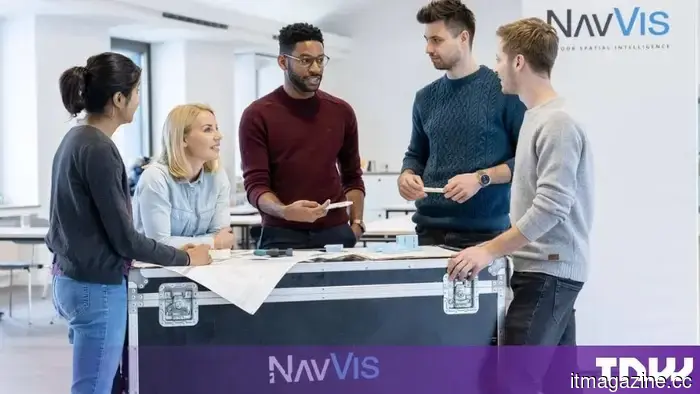 NavVis secured €73.7M to develop the spatial data layer essential for factories prior to implementing AI.
NavVis, located in Munich, secured €73.7M in a Series D funding round to expand its spatial twin platform. The company has scanned over 1 billion square meters of industrial space, with customers including BMW, VW, Toyota, Siemens, and BASF.
NavVis secured €73.7M to develop the spatial data layer essential for factories prior to implementing AI.
NavVis, located in Munich, secured €73.7M in a Series D funding round to expand its spatial twin platform. The company has scanned over 1 billion square meters of industrial space, with customers including BMW, VW, Toyota, Siemens, and BASF.
 Bill Ackman shares Jeff Bezos' view that the most effective way to contribute to the world is to create something that is functional.
Ackman claims that capitalism addresses issues more effectively than philanthropy. His new Brain Research Institute employs nonprofit funding to create for-profit enterprises.
Bill Ackman shares Jeff Bezos' view that the most effective way to contribute to the world is to create something that is functional.
Ackman claims that capitalism addresses issues more effectively than philanthropy. His new Brain Research Institute employs nonprofit funding to create for-profit enterprises.
NavVis secured €73.7 million to develop the spatial data infrastructure that factories require prior to implementing AI.
NavVis, based in Munich, secured €73.7 million in Series D funding to expand its spatial twin platform. The company has scanned over 1 billion square meters of industrial space, with customers including BMW, VW, Toyota, Siemens, and BASF.