
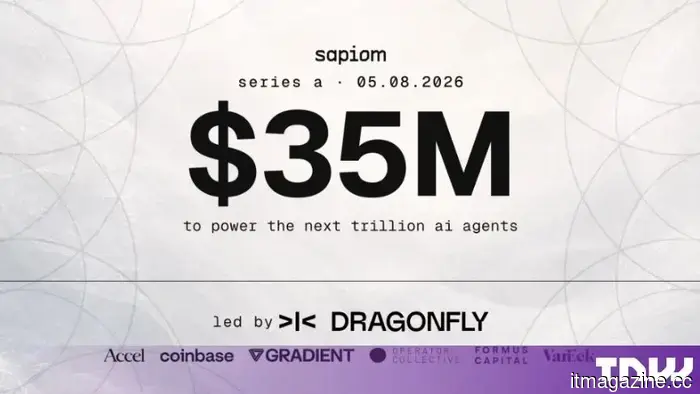
Sapiom secures $35 million to reduce the expenses associated with operating AI agents.
Sapiom, a startup from San Francisco, operates in the space between AI agents and the underlying models they utilize. The company has secured a $35 million Series A funding round led by Dragonfly, coming 11 months after its launch and six months after raising a $15 million seed round led by Accel. With this latest round, total funding amounts to $50 million.
Sapiom's focus is clear and timely: reducing the costs associated with running AI agents. When an agent needs to act, Sapiom determines the appropriate model, tool, or service to use, setting a budget before any funds are spent. Its Router directs each request to the least expensive capable model rather than the priciest. Since its inception six months ago, the platform has managed more than 270 million transactions.
A clear example of this cost reduction can be seen with a client named Polsia, an AI startup that operates without employees, utilizing multiple agents to support other businesses. According to Semafor, its projected revenue surged from $100,000 to $10 million within a year, but its monthly costs for Anthropic reached $1.2 million. After Sapiom conducted evaluations, that expense plummeted to approximately $100,000.
“It’s just unsustainable,” stated founder Ilan Zerbib in an interview with Semafor. He contends that startups cannot afford the rates charged by leading labs, even when demand exists.
However, there's an interesting dynamic: Anthropic is among Sapiom’s investors, participating in the Series A alongside Okta Ventures, Menlo Ventures, and Array Ventures. Thus, a model creator is funding a startup aimed at reducing expenses on model creators. Zerbib considers this relationship to be aligned rather than adversarial.
By lowering inference costs, companies can develop more agents, with some work still requiring the most advanced models, according to Zerbib.
Cost is emerging as a primary constraint in the industry. Gartner predicts that over 40% of agentic AI projects will be canceled by the end of 2027, largely due to rising costs. Corporate AI budgets are undergoing rigorous evaluations, with some organizations already capping spending limits for staff. A KPMG survey from June revealed that only 7% of 2,100 surveyed executives could identify established returns from their AI initiatives.
Zerbib believes the number of agents is poised for significant growth. He estimates there could be tens of millions of software developers, stating, “we’re talking about trillions of agents that will operate in the economy in the next three years.” According to his data, the majority of this work does not require top-tier models. He indicated, “In 95% of cases, it doesn’t make sense to go to a very expensive frontier model.” The Next Web has highlighted how U.S. companies are already transitioning to more affordable models to manage expenses.
Haseeb Qureshi from Dragonfly will be joining the board, describing this issue as an infrastructure challenge rather than merely a dashboard problem. “Agents are becoming employees without managers or budgets,” he remarked, “and increasingly, the CTO is acting as CFO, allocating real funds with little visibility into their usage.”
Sapiom’s Router competes with OpenRouter, a leading name in model routing. According to Semafor, Sapiom's distinction lies in its infrastructure; it operates open-weight models from its data center in San Jose, while most competitors serve only as middlemen. The company charges directly for computation rather than adding a markup. It’s part of a growing trend of startups offering agent infrastructure to investors this year.
However, this advantage may be short-lived, as routing seems to be evolving into a commodity. Companies like Amazon and Microsoft have begun incorporating it into their offerings, Bedrock and Azure, respectively. Open-source routers are also available for free, with OpenRouter managing roughly 25 trillion tokens weekly.
One market analysis identifies 80 active routing competitors, but Sapiom is placing its bets on its underlying infrastructure: the inference and the accompanying controls. They believe this is what distinguishes a feature from a full-fledged company.
Other articles
 Anthropic has announced that it is developing custom chips for Claude and is seeking engineers with experience in "shipping silicon."
Anthropic has announced that it is recruiting engineers to create custom chips for Claude. The position offers a salary of up to $485K. Hardware from AWS, Google, Nvidia, and AMD will continue to play a key role.
Anthropic has announced that it is developing custom chips for Claude and is seeking engineers with experience in "shipping silicon."
Anthropic has announced that it is recruiting engineers to create custom chips for Claude. The position offers a salary of up to $485K. Hardware from AWS, Google, Nvidia, and AMD will continue to play a key role.
 Europe is enjoying the advantages of an open market with an impressive $22K electric vehicle, while the US market remains unexciting.
Geely's latest E2 hatchback is priced starting at only $22,490 in Europe, whereas the most affordable electric vehicles in America exceed $28,000.
Europe is enjoying the advantages of an open market with an impressive $22K electric vehicle, while the US market remains unexciting.
Geely's latest E2 hatchback is priced starting at only $22,490 in Europe, whereas the most affordable electric vehicles in America exceed $28,000.
 Google DeepMind restructuring: Co-leads of Gemini depart to establish a startup.
Demis Hassabis is transferring control of Google DeepMind. Jeff Dean, Oriol Vinyals, Quoc Le, and Sanjay Ghemawat are departing to establish Discovery Loop.
Google DeepMind restructuring: Co-leads of Gemini depart to establish a startup.
Demis Hassabis is transferring control of Google DeepMind. Jeff Dean, Oriol Vinyals, Quoc Le, and Sanjay Ghemawat are departing to establish Discovery Loop.
 Google's layoffs affected 52 positions in Washington state.
Google is eliminating 52 positions in Washington state, marking its first substantial job cut there since 2023, coinciding with the week it also lost four prominent AI researchers.
Google's layoffs affected 52 positions in Washington state.
Google is eliminating 52 positions in Washington state, marking its first substantial job cut there since 2023, coinciding with the week it also lost four prominent AI researchers.
 Zoox will begin charging for robotaxi services in Las Vegas starting August 10.
Amazon's Zoox has scheduled its inaugural paid robotaxi service in Las Vegas for August 10. The fares will be aligned with the pricing of "comfort" tier ride-hailing services. To date, nearly 1 million complimentary rides have been provided.
Zoox will begin charging for robotaxi services in Las Vegas starting August 10.
Amazon's Zoox has scheduled its inaugural paid robotaxi service in Las Vegas for August 10. The fares will be aligned with the pricing of "comfort" tier ride-hailing services. To date, nearly 1 million complimentary rides have been provided.
 Wispr Flow introduces an AI note-taking tool that operates without the need to join calls.
Wispr Flow has introduced Notetaker, an AI meeting assistant for Mac that can record calls without needing to join as a participant, and transforms conversations into transcripts, summaries, and follow-up notes.
Wispr Flow introduces an AI note-taking tool that operates without the need to join calls.
Wispr Flow has introduced Notetaker, an AI meeting assistant for Mac that can record calls without needing to join as a participant, and transforms conversations into transcripts, summaries, and follow-up notes.
Sapiom secures $35 million to reduce the expenses associated with operating AI agents.
Sapiom secured $35 million in a Series A funding round to reduce the operational costs of AI agents, potentially by up to ten times. Among its investors is Anthropic, whose expenses the startup aims to decrease.