
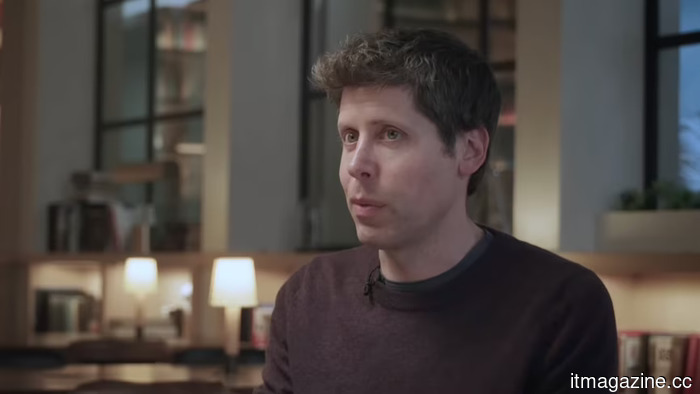
Sam Altman's often overlooked concern about AI: that it may lead us to stop thinking independently.
The leader of a company advocating for the use of AI in all aspects of life has identified a concern that he believes is being largely overlooked: individuals may become so reliant on AI for their thinking that their cognitive abilities will diminish. Sam Altman, CEO of OpenAI, refers to this phenomenon as “cognitive atrophy” and considers it one of the critical unresolved issues surrounding AI. He shared his thoughts on the podcast "Invest Like the Best."
When asked about his main worries regarding the future of AI, Altman stated, “One that I don’t think gets much attention is how are we going to avoid cognitive atrophy?” His perspective was more about maintaining discipline than predicting doom. He emphasized, “How are we going to use these tools to ensure we are continually challenging our minds and grasping the things that truly matter?” framing the risk more as a matter of laziness than an impending disaster.
This concern is particularly notable coming from him. After all, OpenAI's business model encourages people to rely on ChatGPT for a greater portion of their tasks and decisions, making Altman's anxiety about dependency somewhat akin to a candy maker cautioning against sugar consumption.
Research is beginning to support this concern. Nataliya Kosmyna, a researcher at MIT, conducted a preliminary study indicating that individuals who used generative AI to write essays showed decreased performance over time compared to those who utilized Google or received no assistance whatsoever. Her message was clear: “There’s never been a tool like this that has allowed us the opportunity to have thinking done for us.”
Others express the risk in more alarming terms. Vivienne Ming, a theoretical neuroscientist, terms the practice of outsourcing cognitive tasks to AI as “chronic substitution” and cautions that it could diminish the cognitive reserve that protects the brain against dementia.
As AI assumes greater responsibilities, this concern intensifies. These tools have evolved from merely answering questions to engaging in document reviews, research, analysis, customer support, and coding—indicating that the mental tasks being delegated are becoming significantly more complex.
Altman is not the first tech leader to voice such concerns. Last year, Arthur Mensch, CEO of the French lab Mistral, told The Times that AI’s greatest threat may be “deskilling” workers and fostering increased laziness as they rely on it for thought processes.
This trend is not new but has become more pronounced. Technologies like calculators, navigational systems, and search engines previously took over specific mental tasks, each accompanied by similar warnings, often without the predicted catastrophic outcomes.
What sets the current situation apart is the extensive range of capabilities. Previous tools typically offloaded single tasks, whereas a general-purpose AI assistant can read, write, reason, and make decisions, complicating the issue of what cognitive skills people continue to develop.
Despite this, Altman maintained an optimistic outlook. He envisioned a “pretty magical” future where a personal AI tirelessly reads documents, listens to meetings, retrieves old emails, and utilizes unused overnight processing power to generate ideas and offer suggestions on next steps.
Nonetheless, he also delineated the limitations of machines. “The world may need a new term to describe the kind of judgment that humans excel at and which AI seems to struggle with," Altman noted, marking a rare acknowledgment of the technology’s shortcomings from its leading advocate.
This reflects the duality in Altman’s perspective. He holds both the belief that AI can enhance human capability and the fear that it may lead to increased laziness. OpenAI is actively integrating this technology into everyday life, even as its founder articulates concerns about the same issue.
Ultimately, the reality remains uncertain. Whether AI will enhance our cognitive abilities or lead to their decline hinges on how individuals choose to employ it. Altman, who has previously expressed concerns about his own screen time, is not guaranteeing a positive outcome; he is simply highlighting the potential risk.
Other articles
 Bloom Security secures $20 million in seed funding as AI transforms operations on the enterprise endpoint.
Bloom Security has come out of stealth mode with a $20 million seed round, primarily funded by Glilot Capital and Ten Eleven Ventures. The Tel Aviv-based startup claims that AI agents, MCP servers, and browser extensions have transformed every employee's device into an unmonitored environment that traditional EDR solutions were not designed to detect.
Bloom Security secures $20 million in seed funding as AI transforms operations on the enterprise endpoint.
Bloom Security has come out of stealth mode with a $20 million seed round, primarily funded by Glilot Capital and Ten Eleven Ventures. The Tel Aviv-based startup claims that AI agents, MCP servers, and browser extensions have transformed every employee's device into an unmonitored environment that traditional EDR solutions were not designed to detect.
 Bloom Security secures $20 million in seed funding as AI transforms operations on the enterprise endpoint.
Bloom Security has come out of stealth mode with a $20 million seed funding round led by Glilot Capital and Ten Eleven Ventures. The Tel Aviv-based startup claims that AI agents, MCP servers, and browser extensions have transformed every employee device into an unmonitored environment that Endpoint Detection and Response (EDR) systems were not designed to detect.
Bloom Security secures $20 million in seed funding as AI transforms operations on the enterprise endpoint.
Bloom Security has come out of stealth mode with a $20 million seed funding round led by Glilot Capital and Ten Eleven Ventures. The Tel Aviv-based startup claims that AI agents, MCP servers, and browser extensions have transformed every employee device into an unmonitored environment that Endpoint Detection and Response (EDR) systems were not designed to detect.
 AEREDIUM's latest patent aims to substitute quarterly stablecoin audits with AI that continuously monitors.
AEREDIUM has received a U.S. patent for a multi-model AI system that consistently confirms the reserves of digital assets, documents decisions on-chain, and has the capability to automatically stop token transactions if the integrity of the reserves declines.
AEREDIUM's latest patent aims to substitute quarterly stablecoin audits with AI that continuously monitors.
AEREDIUM has received a U.S. patent for a multi-model AI system that consistently confirms the reserves of digital assets, documents decisions on-chain, and has the capability to automatically stop token transactions if the integrity of the reserves declines.
 EY developed an 'AI router' to prevent their AI expenses from escalating.
EY has developed an "AI router" that directs tasks to more affordable models in order to manage token expenses, as its survey reveals that 82% of companies are concerned about AI costs.
EY developed an 'AI router' to prevent their AI expenses from escalating.
EY has developed an "AI router" that directs tasks to more affordable models in order to manage token expenses, as its survey reveals that 82% of companies are concerned about AI costs.
 AEREDIUM's latest patent aims to substitute quarterly audits of stablecoins with AI that continuously monitors them.
AEREDIUM has received a U.S. patent for a multi-model AI system that consistently checks digital asset reserves, documents decisions on-chain, and can automatically stop token transactions if the integrity of the reserves declines.
CoreWeave and Leidos are developing a classified AI cloud for U.S. intelligence agencies.
CoreWeave and Leidos will operate CoreWeave's AI cloud within SCIF-accredited data centers for U.S. intelligence and defense, as part of a sovereign-compute initiative.
AEREDIUM's latest patent aims to substitute quarterly audits of stablecoins with AI that continuously monitors them.
AEREDIUM has received a U.S. patent for a multi-model AI system that consistently checks digital asset reserves, documents decisions on-chain, and can automatically stop token transactions if the integrity of the reserves declines.
CoreWeave and Leidos are developing a classified AI cloud for U.S. intelligence agencies.
CoreWeave and Leidos will operate CoreWeave's AI cloud within SCIF-accredited data centers for U.S. intelligence and defense, as part of a sovereign-compute initiative.
Sam Altman's often overlooked concern about AI: that it may lead us to stop thinking independently.
Sam Altman refers to “cognitive atrophy” as an overlooked risk associated with AI, aligning with researchers who caution that allowing AI to make decisions for us can diminish our mental abilities.