
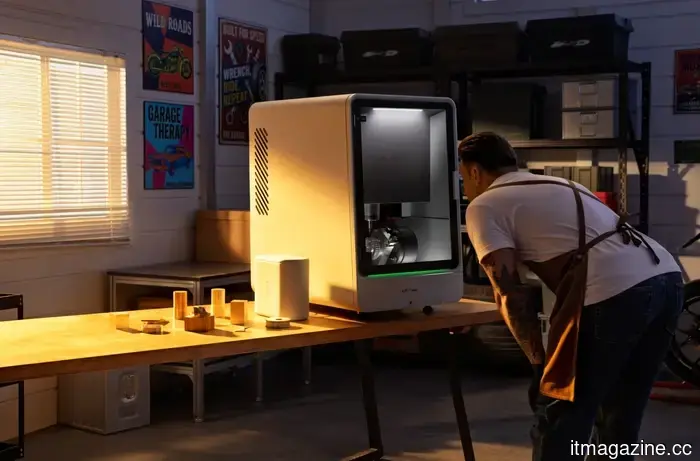
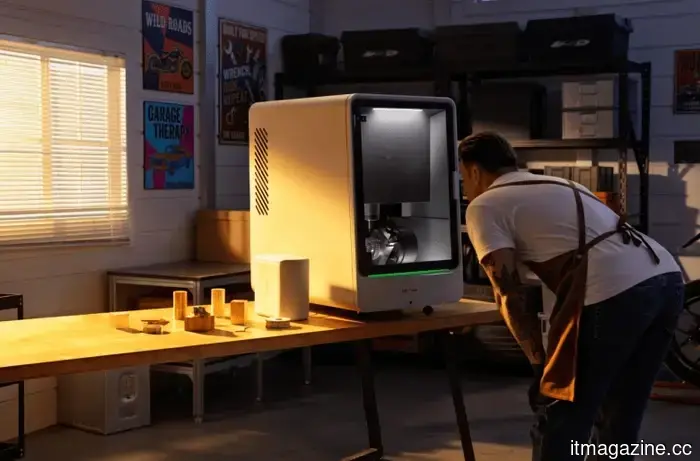
InfiMaker aims to make industrial manufacturing accessible on every desktop through the use of AI.
When individuals consider advanced manufacturing, they often envision expensive industrial machines working within factories rather than a small device resting on a desk. However, InfiMaker, a startup established in 2024, is seeking to alter that perception.
The startup positions itself as a desktop manufacturing firm, creating manufacturing tools tailored for engineers, designers, entrepreneurs, and makers. By integrating AI with software automation, its goal is to make industrial-grade precision machining more accessible to individual users.
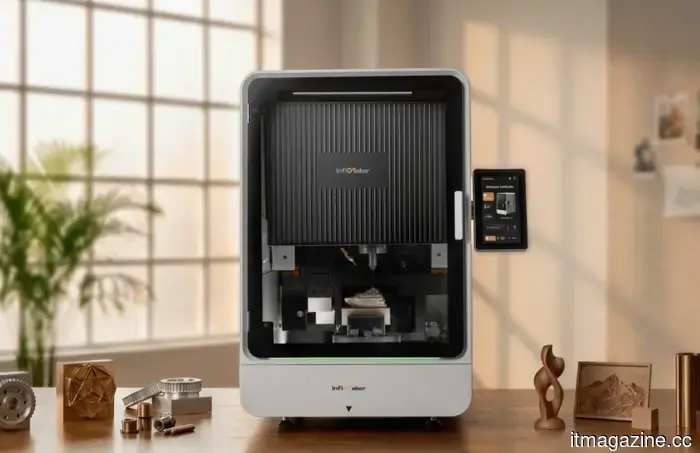
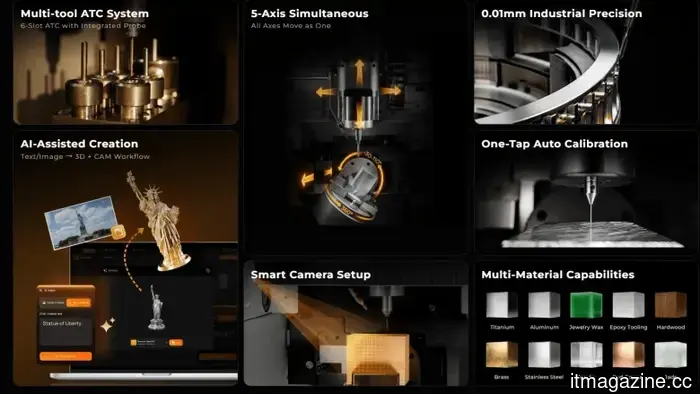
Differing from most desktop CNC (Computer Numerical Control) manufacturers, InfiMaker has opted not to enter the saturated market for 3-axis machines. Instead, it is launching the K1, a desktop 5-axis CNC platform.
According to Bowen Xie, the Founder and CEO of InfiMaker, merely introducing another desktop 3-axis machine would not significantly change the user experience. He argues that the primary barrier to the broader adoption of 5-axis machining is not the hardware itself, but rather the complexity of traditional software workflows and the expertise required to manage them.
Conventional 5-axis CNC machines have historically been limited to industrial applications due to their high cost and steep learning curve. Operators are typically required to have knowledge of CAM software, machining parameters, and toolpath generation before they can produce a part, which makes this technology unreachable for many engineers, designers, and makers.
Xie is confident that advancements in AI can help lower these hurdles. By automating a significant portion of the CAM workflow, the company aims to make 5-axis machining as easy to use as consumer electronics instead of a tool meant solely for manufacturing experts.
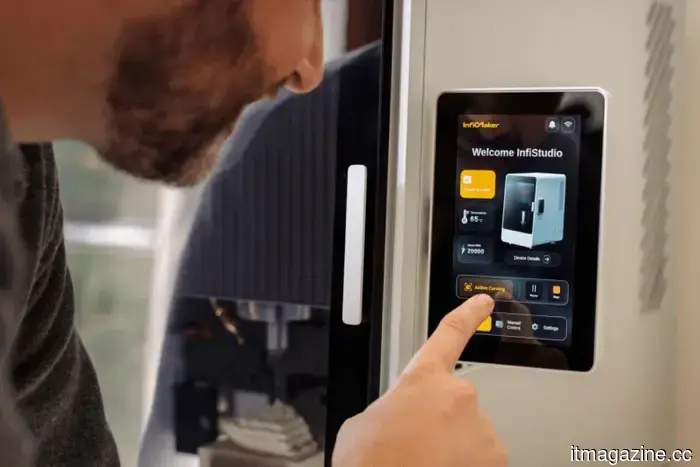
This philosophy is evident throughout the K1’s workflow. Utilizing the company’s proprietary CAM software, InfiStudio, the program integrates AI-assisted parameter generation and machining-strategy recommendations with automated toolpath generation, material-specific presets, and guided workflows.
For decorative and artistic tasks, users can upload a reference image and let AI create a 3D model before initiating the machining process. For precision components, users can import CAD models, examine recommended machining settings, and generate toolpaths via a guided workflow, significantly reducing the need for manual setup.
To further streamline the workflow, the K1 includes automatic material recognition. An onboard camera detects material tags and automatically retrieves the relevant machining profile and cutting parameters, which minimizes the need for manual adjustments and shortens the time from design to production.
“We’re not just working to build a CNC machine with a more powerful spindle,” the founder explained to TechNode. “We aim to minimize the gap between a CAD model and the final machined piece.” Rather than only competing based on hardware specifications, InfiMaker emphasizes that software automation and AI-assisted workflows are crucial for enhancing the user experience, as noted by Xie.
In addition to its products, the company holds a broader perspective on the future of manufacturing.
InfiMaker believes the next phase of competition in manufacturing will be defined by not just machine performance, but also by accessibility and workflow design. While AI may not replace manufacturing engineers, it can reduce the knowledge barrier, making advanced manufacturing capabilities available to a much larger group of designers, developers, entrepreneurs, and creators, Xie stated.
This same philosophy guides the company’s long-term vision. “We want to make hands-on building feasible again, one person, one desk, a complete factory,” Xie expressed.
Currently, InfiMaker is concentrating on North America and Europe, where it identifies established maker communities and a strong demand for productivity tools. The company intends to continue expanding globally by fostering user communities and integrating customer feedback into future product development.
As AI becomes more woven into industrial software, desktop manufacturing is shifting focus from merely enhancing machine specifications to crafting a more efficient manufacturing experience. For InfiMaker, the aim is not just to launch another 5-axis CNC machine, but to enhance accessibility to industrial-grade manufacturing through the fusion of AI, software, and hardware.
If this vision materializes, future manufacturing innovations may increasingly occur not just on factory floors, but also on the desks of engineers, designers, and creators worldwide.
Other articles
 Your physical copy of GTA 6 might become unusable before you have the chance to play it.
Rockstar has announced that download codes for GTA 6 on PS5 included in physical copies sold in Japan will become invalid 170 days after the game's launch because of regional regulations.
Your physical copy of GTA 6 might become unusable before you have the chance to play it.
Rockstar has announced that download codes for GTA 6 on PS5 included in physical copies sold in Japan will become invalid 170 days after the game's launch because of regional regulations.
 In Snapchat's newest update, Spotify joins forces with Snap Map.
Snapchat has launched Now Playing for Snap Map, allowing users to share their Spotify listening habits in real time and explore music with friends.
In Snapchat's newest update, Spotify joins forces with Snap Map.
Snapchat has launched Now Playing for Snap Map, allowing users to share their Spotify listening habits in real time and explore music with friends.
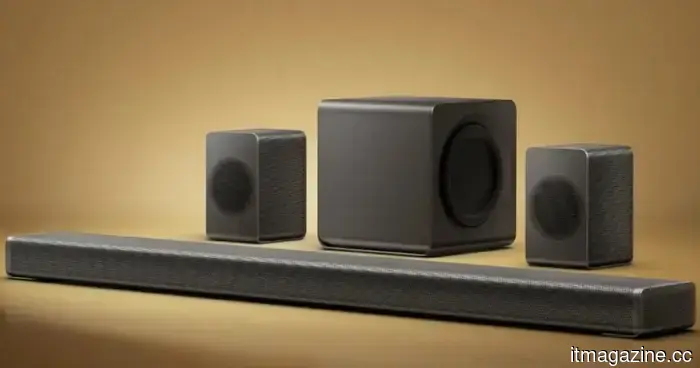 TCL has created a 22-speaker soundbar designed to transform living rooms into theaters, but it will not be available in the US.
TCL's latest Q95K soundbar features 22 speakers, delivers 1420W of power, and incorporates Bang & Olufsen tuning within an 11.1.4 channel system, but it is currently available only in China.
TCL has created a 22-speaker soundbar designed to transform living rooms into theaters, but it will not be available in the US.
TCL's latest Q95K soundbar features 22 speakers, delivers 1420W of power, and incorporates Bang & Olufsen tuning within an 11.1.4 channel system, but it is currently available only in China.
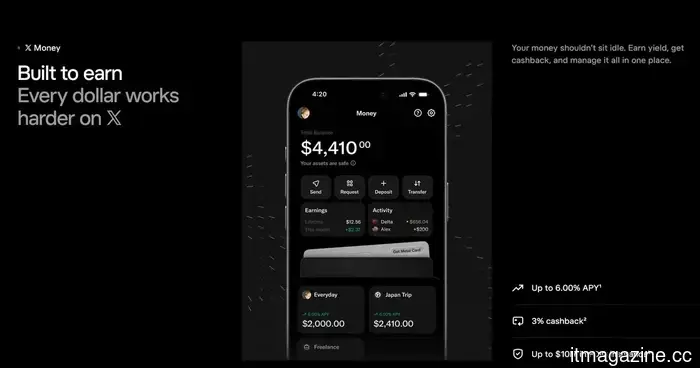 X Money has officially arrived, and it offers much more than just a digital wallet.
X Money has officially debuted in the US, offering peer-to-peer payments, a Visa debit card, and high-yield savings accounts for qualified X Premium users.
X Money has officially arrived, and it offers much more than just a digital wallet.
X Money has officially debuted in the US, offering peer-to-peer payments, a Visa debit card, and high-yield savings accounts for qualified X Premium users.
 YouTube Premium is evolving into a streaming bundle by incorporating Peacock.
Beginning in early 2027, YouTube Premium subscribers in the U.S. will have Peacock Premium included with their subscription due to a new collaboration with NBCUniversal.
YouTube Premium is evolving into a streaming bundle by incorporating Peacock.
Beginning in early 2027, YouTube Premium subscribers in the U.S. will have Peacock Premium included with their subscription due to a new collaboration with NBCUniversal.
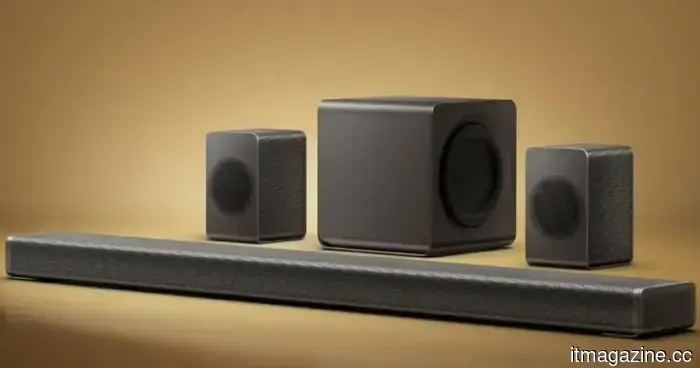 TCL has created a 22-speaker soundbar designed to transform living rooms into movie theaters, but it will not be available in the US.
The new Q95K soundbar from TCL features 22 speakers, delivers 1420W of power, and includes Bang & Olufsen tuning in an 11.1.4 channel configuration, although it is currently available only in China.
TCL has created a 22-speaker soundbar designed to transform living rooms into movie theaters, but it will not be available in the US.
The new Q95K soundbar from TCL features 22 speakers, delivers 1420W of power, and includes Bang & Olufsen tuning in an 11.1.4 channel configuration, although it is currently available only in China.
InfiMaker aims to make industrial manufacturing accessible on every desktop through the use of AI.
When individuals envision advanced manufacturing, they often imagine expensive industrial machinery functioning within large factories, rather than a small-scale setup.