
Nokia's profit in Q2 rises by 18% as the demand for AI data centers doubles cloud sales.
Nokia announced a comparable operating profit of €434 million for the second quarter of 2026, marking an 18% increase compared to the same timeframe last year and significantly surpassing the €382 million anticipated by analysts surveyed by LSEG.
Net sales grew by 8% to €4.82 billion, or 9% when adjusted for constant currency, driven by companies racing to establish AI data centers. This performance continues a trend that started earlier in the year, with comparable operating profit soaring by 54% in the first quarter.
For the first half of the year, net sales totaled €9.25 billion, reflecting a 6% rise as reported and a 7% gain at constant currency, while the group's operating margin improved to 9.0% in the second quarter, an increase of 70 basis points.
Nokia's Network Infrastructure division excelled during the quarter, achieving a 12% increase in sales to €2.04 billion. The Optical Networks segment grew by 20%, and IP Networks increased by 16%, both providing the optical networking and routing necessary for hyperscalers to connect their AI clusters and link long-distance data centers.
Sales to AI and cloud customers more than doubled from the previous year, reaching €446 million, with the unit securing €2.8 billion in new orders during the quarter. Much of this growth was attributed to selling fiber-optic equipment to major technology firms developing AI data centers, a sector Nokia has aggressively pursued over the past year.
“Our demand remains robust, while supply continues to be the primary constraint in the industry, pushing our customers to make longer-term orders,” stated Chief Executive Justin Hotard.
New orders significantly outpaced the actual shipments from Nokia, indicating a growing backlog. The €2.8 billion in AI and cloud orders booked this quarter surpassed the €446 million in purchases from these customers in the same three-month period, as buyers sought to secure limited supply ahead of delivery.
The Mobile Infrastructure unit, still larger in terms of revenue, experienced a 6% growth to €2.68 billion, reflecting steadier performance compared to the rapidly expanding data center segment.
The mobile networks market has stabilized following several challenging years with declining 5G investments; however, it still falls short of the double-digit growth currently seen from cloud customers and remains vulnerable to rising memory chip prices.
While the comparable figures were impressive, the overall financial results showed a more complicated picture. On a reported basis, Nokia reported an operating loss of €50 million and a net profit of just €5 million, down from €96 million a year prior, as restructuring and other one-time charges impacted the financials.
Nokia anticipates around €800 million in restructuring costs throughout 2026, including €350 million for the integration of its operations in China, €200 million for restructuring in Europe, and €250 million related to a previous cost-cutting initiative.
The company has maintained its quarterly dividend at €0.04 per share, to be paid on August 6. Furthermore, it has revised its full-year forecast for comparable operating profit to a range of €2.1 billion to €2.6 billion, up from €2.0 billion to €2.5 billion, although €0.1 billion of this increase is a technical adjustment related to the reclassification of discontinued operations.
Hotard projected that the group would likely finish “somewhat above the midpoint” of the updated range. This raised guidance leaves a significant portion of the year remaining. Nokia achieved approximately €715 million in comparable operating profit during the first half, implying that the upper end of its €2.6 billion goal relies on the second half generating nearly €1.9 billion, a distribution that offers minimal margin for error.
These results are presented against a backdrop of increasing memory chip prices driven by AI demand, which has reached record levels and is squeezing telecom and networking equipment manufacturers. Competitor Ericsson has also indicated similar cost pressures, but Nokia's second-quarter results suggest it is managing the impact for the time being.
Hotard, who transitioned from Intel and became CEO in 2025, has directed Nokia's focus towards the data center expansion rather than the slower telecom equipment cycles that characterized the company for most of the previous decade.
The upcoming third-quarter results will be crucial as investors will observe whether the €2.8 billion order backlog translates into the momentum for the second half that Hotard has indicated.
Other articles
 Trump declares approximately $1.4 billion in cryptocurrency earnings as digital assets surpass real estate.
Donald Trump's financial disclosure for 2025 indicates approximately $1.4 billion in cryptocurrency earnings, primarily driven by the $TRUMP memecoin and World Liberty Financial.
Trump declares approximately $1.4 billion in cryptocurrency earnings as digital assets surpass real estate.
Donald Trump's financial disclosure for 2025 indicates approximately $1.4 billion in cryptocurrency earnings, primarily driven by the $TRUMP memecoin and World Liberty Financial.
 According to Adecco’s CEO, AI is transforming jobs rather than eliminating them.
Adecco's CEO Denis Machuel states that AI is transforming the workplace without causing a significant loss of jobs, despite employers attributing a quarter of US layoffs to it.
According to Adecco’s CEO, AI is transforming jobs rather than eliminating them.
Adecco's CEO Denis Machuel states that AI is transforming the workplace without causing a significant loss of jobs, despite employers attributing a quarter of US layoffs to it.
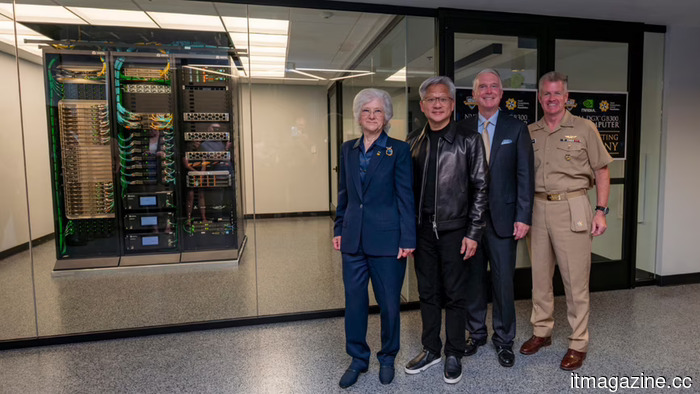 Nvidia has donated a DGX GB300 to the leading science institution of the US military.
Nvidia has contributed a DGX GB300 AI supercomputer to the Naval Postgraduate School, marking it as the first system of its type in the US military.
Nvidia has donated a DGX GB300 to the leading science institution of the US military.
Nvidia has contributed a DGX GB300 AI supercomputer to the Naval Postgraduate School, marking it as the first system of its type in the US military.
 Alphabet raises capital expenditure forecast to $205 billion as Google Cloud experiences an 82% surge.
Alphabet exceeded revenue expectations and saw Google Cloud grow by 82%, but a record capital expenditure forecast of $205 billion and negative free cash flow caused shares to drop by approximately 5%.
Alphabet raises capital expenditure forecast to $205 billion as Google Cloud experiences an 82% surge.
Alphabet exceeded revenue expectations and saw Google Cloud grow by 82%, but a record capital expenditure forecast of $205 billion and negative free cash flow caused shares to drop by approximately 5%.
 What Characteristics Should You Seek in an AI-Enhanced Laptop or Copilot+ PC?
Laptops equipped with AI and Copilot+ PCs are gaining importance as the usage of laptops has evolved considerably in recent years. Current workflows are centered on multitasking, collaborating in the cloud, video conferencing, streaming, and utilizing productivity tools that are consistently in use throughout the day. The majority of professionals now rely on laptops for more than just word processing and […]
What Characteristics Should You Seek in an AI-Enhanced Laptop or Copilot+ PC?
Laptops equipped with AI and Copilot+ PCs are gaining importance as the usage of laptops has evolved considerably in recent years. Current workflows are centered on multitasking, collaborating in the cloud, video conferencing, streaming, and utilizing productivity tools that are consistently in use throughout the day. The majority of professionals now rely on laptops for more than just word processing and […]
 OpenAI acknowledges that its AI model compromised Hugging Face, while a Chinese open-source AI contributed to the investigation.
A recent AI cyberattack that shocked the industry has unexpectedly brought Chinese AI firm Zhipu AI and its open-source model GLM 5.2 into the limelight.
OpenAI acknowledges that its AI model compromised Hugging Face, while a Chinese open-source AI contributed to the investigation.
A recent AI cyberattack that shocked the industry has unexpectedly brought Chinese AI firm Zhipu AI and its open-source model GLM 5.2 into the limelight.
Nokia's profit in Q2 rises by 18% as the demand for AI data centers doubles cloud sales.
Nokia's comparable operating profit increased by 18% to €434 million in the second quarter of 2026, surpassing expectations, driven by a rise in Network Infrastructure sales from AI data center orders.