
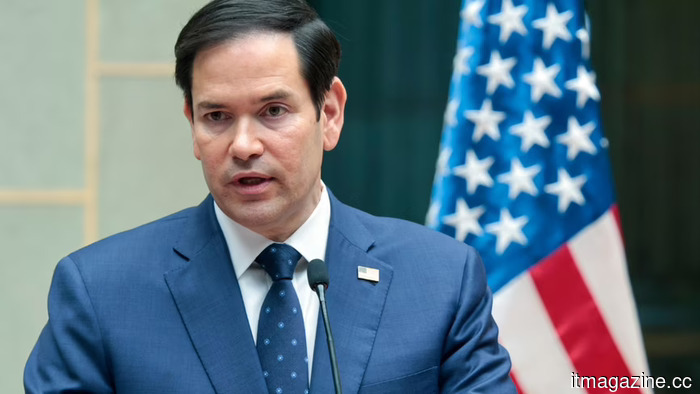
Marco Rubio advises US diplomats to minimize concerns about a technological 'kill switch.'
U.S. Secretary of State Marco Rubio has directed American diplomats to refute a phrase that has gained traction in allied capitals since last summer: the tech “kill switch.” In a cable dated July 16, which was reviewed by Reuters, Rubio advised envoys to challenge the notion that Washington can remotely disable U.S. technology overseas. This anxiety intensified after the government briefly restricted foreign access to Anthropic’s most advanced models in June, reigniting European discussions about digital sovereignty.
“Pausing specific applications or mandating a 30-day testing period prior to the launch of highly powerful new technology is not a ‘Kill Switch,’” the cable states, based on Reuters’ assessment of the document. “There is no governmental ‘magic button.’” It describes the narrative as exaggerated and explains that it does not adequately reflect the complexities of U.S. technology policy.
The source of the anxiety is clear. On June 12, the Trump administration prohibited non-U.S. residents from accessing Anthropic’s advanced models, Mythos and Fable, citing national security, only to reverse this decision within the same month. This sudden change left officials in Europe and Asia questioning how much of their AI infrastructure was controlled by mechanisms beyond their reach, prompting tech executives in several capitals to rush towards promoting domestic alternatives.
This ban followed a June 2 executive order requiring AI developers to submit new models for 30 days of cybersecurity testing prior to their release. For governments reliant on American models for public services, this sequence resembled not just a routine safety check but a form of leverage. Brussels entered discussions with Washington regarding the restoration of access, and the situation became a practical example of dependency.
Canadian Prime Minister Mark Carney compared the incident to the 2008 financial crisis, cautioning against a systemic AI “model risk” that could not be contained by any single government. European legislators echoed this sentiment publicly. Christophe Grudler and Aura Salla, members of the centre-right European People’s Party, claimed that the United States possessed a real “kill-switch” over essential technologies that could easily be disabled by a foreign government.
Edward Fishman of the Council on Foreign Relations informed Reuters that allies increasingly worry that their dependence on American artificial intelligence exposes them to economic coercion. EU finance ministers had already called for guaranteed access to Anthropic’s systems, and Austria proposed the idea of hosting the company within Europe.
Not everyone accepted this framing. The International Association of Privacy Professionals asserted that the Anthropic incident represented a governance issue rather than a kill switch, framing it as a security challenge disguised as a sovereignty crisis. Rubio’s cable aligns with this interpretation and expands upon it.
The document goes beyond mere semantic debate. It instructs diplomats to discourage “so-called ‘digital sovereignty’” initiatives that would isolate American products and to advocate for U.S. AI as the superior choice whenever foreign governments consider domestic alternatives. Essentially, the message conveyed is that dependence should not be viewed as a risk to manage but as a market to protect.
The term itself didn’t arise out of nowhere. For over a year, U.S. lawmakers have proposed the Chip Security Act, which would require location tracking—and in some drafts, a remote kill switch—on exported Nvidia chips to restrict access for China. Another initiative, the Remote Access Security Act, aimed to extend export controls to the cloud, eliminating loopholes that allowed restricted chips to be rented offshore.
Nvidia has consistently denied that its chips include backdoors or kill switches and has urged Congress to avoid location-verification requirements. Concurrently, Washington has tightened chip restrictions concerning Chinese companies.
Whether a testing period and a temporary export ban constitute a switch is partly a matter of language and partly one of trust. Marco Rubio is counting on his diplomats to win the semantic debate. The more significant issue, which the cable does not address, is that allies are now aware of the mechanism's existence, regardless of what it is labeled.
Other articles
 Shield AI's X-BAT: the AI fighter jet that doesn't require a runway.
Shield AI and GE Aerospace have activated the engine of the X-BAT, an AI-operated jet that can take off vertically without the need for a runway. Flight tests are scheduled to occur later this year.
Shield AI's X-BAT: the AI fighter jet that doesn't require a runway.
Shield AI and GE Aerospace have activated the engine of the X-BAT, an AI-operated jet that can take off vertically without the need for a runway. Flight tests are scheduled to occur later this year.
 China's shortage of AI talent has led tech giants to recruit teenagers.
Chinese AI firms are facing a shortage of engineers, prompting them to seek talent starting from the age of 13 through camps, mentorship programs, and even guaranteed employment immediately after high school.
China's shortage of AI talent has led tech giants to recruit teenagers.
Chinese AI firms are facing a shortage of engineers, prompting them to seek talent starting from the age of 13 through camps, mentorship programs, and even guaranteed employment immediately after high school.
 Galaxy Z Fold 8 vs. Galaxy Z Fold 8 Ultra: Is the additional $200 justifiable and is the Ultra a worthwhile investment?
Samsung's latest Fold 8 and Fold 8 Ultra come with identical chip and storage options, but they differ significantly in terms of camera specifications, display size, and battery capacity.
Estée Lauder affected by Oracle E-Business data breach.
Estée Lauder reported that hackers took employees' Social Security numbers, banking, and health information through a vulnerability in Oracle E-Business in 2025, revealing the breach almost a year later.
Galaxy Z Fold 8 vs. Galaxy Z Fold 8 Ultra: Is the additional $200 justifiable and is the Ultra a worthwhile investment?
Samsung's latest Fold 8 and Fold 8 Ultra come with identical chip and storage options, but they differ significantly in terms of camera specifications, display size, and battery capacity.
Estée Lauder affected by Oracle E-Business data breach.
Estée Lauder reported that hackers took employees' Social Security numbers, banking, and health information through a vulnerability in Oracle E-Business in 2025, revealing the breach almost a year later.
 Galaxy Z Fold 8 vs. Galaxy Z Fold 8 Ultra: Is it worth spending an additional $200 for the Ultra model?
The Samsung Fold 8 and Fold 8 Ultra utilize the same chip and storage options, but they differ significantly in terms of camera hardware, screen size, and battery.
Galaxy Z Fold 8 vs. Galaxy Z Fold 8 Ultra: Is it worth spending an additional $200 for the Ultra model?
The Samsung Fold 8 and Fold 8 Ultra utilize the same chip and storage options, but they differ significantly in terms of camera hardware, screen size, and battery.
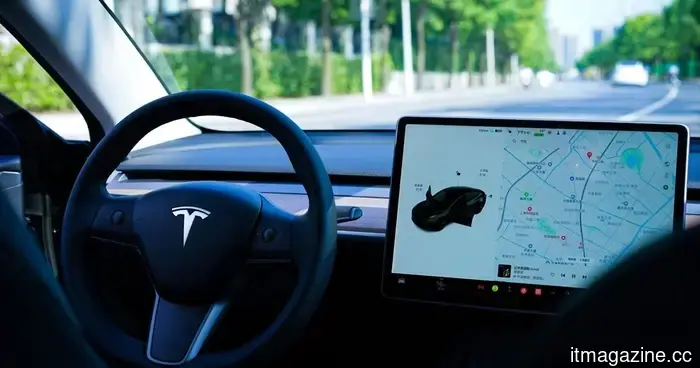 Tesla's Summer Update introduces a more intelligent Grok, customized navigation, and scoring for Caraoke.
Tesla's summer update for 2026 includes a phone call feature called Grok, scored karaoke sessions, enhanced navigation, self-driving statistics available in the app, and personalized wraps that can be sent directly from your phone.
Tesla's Summer Update introduces a more intelligent Grok, customized navigation, and scoring for Caraoke.
Tesla's summer update for 2026 includes a phone call feature called Grok, scored karaoke sessions, enhanced navigation, self-driving statistics available in the app, and personalized wraps that can be sent directly from your phone.
Marco Rubio advises US diplomats to minimize concerns about a technological 'kill switch.'
A cable from the State Department instructs US diplomats to refute the notion that Washington has the ability to remotely deactivate American technology in other countries.