
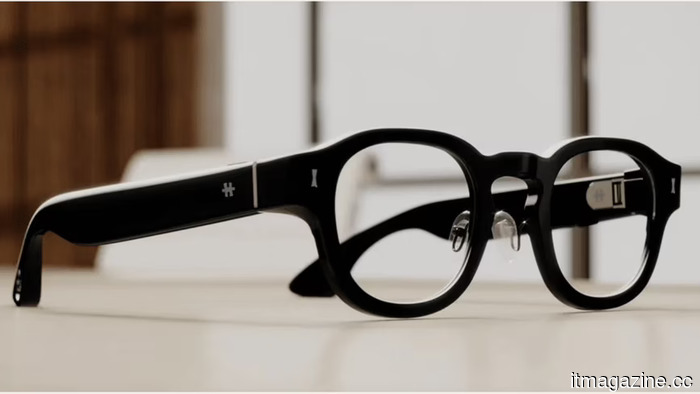
Halliday's G2 smart glasses, which do not have a camera, focus on enhancing meetings.
It is uncommon for a crowdfunded hardware startup to receive a second chance to make a first impression. Halliday is seizing that opportunity. The company introduced the G2 on Tuesday, with prices starting at $499 and shipping set for September.
A harsh beginning
The initial glasses were met with criticism. Engadget rated them 54 out of 100, one of the lowest scores in its history. Android Police rated them 5 out of 10, describing them as a “buzzword-laden curiosity.”
The issues stemmed from a cumbersome projector display positioned by the eye, poor-quality speakers, and a slow control ring. Chief Operating Officer Carter Hou acknowledged the shortcomings. He told Engadget that the company made “numerous errors” and has since overhauled its engineering and supply-chain teams.
What’s different
The G2 eliminates the gimmicks. The projector has been removed, replaced by waveguide displays, one for each eye, with a brightness of 1,600 nits. The unpopular control ring is also gone, replaced by a touchpad on the arm. The problematic charging port has been removed as well, and a camera remains absent by design.
Early hands-on reviews are more favorable. The screen is now easier to view, and a four-microphone array captures commands even in a noisy environment. The Verge, previously not impressed with the original, now describes the G2 as “better glasses.”
The significant shift: meetings
The most notable change is the G2's purpose. Halliday has focused the G2 on business meetings. Its Meeting Flow utilizes AI agents in real-time during discussions: one tracks conversation threads, another highlights decisions made, and a third prompts for commitments before the meeting concludes. A summary is then sent to the app afterward.
Hou argues that competitors like Plaud only assist post-meeting. Additional features include translation in 45 languages, a “Hey Halliday” assistant, an auto-scrolling cheat sheet, phone calls, and music.
The drawbacks
Two main concerns arise. The best features operate on a credit system, with options ranging from a free tier up to $99 a month, mirroring the subscription trend in wearable technology and smart glasses. Moreover, a headset that transcribes every meeting prompts the same privacy concerns associated with any always-listening device, regardless of having a camera.
Additionally, there is the inherent risk of a startup. Halliday is requesting a $10 deposit now, with the remainder due upon shipping, a similar crowdfunding approach that left initial backers waiting for the first-generation product.
Whether a screen-free, AI-centric pair of glasses can fulfill a genuine purpose, rather than simply serving as another buzzword-ridden novelty, is what the G2 must demonstrate.
Other articles
 Apple has addressed a bug in the Hide My Email feature that revealed the actual email addresses of users.
A bug in Hide My Email revealed actual addresses through bounced spam messages for more than a year before Apple fixed it, mere days after it became publicly known.
Apple has addressed a bug in the Hide My Email feature that revealed the actual email addresses of users.
A bug in Hide My Email revealed actual addresses through bounced spam messages for more than a year before Apple fixed it, mere days after it became publicly known.
 Light Flip: the $299 anti-AI flip phone that doesn't have a touchscreen.
Light's inaugural flip phone removes the touchscreen, apps, social media, and AI features. Priced at $299, the Light Flip caters to those looking for a digital detox and is set to be released in 2027.
Light Flip: the $299 anti-AI flip phone that doesn't have a touchscreen.
Light's inaugural flip phone removes the touchscreen, apps, social media, and AI features. Priced at $299, the Light Flip caters to those looking for a digital detox and is set to be released in 2027.
 Samsung's offer of doubling free storage for preorders has ended in Austria, and the new promotion isn't as appealing.
Samsung's traditional pre-order benefit of offering double storage at no extra cost has been removed for Austria, now substituted with discounted upgrades for the Galaxy Z Fold 8 and Z Flip 8.
Samsung's offer of doubling free storage for preorders has ended in Austria, and the new promotion isn't as appealing.
Samsung's traditional pre-order benefit of offering double storage at no extra cost has been removed for Austria, now substituted with discounted upgrades for the Galaxy Z Fold 8 and Z Flip 8.
 BlackRock secures $12 billion for Meta's data center in El Paso.
BlackRock is spearheading a $12 billion debt issuance to construct Meta's data center in El Paso, holding 80% of the ownership and allowing Meta to retain the majority of the expenses off its balance sheet.
BlackRock secures $12 billion for Meta's data center in El Paso.
BlackRock is spearheading a $12 billion debt issuance to construct Meta's data center in El Paso, holding 80% of the ownership and allowing Meta to retain the majority of the expenses off its balance sheet.
 US computer science enrollment declines for the first time in two decades.
A Stanford study reveals that enrolment in computer science programs in the US has declined for the first time in 20 years, attributed to AI's capability to write code, although economists are not yet placing blame on AI.
US computer science enrollment declines for the first time in two decades.
A Stanford study reveals that enrolment in computer science programs in the US has declined for the first time in 20 years, attributed to AI's capability to write code, although economists are not yet placing blame on AI.
 SkyPilot secures $20 million to position itself as the neutral hub for AI computing.
Ion Stoica's team at Berkeley has secured $20 million for SkyPilot, a provider-agnostic control plane that consolidates dispersed AI computing resources from over 20 cloud platforms into a single entity.
SkyPilot secures $20 million to position itself as the neutral hub for AI computing.
Ion Stoica's team at Berkeley has secured $20 million for SkyPilot, a provider-agnostic control plane that consolidates dispersed AI computing resources from over 20 cloud platforms into a single entity.
Halliday's G2 smart glasses, which do not have a camera, focus on enhancing meetings.
Following the release of the most-criticized smart glasses of 2025, Halliday is back with the camera-free G2, designed specifically for live work meetings and set to launch in September.