
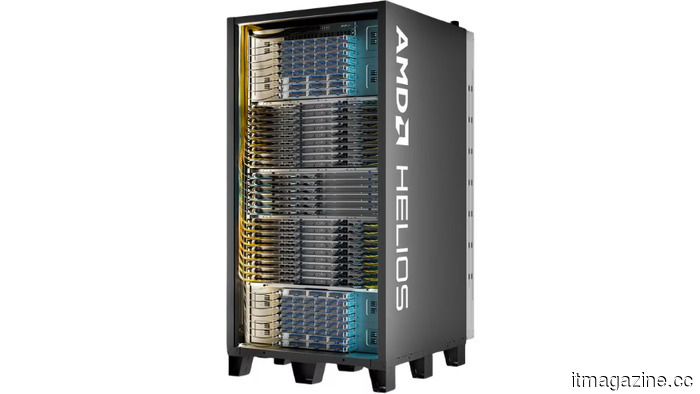
AMD's Helios incorporates 72 GPUs and 31 terabytes of HBM4 within a single rack. This is AMD's response to Nvidia's NVL72.
**Summary**: AMD Helios integrates 72 MI455X GPUs, 31TB of HBM4 memory, and delivers 2.9 exaflops of inference capacity within a single rack. It is constructed on open standards. Engineering samples will be available in the second half of 2026, with mass production commencing in the second quarter of 2027.
AMD's Helios features one rack with 72 Instinct MI455X GPUs, 31 terabytes of HBM4 memory, and 2.9 exaflops of FP4 inference processing power. This marks AMD's inaugural rack-scale AI system, positioned as a direct competitor to Nvidia’s Vera Rubin NVL72. The setup includes 18 compute trays, each equipped with four MI455X accelerators based on the new CDNA 5 architecture and one sixth-generation EPYC “Venice” CPU. Engineering samples are expected to be released in late 2026, with mass production starting in Q2 of 2027.
The architecture embraces open standards, incorporating UALink for interconnect scaling between GPUs within the rack, following Ultra Ethernet Consortium specifications for inter-rack networking, and adopting the OCP Open Rack Wide form factor. In contrast, Nvidia’s NVL72 relies on proprietary NVLink technology. AMD anticipates that data center operators seeking flexibility, without being confined to a single vendor's interconnect, will opt for this approach. Networking is facilitated by AMD Pensando AI NICs, utilizing programmable hardware and UEC-compliant RDMA.
The specifications focus on memory capacity as a competitive edge, rather than just processing power. Each MI455X GPU is equipped with HBM4 providing 19.6 TB/s of bandwidth. Collectively, the rack offers 260 TB/s of scale-up bandwidth and 43 TB/s of scale-out bandwidth. This memory capability is crucial for training frontier models and performing long-context inference, where the limitation has shifted from pure computation to the system's data handling and movement capacity. The ongoing AI-driven memory challenge has significantly increased HBM prices, and the 31TB of HBM4 in a single rack represents a substantial material cost, manageable only by hyperscale and sovereign computing budgets.
In June, Supermicro displayed Helios hardware at Computex. AMD has pledged billions toward UK AI infrastructure during London Tech Week, with Helios being the hardware that will support these initiatives. The ROCm software stack is compatible with PyTorch, TensorFlow, and JAX, allowing developers to transition from Nvidia’s CUDA ecosystem without needing to rewrite code—at least theoretically. The challenge remains whether AMD can bridge the software gap that has hindered its position in AI computing, as Helios is designed to address this issue. While the hardware specifications are competitive, the ecosystem will be the true test.
Other articles
 A new AI model aims to make self-driving cars think carefully before making a sudden turn.
A team from Seoul National University developed an AI that evaluates the safety decisions of self-driving cars in real-time, and it recently received a noteworthy highlight paper recognition at CVPR.
OneDrive will prevent screenshots of sensitive documents, but this restriction applies only when using Microsoft's browser.
Beginning in August, OneDrive and SharePoint will prevent screen captures of PDFs that have sensitivity labels when using Edge. This feature will not be available for Chrome, Firefox, or Safari.
A new AI model aims to make self-driving cars think carefully before making a sudden turn.
A team from Seoul National University developed an AI that evaluates the safety decisions of self-driving cars in real-time, and it recently received a noteworthy highlight paper recognition at CVPR.
OneDrive will prevent screenshots of sensitive documents, but this restriction applies only when using Microsoft's browser.
Beginning in August, OneDrive and SharePoint will prevent screen captures of PDFs that have sensitivity labels when using Edge. This feature will not be available for Chrome, Firefox, or Safari.
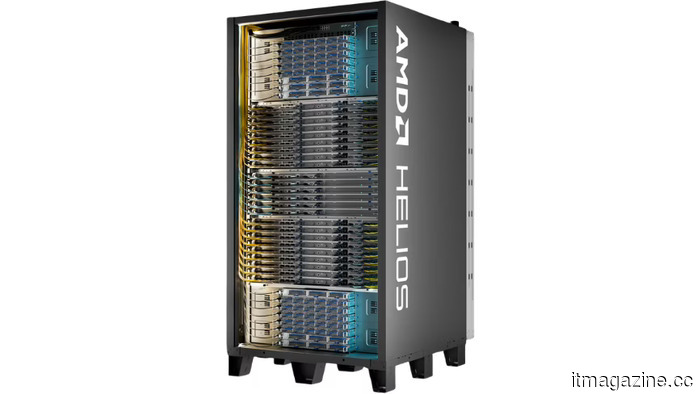 AMD's Helios integrates 72 GPUs and 31 terabytes of HBM4 within a single rack. This is AMD's response to Nvidia's NVL72.
The AMD Helios contains 72 MI455X GPUs, 31TB of HBM4, and delivers 2.9 exaflops of inference computing within a single rack. Engineering samples are set to be shipped in the second half of 2026, with mass production beginning in the second quarter of 2027.
AMD's Helios integrates 72 GPUs and 31 terabytes of HBM4 within a single rack. This is AMD's response to Nvidia's NVL72.
The AMD Helios contains 72 MI455X GPUs, 31TB of HBM4, and delivers 2.9 exaflops of inference computing within a single rack. Engineering samples are set to be shipped in the second half of 2026, with mass production beginning in the second quarter of 2027.
 A mini lab the size of AirPods could assist in detecting disease markers within minutes.
The VPodDuo, which is about the size of an AirPods case, pairs with a smartphone to analyze molecular tests for viruses, bacteria, and cancer-related biomarkers in approximately 10 minutes.
A mini lab the size of AirPods could assist in detecting disease markers within minutes.
The VPodDuo, which is about the size of an AirPods case, pairs with a smartphone to analyze molecular tests for viruses, bacteria, and cancer-related biomarkers in approximately 10 minutes.
 Singles are utilizing ChatGPT and Claude to craft their dating messages, and the apps have no intention of putting a stop to it.
26% of adults in the U.S. have sought assistance from AI for dating purposes. Match, Hinge, and Bumble indicate that they are not filtering out messages generated by AI. This trend is referred to as chatfishing.
Singles are utilizing ChatGPT and Claude to craft their dating messages, and the apps have no intention of putting a stop to it.
26% of adults in the U.S. have sought assistance from AI for dating purposes. Match, Hinge, and Bumble indicate that they are not filtering out messages generated by AI. This trend is referred to as chatfishing.
AMD's Helios incorporates 72 GPUs and 31 terabytes of HBM4 within a single rack. This is AMD's response to Nvidia's NVL72.
The AMD Helios contains 72 MI455X GPUs, 31TB of HBM4, and delivers 2.9 exaflops of inference computing capabilities within a single rack. Engineering samples are expected to ship in the second half of 2026, with mass production set to begin in the second quarter of 2027.