
From trading Bitcoin to becoming a financial super app: Binance turns 9.
Nine years later, Binance has grown to serve over 316 million users with services that include trading, payments, savings, tokenized securities, and access to traditional assets. Its transformation from a simple cryptocurrency exchange to a comprehensive financial platform reflects the broader development of the centralized exchange industry.
A recent case study by CoinDesk Research outlines this evolution through five distinct phases, showcasing how the function of crypto exchanges has broadened alongside the digital asset economy.
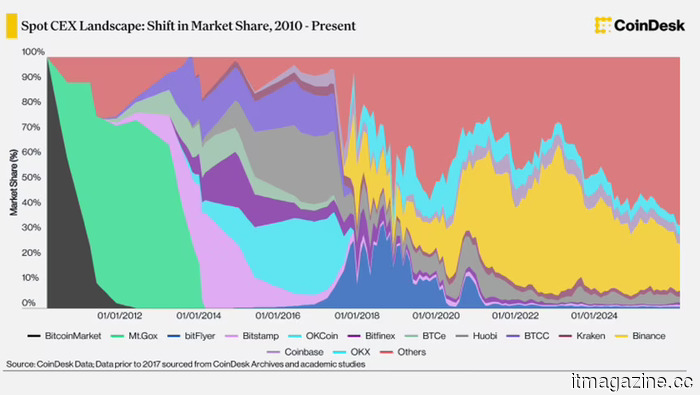
Phase 1: Bitcoin-only trading and the vulnerability of early dominance (2010–2016)
In the early days of digital asset trading, the emphasis was on fundamental price discovery. The first documented BTC price was $0.003 during a trade on BitcoinMarket in March 2010.
However, the initial market dominance of exchanges was precarious. Mt. Gox once managed approximately 80% of worldwide volume before its collapse, which left 850,000 BTC unaccounted for. By 2016, zero-fee exchanges in China accounted for roughly 90% of global volume, only to be forced offshore due to domestic regulations.
These early exchanges addressed specific challenges like price discovery or liquidity but were limited in their trading capabilities. The next phase of the industry would demand platforms that could integrate scale, speed, security, and a wide range of products into a cohesive ecosystem, a shift that began with Binance's launch in 2017.
Phase 2: The expansion into multiple assets and the rise of Binance (2017–2019)
The ICO boom of 2017 created a surge in demand for quick token listings. Platforms that could rapidly onboard assets parallel to market creation captured the emerging order flow.
Binance debuted in July 2017 and, according to CoinDesk Research, became the largest spot exchange globally within six months. This swift rise not only illustrated execution speed but also highlighted that global users increasingly preferred a wide array of available assets, substantial liquidity, and a seamless trading experience over fragmented regional exchanges.
A significant shift occurred in the late 2010s, as cryptocurrency exchanges transitioned from niche experiments to platforms focused on achieving product-market fit.
Phase 3: Derivatives surpass spot trading and alter exchange economics (2019–2022)
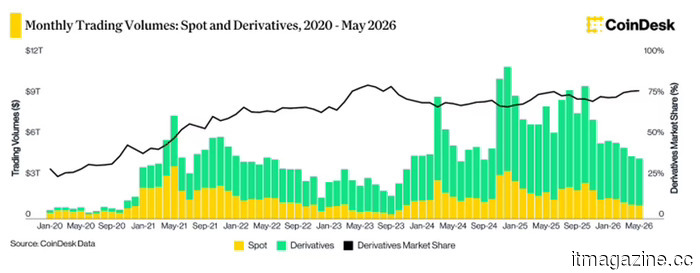
The introduction of perpetual swaps by BitMEX in 2016 led to their mainstream adoption. By 2021, derivatives trading volumes had eclipsed spot trading, reaching a peak of 80.9% in September 2023, according to CoinDesk data.
An EY report indicated that by late 2023, futures and perpetual swaps represented 96.2% of monthly BTC and ETH derivative volumes, driven predominantly by non-US markets. Institutional involvement surged, with CME Group Bitcoin futures surpassing $20 billion in notional open interest by late 2024. As derivatives became the primary driver of market activity, leading exchanges evolved from basic spot markets into robust trading infrastructures capable of accommodating both institutional and retail participants across various asset classes.
Phase 4: The post-FTX emphasis on transparency (2022–2024)
The failure of FTX reset expectations regarding exchange credibility. The collapse in November 2022 of what was then the third-largest exchange (valued at $18 billion) highlighted the critical need for custody and transparency.
Proof of Reserves assurances became a fundamental expectation rather than an optional feature, with 62% of exchanges evaluated by CoinDesk providing such attestations by April 2026, up from 49% the previous November. Although the aftermath of the FTX incident prompted the industry to prioritize custody, governance, and transparency, it also signified a shift from growth at all costs to operational maturity. CoinDesk Research notes that Binance retained its leadership role throughout this period as Proof of Reserves, compliance, and risk management became essential competitive differentiators in the sector.
Phase 5: The emergence of super-app convergence and the blurring of category boundaries (2025–Present)
The latest phase of CEX evolution is characterized by convergence. Instead of functioning solely as cryptocurrency exchanges, leading platforms are increasingly integrating digital assets, payments, tokenized securities, yield products, and traditional financial markets within a single ecosystem.
CoinDesk Research highlights that centralized exchanges are progressively incorporating on-chain capabilities while also extending their services beyond crypto into more extensive financial offerings. Binance's introduction of Binance Alpha, along with tokenized U.S. equities, payment systems, and multi-asset investment options, exemplifies how the industry's largest exchange is evolving beyond its initial identity as a trading venue.
Binance's Interim Chief Marketing Officer, Eowyn Chen, asserts that this signifies a broader transformation in financial architecture rather than mere product expansion: “Most fintech ‘super-apps’ are just a collection of separate products behind one login. The future financial infrastructure won’t be a mere bundle; it will be a system where each product enhances the value of the others.”
This convergence illustrates a broader
Other articles
 This rotating drone conceals itself in plain view by employing a visual illusion.
Engineers at Northwestern have developed a spinning drone that takes advantage of motion blur, rendering it approximately ten times less detectable than traditional drones.
This rotating drone conceals itself in plain view by employing a visual illusion.
Engineers at Northwestern have developed a spinning drone that takes advantage of motion blur, rendering it approximately ten times less detectable than traditional drones.
 Google employees gather at their Mountain View headquarters, calling for job security.
Approximately 100 members of the Alphabet Workers Union assembled at Google's headquarters in Mountain View, presenting a petition with 4,500 signatures advocating for severance and protections against layoffs.
Google employees gather at their Mountain View headquarters, calling for job security.
Approximately 100 members of the Alphabet Workers Union assembled at Google's headquarters in Mountain View, presenting a petition with 4,500 signatures advocating for severance and protections against layoffs.
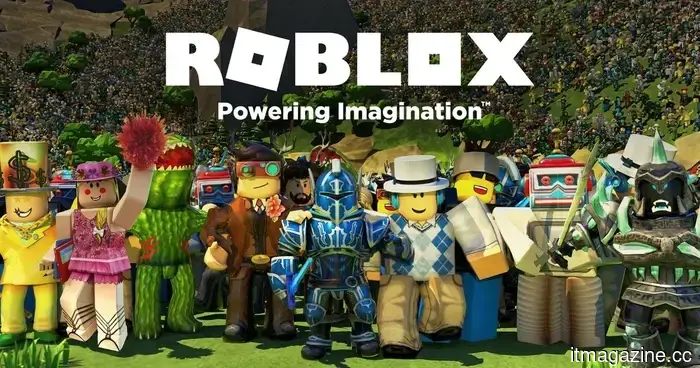 Roblox's AI Build feature aims to simplify game development to the level of sending a text message.
Roblox is commemorating its 20th anniversary with Build, a new feature that converts text prompts into playable games directly from your mobile device.
Roblox's AI Build feature aims to simplify game development to the level of sending a text message.
Roblox is commemorating its 20th anniversary with Build, a new feature that converts text prompts into playable games directly from your mobile device.
 From Bitcoin trading to financial super apps: Binance turns 9.
CoinDesk Research outlines the evolution of cryptocurrency exchanges in five phases, as Binance celebrates nine years and 316 million users by implementing a super-app strategy.
From Bitcoin trading to financial super apps: Binance turns 9.
CoinDesk Research outlines the evolution of cryptocurrency exchanges in five phases, as Binance celebrates nine years and 316 million users by implementing a super-app strategy.
 A "smart" charger with a screen has appeared in Russia.
The company Anker has announced the launch of sales in Russia of its new 45W Anker Nano Charger. This is not just another "brick" for the socket, but a real small computer with a color display.
A "smart" charger with a screen has appeared in Russia.
The company Anker has announced the launch of sales in Russia of its new 45W Anker Nano Charger. This is not just another "brick" for the socket, but a real small computer with a color display.
 DeepMind introduces an AI biosecurity initiative.
Google DeepMind and Isomorphic Labs have initiated an AI biosecurity program aimed at assisting governments in preventing, detecting, and responding to biological threats.
DeepMind introduces an AI biosecurity initiative.
Google DeepMind and Isomorphic Labs have initiated an AI biosecurity program aimed at assisting governments in preventing, detecting, and responding to biological threats.
From trading Bitcoin to becoming a financial super app: Binance turns 9.
CoinDesk Research outlines the evolution of cryptocurrency exchanges in five stages, as Binance celebrates nine years and 316 million users with its super-app approach.