

From Bitcoin trading to financial super apps: Binance turns 9.
Nine years on, Binance caters to over 316 million users engaged in trading, payments, savings, tokenized securities, and access to traditional assets. Its transformation from a straightforward cryptocurrency exchange to an all-encompassing financial platform mirrors the overall growth of the centralized exchange sector itself.
A recent case study from CoinDesk Research outlines this evolution in five distinct phases, demonstrating how the function of crypto exchanges has grown along with the digital asset economy.
Phase 1: Bitcoin-only trading and the instability of early dominance (2010–2016)
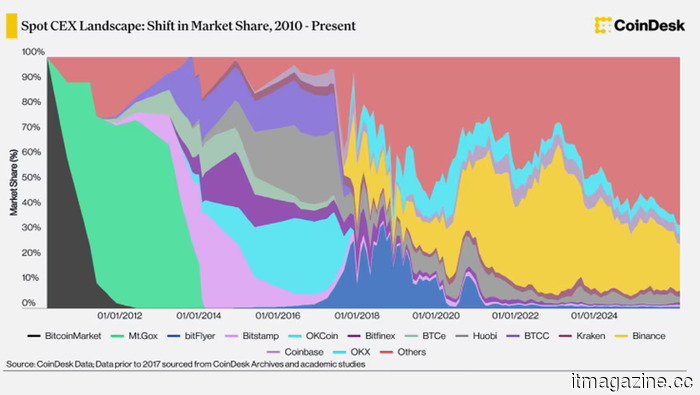
The initial phase of digital asset trading centered around basic price discovery. Bitcoin’s first recorded price was $0.003 during a March 2010 transaction on BitcoinMarket. However, the early dominance of exchanges was precarious. Mt. Gox once managed approximately 80% of global volume before its downfall, which left 850,000 BTC missing. By 2016, zero-fee Chinese exchanges controlled about 90% of global volume, only to be displaced offshore by domestic prohibitions. These early exchanges dealt with specific issues like price discovery or liquidity but remained limited trading platforms. The industry's next phase required venues that could integrate scale, speed, security, and a wide variety of products into a cohesive ecosystem, a shift that began with Binance's inception in 2017.
Phase 2: The multi-asset expansion and the rise of Binance (2017–2019)
The ICO boom in 2017 created a demand for fast token listings, and platforms that could onboard assets quickly captured the emerging market flow. Binance was launched in July 2017 and, according to CoinDesk Research, became the leading spot exchange within six months. This rapid growth was not just about execution speed; it indicated that global users increasingly valued broad asset selection, significant liquidity, and a streamlined trading experience over fragmented regional markets. The late 2000s marked a pivotal moment when cryptocurrency exchanges morphed from niche initiatives to platforms focused on fitting products to market needs.
Phase 3: Derivatives surpass spot trading and alter exchange dynamics (2019–2022)
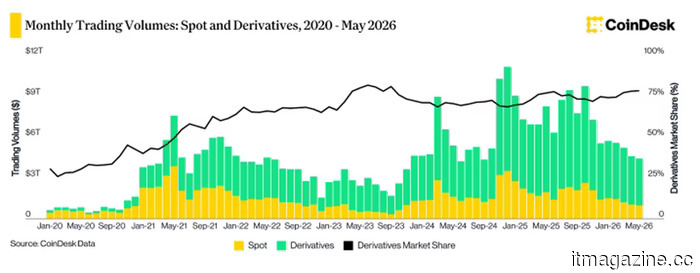
Perpetual swaps gained popularity after their introduction by BitMEX in 2016. By 2021, derivatives volume outstripped spot trading, peaking at 80.9% in September 2023, according to CoinDesk data. An EY report noted that by late 2023, futures and perpetual swaps accounted for 96.2% of monthly BTC and ETH derivative volume, with the non-US market responsible for over 95% of global activity. Institutional involvement surged, leading CME Group Bitcoin futures to surpass $20 billion in notional open interest by late 2024. As derivatives became the primary source of market activity, leading exchanges increasingly transformed from basic spot marketplaces into extensive trading infrastructures capable of accommodating both institutional and retail participation across various asset classes.
Phase 4: The post-FTX transparency overhaul (2022–2024)
The collapse of FTX recalibrated the standards for exchange credibility. The November 2022 failure of what was then the third-largest exchange (valued at $18 billion) brought custody and transparency to the forefront. Proof of Reserves attestations transformed into a basic expectation rather than a discretionary disclosure. By April 2026, 62% of exchanges reviewed by CoinDesk provided these attestations, an increase from 49% the previous November. The aftermath of FTX required the industry to emphasize custody, governance, and transparency, marking a shift from growth at any cost to a focus on operational maturity. CoinDesk Research notes that Binance preserved its leading position during this time as Proof of Reserves, compliance, and risk management emerged as critical competitive advantages in the sector.
Phase 5: Super-app convergence and the blurring of category boundaries (2025–Present)
The latest phase of CEX evolution is characterized by convergence. Leading platforms are increasingly integrating digital assets, payments, tokenized securities, yield products, and traditional financial markets into a single ecosystem. CoinDesk Research indicates that centralized exchanges are integrating on-chain functions while also branching out into broader financial services. Binance's introduction of Binance Alpha, along with tokenized U.S. equities, payment infrastructure, and multi-asset investment capabilities exemplifies how the largest exchange is transcending its original purpose as a trading venue.
Binance's interim Chief Marketing Officer Eowyn Chen posits that this signifies a more extensive transformation in financial architecture rather than mere product expansion, stating, “Most fintech ‘super-apps’ are just bundles, separate products stitched behind one login. The next generation of financial infrastructure won’t be a bundle; it’ll be a system, where every product compounds the value of the next.” This convergence illustrates a wider shift in financial infrastructure, where the lines between exchange, brokerage, payment provider, and investment platform continue to blur.
The significance of longevity as a differentiator
Longevity in the crypto
Other articles
 A "smart" charger with a screen has appeared in Russia.
The company Anker has announced the launch of sales in Russia of its new 45W Anker Nano Charger. This is not just another "brick" for the socket, but a real small computer with a color display.
A "smart" charger with a screen has appeared in Russia.
The company Anker has announced the launch of sales in Russia of its new 45W Anker Nano Charger. This is not just another "brick" for the socket, but a real small computer with a color display.
 Messi or Ronaldo? Caviar transformed football's greatest rivalry into a luxurious 24-karat decision.
Caviar has turned the longstanding Messi-Ronaldo argument in football into a competition between Android and iPhone, featuring artisanal enamel, 24-karat gold, and price tags in the five figures.
Messi or Ronaldo? Caviar transformed football's greatest rivalry into a luxurious 24-karat decision.
Caviar has turned the longstanding Messi-Ronaldo argument in football into a competition between Android and iPhone, featuring artisanal enamel, 24-karat gold, and price tags in the five figures.
 BrainCo introduces a brain-to-robot platform at WAIC.
China's BrainCo introduced a brain-to-robot system at WAIC that allows individuals to control robots solely through their thoughts, using an EEG headset, in less than 200 milliseconds.
BrainCo introduces a brain-to-robot platform at WAIC.
China's BrainCo introduced a brain-to-robot system at WAIC that allows individuals to control robots solely through their thoughts, using an EEG headset, in less than 200 milliseconds.
 a16z heads a $20M seed funding round for the AI agent startup Runta.
a16z has spearheaded a $20M seed investment in Runta, which is reconstructing AI agent infrastructure to enable companies to operate agents securely using sandboxes and guardrails.
a16z heads a $20M seed funding round for the AI agent startup Runta.
a16z has spearheaded a $20M seed investment in Runta, which is reconstructing AI agent infrastructure to enable companies to operate agents securely using sandboxes and guardrails.
 Meet the DeepMind philosopher who is contemplating AI ethics.
A long-read from The Guardian profiles Iason Gabriel, the DeepMind philosopher who has dedicated nearly ten years to exploring the ethics of AI at Google.
Meet the DeepMind philosopher who is contemplating AI ethics.
A long-read from The Guardian profiles Iason Gabriel, the DeepMind philosopher who has dedicated nearly ten years to exploring the ethics of AI at Google.
 A study warns that AI models could be suppressing political discourse.
A study conducted by an Oversight Board funded by Meta revealed that top AI models are twice as inclined to avoid criticizing repressive governments, thus influencing political discourse.
A study warns that AI models could be suppressing political discourse.
A study conducted by an Oversight Board funded by Meta revealed that top AI models are twice as inclined to avoid criticizing repressive governments, thus influencing political discourse.
From Bitcoin trading to financial super apps: Binance turns 9.
CoinDesk Research outlines the evolution of cryptocurrency exchanges in five phases, as Binance celebrates nine years and 316 million users by implementing a super-app strategy.