
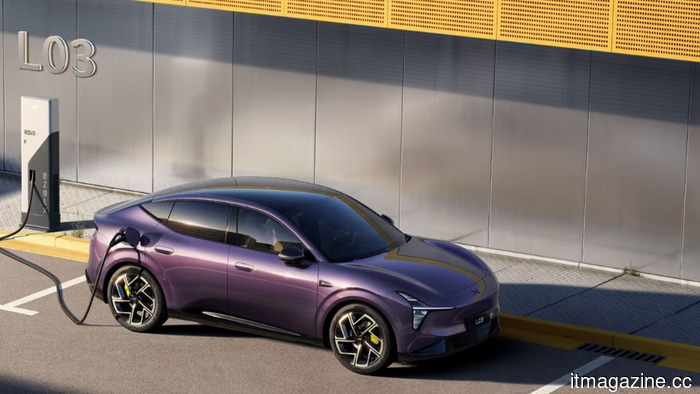
Xpeng's L03 is the first electric vehicle from China to feature its own AI driving chips in a vehicle aimed at the mass market.
Xpeng introduced the L03 on Wednesday in Munich, marking the launch of its most internationally ambitious electric vehicle across 65 markets. This coupe-SUV incorporates the company’s proprietary Turing AI chips in every trim, with at least one chip included and the top Ultra variant featuring three, delivering a total of 2,250 trillion operations per second. It is notable as the first consumer vehicle from a Chinese automaker where every configuration includes in-house autonomous driving hardware as standard.
The chips enable Xpeng’s second-generation VLA system, a model combining vision, language, and action, which the company describes as a foundational model for interpreting real-world driving conditions and selecting driving responses. While the system serves as a driver-assistance feature and does not offer full autonomy, Xpeng has plans to gradually activate it in Europe starting in 2027. Additionally, the L03 is the first vehicle from an Asia-Pacific manufacturer to include Google’s Maps Auto SDK embedded in the infotainment system, eliminating the need for phone mirroring or a separate navigation app.
The L03 was designed by a team led by JuanMa Lopez, formerly the head of exterior design at Ferrari, having contributed to models like the LaFerrari and SF90 Stradale. With its sleek roofline, frameless doors, and a drag coefficient among the lowest in the crossover segment, its design is more reminiscent of a sports car than a family vehicle. Xpeng offers the L03 as a fully battery-electric vehicle with a range of up to 625 kilometers based on China’s CLTC cycle, and as a Power X range-extender boasting a claimed 1,330 kilometers.
The true significance of the L03 lies in the vertical integration it demonstrates. Xpeng is one of the few Chinese manufacturers that has developed its own autonomous driving chips instead of purchasing them from companies like Nvidia or Horizon Robotics, and it has started mass-producing vehicles with these chips priced from approximately $21,000 in China. Volkswagen, which has a roughly five percent stake in Xpeng, has already begun utilizing the Turing chip and VLA system in its vehicles, making it the first major Western automaker to adopt this level of Chinese autonomous driving technology.
In Europe, the L03 starts at €34,990 in France and Belgium and €35,600 in Germany, pricing it competitively against Tesla’s Model Y and Hyundai’s Ioniq 5 in markets where Chinese EVs are still earning consumer trust. However, European WLTP range figures, which are typically lower than those from Chinese testing cycles, have not yet been released. According to Xpeng, charging from 10 to 80 percent takes approximately 19 minutes.
The arrival of the L03 coincides with Xpeng's expansion into robotaxis, humanoid robots, and flying cars, all powered by the same Turing chip and VLA software stack that the company is now producing at its Guangzhou facility. The crucial question remains whether European and other international consumers will place their trust in a relatively unfamiliar Chinese brand with this level of onboard computing power. While the technology is being delivered, market acceptance is still uncertain.
Other articles
 Fireworks has secured $1.5 billion to develop specialized intelligence.
Fireworks secured $1.5 billion at a valuation of $17.5 billion, believing that every company will develop its own tailored intelligence rather than leasing it from a major laboratory.
Fireworks has secured $1.5 billion to develop specialized intelligence.
Fireworks secured $1.5 billion at a valuation of $17.5 billion, believing that every company will develop its own tailored intelligence rather than leasing it from a major laboratory.
 AI brain implant allows a paralyzed man to regain movement.
A brain implant known as the double neural bypass has enabled a paralyzed man to regain movement and sensation, with the improvements lasting for several years, according to Nature Medicine.
AI brain implant allows a paralyzed man to regain movement.
A brain implant known as the double neural bypass has enabled a paralyzed man to regain movement and sensation, with the improvements lasting for several years, according to Nature Medicine.
 Ryan Cohen from GameStop describes physical game sales as 'completely insignificant' and redirects every inquiry towards eBay.
GameStop CEO Ryan Cohen deemed physical game sales as unimportant during an appearance on Bloomberg TV, as collectibles accounted for 41 percent of revenue and he advances his eBay proposal.
Ryan Cohen from GameStop describes physical game sales as 'completely insignificant' and redirects every inquiry towards eBay.
GameStop CEO Ryan Cohen deemed physical game sales as unimportant during an appearance on Bloomberg TV, as collectibles accounted for 41 percent of revenue and he advances his eBay proposal.
 This intelligent knitted material is capable of flipping switches, tracking your steps, and even altering its shape.
Researchers at Harvard have developed a programmable knitted material that can alter its shape, function as electronic switches, and has the potential to power the future of wearable technology.
Apple is gearing up to launch an OLED iPad mini in October as it broadens its tablet range.
Apple is gearing up for the most significant update to the iPad mini in years, featuring an OLED display and A19 Pro chip, with plans for a release in October despite increasing component costs.
This intelligent knitted material is capable of flipping switches, tracking your steps, and even altering its shape.
Researchers at Harvard have developed a programmable knitted material that can alter its shape, function as electronic switches, and has the potential to power the future of wearable technology.
Apple is gearing up to launch an OLED iPad mini in October as it broadens its tablet range.
Apple is gearing up for the most significant update to the iPad mini in years, featuring an OLED display and A19 Pro chip, with plans for a release in October despite increasing component costs.
 World AI Cooperation Organization established in Shanghai.
Twenty-nine nations have agreed to a treaty to form the World AI Cooperation Organization, an intergovernmental organization for artificial intelligence based in Shanghai.
World AI Cooperation Organization established in Shanghai.
Twenty-nine nations have agreed to a treaty to form the World AI Cooperation Organization, an intergovernmental organization for artificial intelligence based in Shanghai.
Xpeng's L03 is the first electric vehicle from China to feature its own AI driving chips in a vehicle aimed at the mass market.
Xpeng introduced the L03 coupe-SUV in 65 markets, equipped with proprietary Turing AI chips and a second-generation autonomous driving system in all variants.