

What are the simplest methods for accepting payments both online and in person?
This post is presented in a paid collaboration with QuickBooks.
Today's customers anticipate that businesses will accept payments in the most convenient way, whether that's tapping a card at a checkout, paying an invoice through their phone, or making an online purchase. For small businesses, meeting these expectations is crucial, but managing various payment systems behind the scenes can rapidly become complex.
The simplest payment setup isn’t always the one with the most choices. Instead, it should align with how a business sells while keeping invoicing, payment collection, and accounting interconnected. For many businesses, this means providing a few dependable ways to accept payments rather than attempting to accommodate every available method.
Platforms like QuickBooks Payments are designed with this concept in mind, enabling businesses to accept payments both online and in-person through a connected workflow that reduces manual effort and enhances visibility into incoming revenue.
The significance of choosing the right payment methods
Different businesses accept payments in various ways. A retailer may handle hundreds of in-store transactions daily, while a consultant may never interact with clients face-to-face. Contractors typically collect payments on-site, while online sellers rely entirely on digital checkouts.
Trying to provide every payment option can introduce unnecessary complexity. Working with multiple payment providers usually means dealing with separate logins, varying fee structures, and added reconciliation tasks at the month's end.
A more straightforward approach is to select payment methods based on actual customer purchasing behavior. Most small businesses need only a few trustworthy options that cater to the majority of transactions while ensuring the payment experience is simple for both customers and staff.
Simplifying in-person payments
For businesses that interact with customers directly, speed and convenience are essential. The easier a transaction is to complete, the better the customer experience and the quicker the business receives payment.
A mobile card reader is still one of the most adaptable options for processing payments outside of a typical checkout environment. Whether a contractor is receiving payment after finishing a job or a vendor is selling at a local market, portable card readers enable businesses to accept tap, dip, and swipe payments almost anywhere.
The Tap to Pay feature on compatible smartphones adds further flexibility by letting customers pay directly with a contactless card or digital wallet without needing separate card reader hardware. For businesses that often operate on-site, minimizing equipment can streamline daily transactions.
Instead of viewing these as distinct payment systems, QuickBooks Payments integrates in-person transactions with the invoicing and accounting platform. Payments are recorded automatically, cutting down on the need for manual reconciliation later.
Streamlining online payments
Online payments should be made just as easy as in-person transactions. Customers are much more likely to finalize a payment when they can do so immediately without navigating through multiple websites or creating additional accounts.
A straightforward method is to embed a secure payment link directly within an invoice. Customers can access the invoice, select their payment method, and finish the transaction in just a few simple steps. This reduces unnecessary friction and aids businesses in shortening the timeframe between sending an invoice and receiving payment.
Businesses with e-commerce sites also gain from providing a seamless checkout experience. Allowing customers to finalize purchases directly from the website helps reduce abandoned carts and creates a more fluid buying experience.
Some businesses still accept payments over the phone for returning customers or custom orders. A virtual terminal enables secure processing of those payments without needing the customer to be physically present.
With QuickBooks Payments, each of these payment methods integrates into the same cohesive workflow, simplifying the management of both online and in-person sales from one platform.
Keeping every payment interconnected
Accepting payments is just one aspect of the overall process. Businesses also need to track invoices, monitor deposits, update accounting records, and understand how each payment impacts cash flow.
When these tasks are performed across different systems, every transaction results in extra work. Owners find themselves spending time exporting reports, reconciling accounts, and verifying if financial records align instead of concentrating on customers or expanding the business.
An integrated payment workflow simplifies this experience. Estimates become invoices, invoices turn into payments, and payment data flows directly into accounting records, eliminating the need for duplicate data entry.
That’s where QuickBooks Payments offers an advantage. Instead of managing separate solutions for card payments, online invoices, and bookkeeping, businesses can oversee the entire payment process within a single connected ecosystem. This leads to better visibility into cash flow, fewer administrative burdens, and increased time for managing the business.
Simplicity often prevails over having more payment options
The easiest way to accept payments is not necessarily the one with the most extensive list of supported methods. It’s the one that reflects how customers genuinely prefer to pay while maintaining simple business operations behind the scenes.
For many small businesses, this involves combining one or two solid in-person payment options with a few adaptable online payment methods instead of juggling various unconnected systems. A unified workflow helps reduce administrative efforts, enhances visibility into incoming revenue, and fosters a smoother experience for both customers and business owners.
As customer expectations continue to change, being able to accept payments wherever transactions occur has become even more vital.
Other articles
 The UK has recently suggested implementing a midnight curfew for teenagers on social media, which they can easily circumvent in a matter of seconds.
The UK government has suggested implementing a midnight curfew that would prevent 16 and 17-year-olds from accessing apps such as Instagram, TikTok, and YouTube, though this limitation can be easily disabled with just a few taps.
The UK has recently suggested implementing a midnight curfew for teenagers on social media, which they can easily circumvent in a matter of seconds.
The UK government has suggested implementing a midnight curfew that would prevent 16 and 17-year-olds from accessing apps such as Instagram, TikTok, and YouTube, though this limitation can be easily disabled with just a few taps.
 OpenAI created GPT-Red to exploit its own AI and kept it concealed.
OpenAI developed GPT-Red, an internal AI hacker that targets its own models to strengthen GPT-5.6 against prompt injection, and it performs so effectively that it cannot be released.
OpenAI created GPT-Red to exploit its own AI and kept it concealed.
OpenAI developed GPT-Red, an internal AI hacker that targets its own models to strengthen GPT-5.6 against prompt injection, and it performs so effectively that it cannot be released.
 Miles Wang departs from OpenAI to join a $2 billion AI pharmaceuticals startup.
Miles Wang, a researcher at OpenAI, is negotiating to secure $200 million at a valuation of $2 billion for a yet-to-be-named AI drug-discovery startup that currently lacks a product.
Miles Wang departs from OpenAI to join a $2 billion AI pharmaceuticals startup.
Miles Wang, a researcher at OpenAI, is negotiating to secure $200 million at a valuation of $2 billion for a yet-to-be-named AI drug-discovery startup that currently lacks a product.
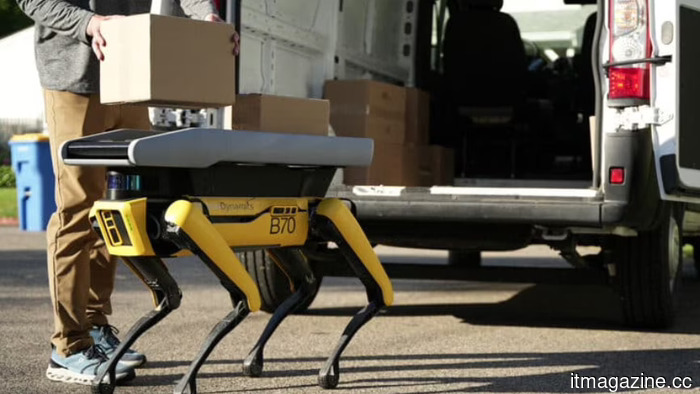 Boston Dynamics is evaluating Spot as a delivery robot that moves from the van to the front door.
Boston Dynamics equipped Spot with a conveyor belt designed to transport packages from delivery vans to front doors, focusing on the final 50 feet of the logistics chain.
Boston Dynamics is evaluating Spot as a delivery robot that moves from the van to the front door.
Boston Dynamics equipped Spot with a conveyor belt designed to transport packages from delivery vans to front doors, focusing on the final 50 feet of the logistics chain.
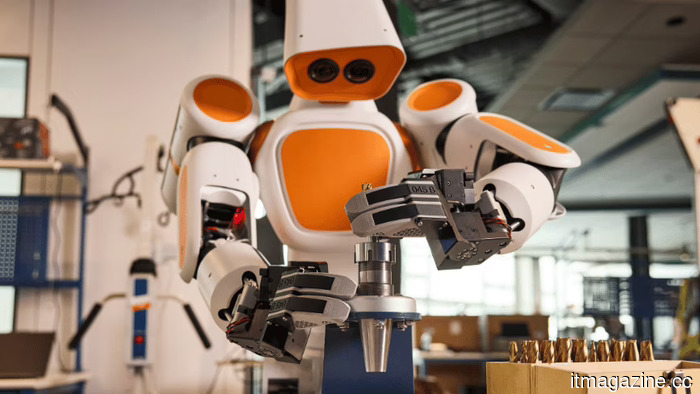 Walden Robotics begins with $300 million in funding, but without legs.
Walden Robotics, a spin-off from Toyota, has emerged from stealth mode with $300 million in funding and a valuation of $1.1 billion. Its factory humanoid robots are designed to move on wheels rather than legs.
Walden Robotics begins with $300 million in funding, but without legs.
Walden Robotics, a spin-off from Toyota, has emerged from stealth mode with $300 million in funding and a valuation of $1.1 billion. Its factory humanoid robots are designed to move on wheels rather than legs.
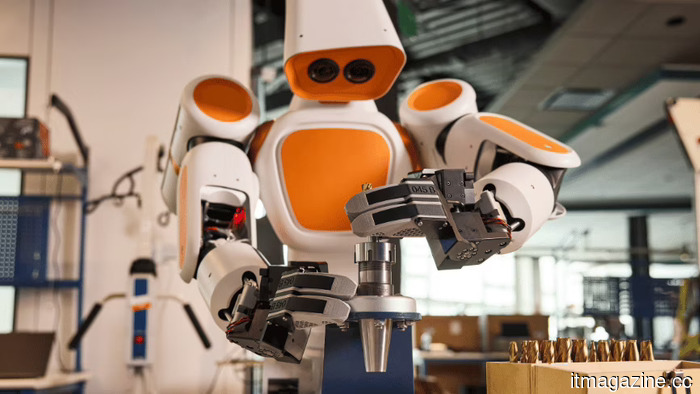 Walden Robotics debuts with $300 million in funding and legs not included.
Walden Robotics, a spin-off from Toyota, emerged from stealth mode with $300 million in funding at a valuation of $1.1 billion. Its factory humanoid robots operate on wheels instead of legs.
Walden Robotics debuts with $300 million in funding and legs not included.
Walden Robotics, a spin-off from Toyota, emerged from stealth mode with $300 million in funding at a valuation of $1.1 billion. Its factory humanoid robots operate on wheels instead of legs.
What are the simplest methods for accepting payments both online and in person?
This post is provided in collaboration with QuickBooks. Today's customers anticipate that businesses will accommodate payments in the most convenient ways, whether it's by tapping a card at the checkout, settling an invoice via phone, or making an online purchase. For small businesses, fulfilling these expectations is crucial, but handling various payment systems [...]