

WarpSpeed aims to be the AI assistant that truly helps you get your life in order.
Most of us don’t require AI to compose sonnets, create pirate jokes, or delve into quantum mechanics for the fifth time. What we truly need is much simpler and yet more challenging: support to navigate daily life.
Emails. Calendars. Tasks. Chats. Reminders. Follow-ups. Missed messages. Unfinished replies. The bill you forgot to pay. The lunch confirmation you neglected. The document someone sent three weeks ago that you now need urgently.
WarpSpeed is attempting to address precisely that issue.
In our most recent Trending Forward interview, Dan Gall and I spoke with Martin Warner, the founder and CEO of WarpSpeed, an AI-driven personal productivity platform designed to consolidate your digital life. Rather than switching between email, calendars, tasks, contacts, and chat applications, WarpSpeed aims to function as a personal AI layer that comprehends your environment and helps you navigate it more efficiently.
I am currently trying WarpSpeed myself, and although it is still in its early stages, I believe it signals a significant evolution in productivity software. Not AI as just a novelty or a blank prompt interface, but AI as a functional assistant embedded within the tools you are already using.
That’s why the complete interview warrants your attention.
Too many apps, not enough context
Martin Warner also contributes to the enjoyment of the conversation. He isn’t a typical single-product founder with a neat backstory. His experience spans finance, technology, film, 3D printing, drones, electric aviation, and entrepreneurial coaching. At one point in our discussion, we touched on his work with autonomous drone routing and electric passenger aircraft. Although it seems like a sidestep, it provides helpful context.
Martin thinks like an inventor. He analyzes complex systems, identifies bottlenecks, and then questions if technology can simplify experiences for regular individuals. This mindset is reflected in WarpSpeed.
The fundamental insight driving WarpSpeed is that our productivity challenges stem not from a shortage of applications but from an excess of apps that lack cohesive understanding. Your email understands one aspect of your life, your calendar another, your task manager yet another, and your chat messages still another. You end up being the one who connects the dots.
WarpSpeed aims to function above these disparate systems, bringing them together. It supports major ecosystems such as Google, Microsoft, and Apple, with the intention of being platform-agnostic. This matters because real users seldom operate in a single seamless environment. You might have a work Gmail account, a personal Apple Calendar, Microsoft tools from a client, and messages spread across various channels.
Users are uninterested in the technical details; they want straightforward answers.
A key aspect of Martin’s argument is that AI should not compel the average person to become a systems integrator. There is significant enthusiasm in tech circles about agents, APIs, MCP servers, and custom workflows, which benefits tech-savvy users. However, for most individuals, it’s akin to being told you can board a train only after constructing the tracks.
WarpSpeed seeks to construct those tracks for you.
Closing the loop
The app integrates email, calendar, tasks, AI chat, and its own Messenger. The assistant within WarpSpeed is named Warp, designed not merely as a chatbot on the sideline but rather as a component of the work itself.
One example Martin demonstrated was WarpSpeed Messenger. In a typical group chat, organizing a trip can swiftly turn chaotic. Someone proposes Madrid, another inquires about hotels, someone else mentions a budget, and eventually, one person has to leave the chat to search online, verify dates, compare options, and return with a summary.
With WarpSpeed, you can bring Warp directly into the discussion. You can ask it to find five-star hotels within the proposed budget, and it can provide context-aware responses. It understands what has already been discussed, can summarize options, check availability, and assist in driving the conversation towards resolution.
It’s ultimately about reaching closure. Much of modern digital work consists of unresolved tasks, and WarpSpeed aims to address more of them.
Email is another primary focus. Martin outlined an upcoming priority system that transcends generic “important” labels. Instead of merely making assumptions based on broad patterns, WarpSpeed considers your actual context: who has followed up multiple times, which bills are due, which contacts are most significant to you, and what decisions need to be made today.
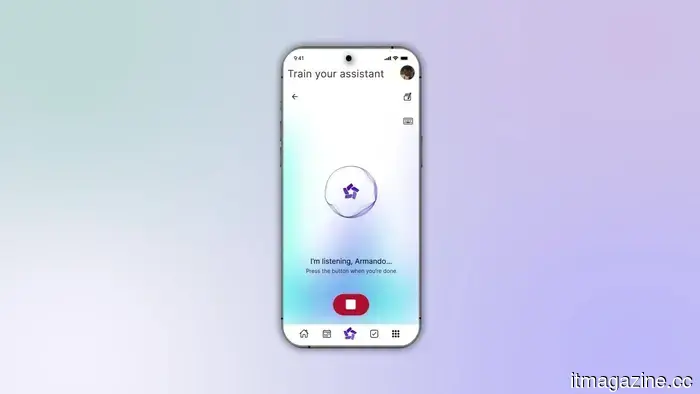
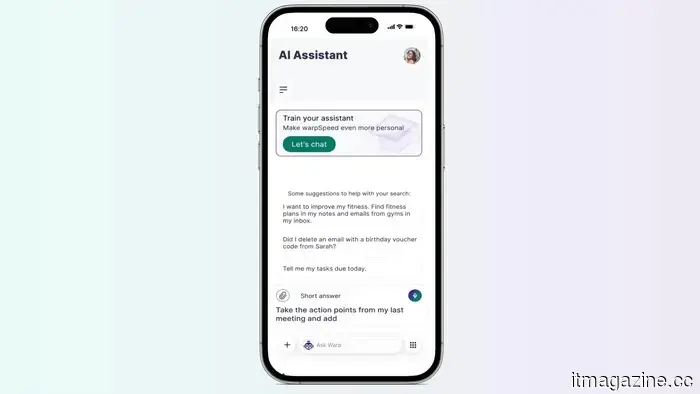
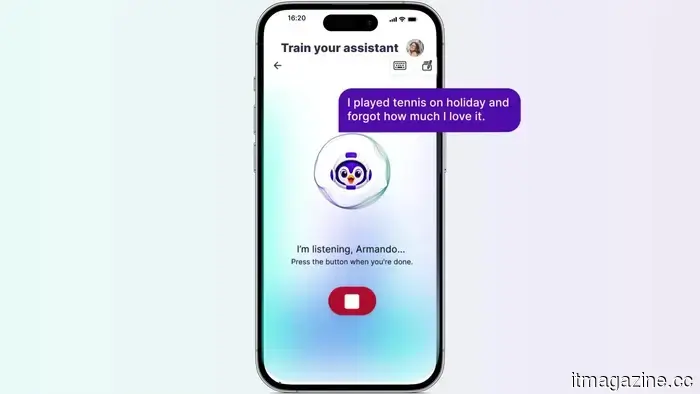
The objective isn’t to prettify email; it's to shorten it. One feature that particularly grabbed my attention was “Train Your Assistant.” This is where WarpSpeed begins to distinguish itself from a conventional AI chatbot. You can engage with Warp and inform it about your preferences, habits, priorities, and constraints. Martin shared a personal example: he informed his assistant that family comes first and work second, advising that his wife should be considered when making relevant decisions. This type of instruction significantly differs from simply requesting a summary of an email; it is akin to teaching the assistant your thought process.
Martin referred to “


Other articles
 WarpSpeed Aims to Be the AI Assistant That Effectively Organizes Your Life
The majority of AI tools are designed to respond to queries or create content. WarpSpeed is adopting a unique strategy by integrating email, calendars, tasks, and messaging into a single AI-driven workspace. In a discussion with founder Martin Warner, we delve into the idea that the future of AI could focus less on chatbots and more on assisting individuals in managing their daily activities.
WarpSpeed Aims to Be the AI Assistant That Effectively Organizes Your Life
The majority of AI tools are designed to respond to queries or create content. WarpSpeed is adopting a unique strategy by integrating email, calendars, tasks, and messaging into a single AI-driven workspace. In a discussion with founder Martin Warner, we delve into the idea that the future of AI could focus less on chatbots and more on assisting individuals in managing their daily activities.
 SWISSto12 secures $70 million for national space infrastructure.
SWISSto12, an uncommon profitable satellite manufacturer, secured $70 million in a Series C funding round as Europe strives to establish its own sovereign space infrastructure.
SWISSto12 secures $70 million for national space infrastructure.
SWISSto12, an uncommon profitable satellite manufacturer, secured $70 million in a Series C funding round as Europe strives to establish its own sovereign space infrastructure.
 EU compels Google to make Android more accessible under the Digital Markets Act.
The EU has mandated that Google make Android accessible to competing AI assistants and share its search data with rival companies as part of the Digital Markets Act.
EU compels Google to make Android more accessible under the Digital Markets Act.
The EU has mandated that Google make Android accessible to competing AI assistants and share its search data with rival companies as part of the Digital Markets Act.
 Apple is said to be updating its complete iPad lineup, with the first new model expected to arrive this fall.
Reports indicate that Apple is gearing up for a major overhaul of its iPad range, with the initial new model expected to launch this fall.
Apple is said to be updating its complete iPad lineup, with the first new model expected to arrive this fall.
Reports indicate that Apple is gearing up for a major overhaul of its iPad range, with the initial new model expected to launch this fall.
 World AI Cooperation Organization established in Shanghai.
Twenty-nine nations have agreed to a treaty to form the World AI Cooperation Organization, an intergovernmental organization for artificial intelligence based in Shanghai.
World AI Cooperation Organization established in Shanghai.
Twenty-nine nations have agreed to a treaty to form the World AI Cooperation Organization, an intergovernmental organization for artificial intelligence based in Shanghai.
 SWISSto12 secures $70 million for national space infrastructure.
SWISSto12, an unusual profitable satellite manufacturer, secured $70 million in a Series C funding round as Europe strives to establish its independent space infrastructure.
SWISSto12 secures $70 million for national space infrastructure.
SWISSto12, an unusual profitable satellite manufacturer, secured $70 million in a Series C funding round as Europe strives to establish its independent space infrastructure.
WarpSpeed aims to be the AI assistant that truly helps you get your life in order.
The majority of AI tools are designed to respond to inquiries or create content. However, WarpSpeed is adopting a different strategy by integrating email, calendars, tasks, and messaging into a single AI-driven workspace. In a discussion with founder Martin Warner, we delve into the reasons why the upcoming phase of AI could focus less on chatbots and more on assisting individuals in managing their daily activities.