
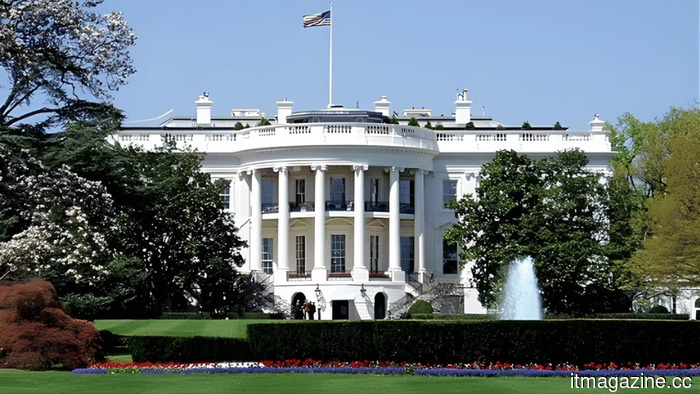
The upcoming AI energy commitment from the White House focuses on utility companies.
The White House is organizing an event expected in the coming weeks, where electric utility companies, those that build and operate data centers for major tech firms, and governors from states with significant developments will be asked to guarantee that these initiatives will not result in increased household electricity bills. Three individuals acquainted with the plans shared details of the initiative with Reuters. The guest list is still being finalized, and, similar to previous efforts, participation will involve a voluntary commitment.
This initiative builds upon a document the administration already possesses. In March, several companies, including Amazon, Google, Meta, Microsoft, OpenAI, Oracle, and xAI, signed the Ratepayer Protection Pledge during a White House event, agreeing to cover the necessary costs for generation and grid upgrades needed for their projects instead of transferring those expenses to current customers, even for reserved capacity that they do not utilize.
A White House official stated, “President Trump’s Ratepayer Protection Pledge has been so impactful that additional stakeholders also want to sign it,” which reflects one interpretation of the situation. Another interpretation suggests that the initial pledge may have included the wrong companies, as hyperscaler firms don’t set retail rates—utilities and state regulators do. If the goal is to keep bills stable, the relevant signatures come from these entities.
Involving governors, who appoint or oversee public utility commissions that authorize rate increases, indicates that the administration recognizes where the actual decision-making lies. The March pledge required signatories to develop, purchase, or generate the energy their data centers need, to negotiate distinct rate agreements with utilities and states, to bear costs for reserved capacity regardless of usage, and to return excess generation to the grid. While it reads clearly as an engineering guideline, its legal framework resembles more of a press release.
The pledge remains voluntary and non-binding, with the White House lacking authority over electricity markets. Any commitments made by utilities will function as statements of intent, subject to their own operational arguments before commissioners who aren’t obligated to uphold what is signed in Washington.
The impetus behind this is tangible. Regulators, consumer advocates, and lawmakers in various states have warned that households could end up subsidizing grid improvements designed for some of the largest corporations globally. American utilities anticipate approximately $1.4 trillion in capital expenditures by 2030 to meet AI demands, with residential customers potentially bearing a significant portion of this cost. Industrial users are already experiencing the impact, as Rust Belt manufacturers have seen capacity charges surge sharply due to data centers competing for the same megawatts.
Congress is also involved, with the House advancing a bill aimed at shifting data center energy costs back to the companies responsible for creating them, aligning with the same goals as the pledge but through legislative means instead of a ceremonial signing.
The administration asserts that America will succeed in the AI race only by rapidly expanding generation and transmission, asserting that consumers should not carry the costs associated with this expansion. However, these two commitments are not easily compatible, which is why the pledge exists: it allows the government to simultaneously promise both without making a choice. Meanwhile, federal energy regulators have been expediting grid connections for data centers, facilitating the development that the pledge intends to make less burdensome.
Electricity prices represent a unique technological concern that reaches voters in a tangible way. An administration that has invested significant political capital in AI infrastructure is now seeking to ensure that citizens do not perceive their monthly bills as a source of contention against it.
No date has been determined, and the White House has not disclosed which utilities have agreed to participate. The event, along with the size of the guest list, will provide insight into how many utilities believe a voluntary commitment regarding future rates is something they can comfortably agree to.
Other articles
 A Seoul court has put a hold on the order designating Coupang's founder as its controlling individual.
The Seoul High Court has put a hold on the FTC’s classification of Coupang founder Bom Kim as the controlling figure of the group while his legal action against the regulator moves forward.
A Seoul court has put a hold on the order designating Coupang's founder as its controlling individual.
The Seoul High Court has put a hold on the FTC’s classification of Coupang founder Bom Kim as the controlling figure of the group while his legal action against the regulator moves forward.
 The Pentagon has halted the cyber audit regulation that was driving small suppliers away.
The Pentagon has halted CMMC Phase 2 cybersecurity audits, pointing to high costs and a lack of assessors as reasons that are pushing small contractors away.
The Pentagon has halted the cyber audit regulation that was driving small suppliers away.
The Pentagon has halted CMMC Phase 2 cybersecurity audits, pointing to high costs and a lack of assessors as reasons that are pushing small contractors away.
 The public beta of iOS 27 has finally arrived, and you can access it without a developer account.
The public beta of iOS 27 has launched, introducing Siri AI, enhanced features, and a more secure testing approach.
The public beta of iOS 27 has finally arrived, and you can access it without a developer account.
The public beta of iOS 27 has launched, introducing Siri AI, enhanced features, and a more secure testing approach.
 Canada’s banking regulator issued a warning to banks, identifying Claude Mythos.
An email from April disclosed through access-to-information regulations reveals that Canada’s OSFI cautioned bank technology leaders regarding Anthropic’s Claude Mythos.
Canada’s banking regulator issued a warning to banks, identifying Claude Mythos.
An email from April disclosed through access-to-information regulations reveals that Canada’s OSFI cautioned bank technology leaders regarding Anthropic’s Claude Mythos.
 NestAI from Finland is developing the AI component that European armed forces aim to possess.
Finland, Estonia, and the Helsinki-based lab NestAI have established a defense AI agreement. There is no financial exchange involved. The emphasis is on maintaining sovereign control over the code.
NestAI from Finland is developing the AI component that European armed forces aim to possess.
Finland, Estonia, and the Helsinki-based lab NestAI have established a defense AI agreement. There is no financial exchange involved. The emphasis is on maintaining sovereign control over the code.
 Smartphone shipments in China decline for the fifth consecutive quarter due to the impact of memory costs.
In the second quarter of 2026, smartphone shipments in China decreased by 4.3% to 66 million units, marking the fifth consecutive decline, largely due to rising memory costs leading to increased Android prices. Both Huawei and Apple experienced growth.
Smartphone shipments in China decline for the fifth consecutive quarter due to the impact of memory costs.
In the second quarter of 2026, smartphone shipments in China decreased by 4.3% to 66 million units, marking the fifth consecutive decline, largely due to rising memory costs leading to increased Android prices. Both Huawei and Apple experienced growth.
The upcoming AI energy commitment from the White House focuses on utility companies.
The White House intends to request that utilities, data center operators, and governors commit to ensuring that the demand for AI power will not increase residential electricity costs.