
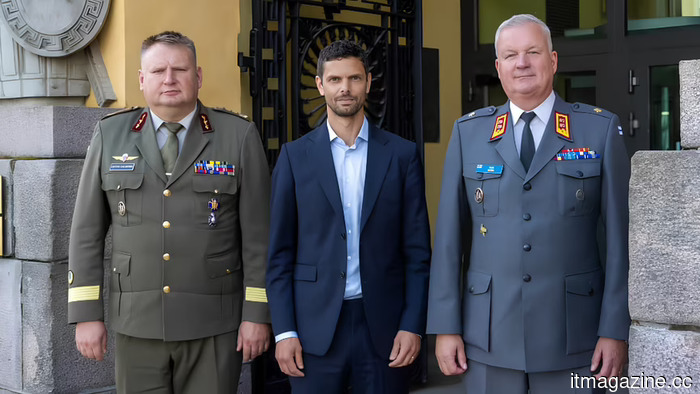
NestAI from Finland is developing the AI component that European armed forces aim to possess.
A Helsinki lab established just a year ago, funded by Nokia and the Finnish government, is now developing software for battlefield applications in collaboration with two defense ministries. The significance lies less in the technology itself and more in who controls it.
On the final day of June, officials from Finland’s Ministry of Defence, the Estonian Defence Forces, and a recently founded AI lab in Helsinki entered into an agreement that does not obligate any of the parties to spend any money. The letter of intent includes no financial commitments whatsoever, a point that the Finnish Defence Forces explicitly noted in their announcement.
This document represents, at face value, one of the least impactful agreements that a defense ministry can endorse. However, it also reflects the current climate in Europe in a significant way.
The letter connects the Finnish Defence Forces’ AI Centre of Excellence with Estonia’s Force Transformation Command, with NestAI acting as the industrial partner, and elaborates on a framework for sharing knowledge, joint development, training, and technical collaboration. Procurement is not addressed. What is being arranged here is not a contract but rather the establishment of a collaborative practice.
NestAI, the industrial partner, is nearly as young as the agreement itself. Founded in 2025, the company now has around 200 engineers and scientists, and in November, it secured €100 million from Nokia and Tesi, the Finnish state investment firm. This funding positions it as one of the better-capitalized physical AI labs in Europe, even before most outside Helsinki knew of its existence.
The product they have developed is called NestOS, and its proposition is quite clear compared to others in the sector. It is an operating layer designed for unmanned vehicles and command-and-control systems, which operates on open, modular architectures and is intended to continue learning after deployment rather than becoming static upon delivery.
“European defense forces require AI systems that can collaborate across national borders and continue to evolve post-deployment,” said Peter Sarlin, the executive chairman of NestAI. He emphasized that the evolution of capabilities should remain “in the control of the nations using the systems.”
This clause encapsulates the entire rationale. The principles of being open and modular are not merely engineering preferences here; they represent a procurement philosophy: no single vendor holds exclusive control over the future direction, and each country retains sovereign control over its own data. Europe has spent the last three years learning how challenging it is to operate critical infrastructure under external conditions.
The initial work focuses on adaptive and learning AI, decision support for command and control, as well as autonomous and unmanned systems. Piloting will be the first step, with participants expected to identify focus areas, implement them, and evaluate their effectiveness before considering broader expansion. In the long term, the goal is to involve AI organizations, centers of excellence, and industry partners from additional countries.
Major General Sami Nurmi, deputy chief of staff for strategy at Defence Command Finland, situated the letter within the broader data and AI strategy developed by the Finnish Defence Forces last year and indicated an intention to include more nations in the initiative.
His Estonian counterpart, Major General Viktor Kalnitski, remarked that merging operational insights with technical expertise should expedite the responsible deployment of AI in command and control, unmanned systems, and adaptive decision support.
The commercial developments are advancing faster than the diplomatic ones. On July 9, Nokia Defense and NestAI revealed a collaborative capability for what the industry terms denied environments—situations where satellite navigation is disrupted, bandwidth fails, and autonomous systems must continue to function.
This represents the first operational outcome of the Nokia alliance, entering a market that has been rewarding European defense technology at a speed that would have seemed absurd in 2021.
While NestAI may not be the largest or most prominent player in this arena, Munich’s Helsing, valued at $18 billion in its latest funding round, has been forming an alliance with Mistral on military AI, and NATO is operating its own sensor-fusion program along the eastern border. Instead of size, NestAI has the advantage of proximity. Finland shares a 1,340-kilometer border with Russia, and Estonia, situated across the Gulf, sharpens focus on who develops the software and where data is processed.
Other articles
 How to install the iOS 27 public beta on your iPhone?
No developer account is required. The public beta of iOS 27 has arrived, and you can install it with just a few taps in Settings, along with a brief account registration.
How to install the iOS 27 public beta on your iPhone?
No developer account is required. The public beta of iOS 27 has arrived, and you can install it with just a few taps in Settings, along with a brief account registration.
 Ericsson's revenue declines by 6% due to rising component costs and a decrease in licensing income.
Ericsson's revenue for Q2 declined by 6% to SEK 52.7 billion, although the adjusted operating profit exceeded expectations. Ekholm has raised concerns regarding the costs of components and pricing.
Ericsson's revenue declines by 6% due to rising component costs and a decrease in licensing income.
Ericsson's revenue for Q2 declined by 6% to SEK 52.7 billion, although the adjusted operating profit exceeded expectations. Ekholm has raised concerns regarding the costs of components and pricing.
-review-Smarter-and-punchier-with-a-subscription-pinch.jpg) Review of the Google Home Speaker (2026): More intelligent and powerful, with a subscription cost.
The newest version of the Google Home Speaker offers an appealing combination of effective voice controls, unexpectedly strong audio performance, and the most sophisticated collection of smart home capabilities available in a speaker priced under $100.
Review of the Google Home Speaker (2026): More intelligent and powerful, with a subscription cost.
The newest version of the Google Home Speaker offers an appealing combination of effective voice controls, unexpectedly strong audio performance, and the most sophisticated collection of smart home capabilities available in a speaker priced under $100.
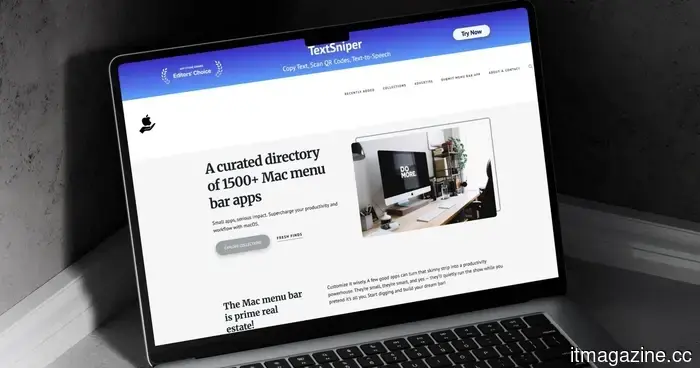 This website is a treasure trove for those who enjoy Mac menu bar applications.
MacMenuBar is a carefully organized directory featuring over 1,500 Mac menu bar applications, categorized into groups such as clipboard managers, timers, and window managers. Here's why you should consider bookmarking it.
This website is a treasure trove for those who enjoy Mac menu bar applications.
MacMenuBar is a carefully organized directory featuring over 1,500 Mac menu bar applications, categorized into groups such as clipboard managers, timers, and window managers. Here's why you should consider bookmarking it.
 China's smartphone shipments have declined for the fifth consecutive quarter due to the impact of memory costs.
In the second quarter of 2026, China's smartphone shipments decreased by 4.3% to 66 million units, marking the fifth consecutive decline, primarily due to rising memory costs which increased Android pricing. Meanwhile, Huawei and Apple experienced growth.
China's smartphone shipments have declined for the fifth consecutive quarter due to the impact of memory costs.
In the second quarter of 2026, China's smartphone shipments decreased by 4.3% to 66 million units, marking the fifth consecutive decline, primarily due to rising memory costs which increased Android pricing. Meanwhile, Huawei and Apple experienced growth.
 The Seoul court has put a hold on the decision that designated Coupang's founder as its controlling individual.
The Seoul High Court has put a halt to the FTC’s classification of Coupang founder Bom Kim as the controlling figure of the group while his legal case against the regulator is ongoing.
The Seoul court has put a hold on the decision that designated Coupang's founder as its controlling individual.
The Seoul High Court has put a halt to the FTC’s classification of Coupang founder Bom Kim as the controlling figure of the group while his legal case against the regulator is ongoing.
NestAI from Finland is developing the AI component that European armed forces aim to possess.
Finland, Estonia, and the Helsinki-based lab NestAI have established a defense AI agreement. There is no financial exchange involved. The emphasis is on maintaining sovereign control over the code.