
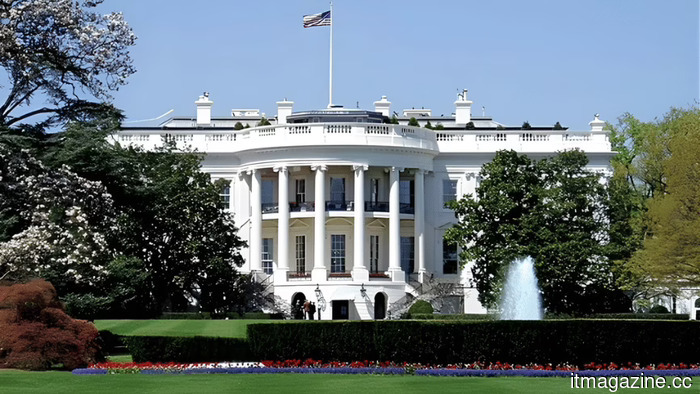
The forthcoming AI energy commitment from the White House focuses on utilities.
The White House is organizing an event anticipated to take place in the coming weeks, where electric utility companies, firms that construct and manage data centers for major tech firms, and governors from states with significant infrastructure developments will be asked to guarantee that these projects will not affect household electricity bills. Three individuals familiar with the arrangements provided details to Reuters. The guest list is still being finalized, and, similar to previous efforts, participants will be asked to make a voluntary pledge.
This initiative builds on an existing document held by the administration. In March, companies such as Amazon, Google, Meta, Microsoft, OpenAI, Oracle, and xAI signed the Ratepayer Protection Pledge at a White House event, committing to finance the generation and grid improvements their projects necessitate instead of passing the costs onto current customers, including for capacity that is reserved but unused.
“A White House official stated that President Trump’s Ratepayer Protection Pledge has proven to be so effective that more stakeholders are interested in signing it,” which is one interpretation of the current situation. Another interpretation suggests that the initial pledge was inadequate in covering the appropriate companies. Hyperscalers do not set retail prices; utilities and state regulators do, and if the political goal is to maintain flat bills, it is essential that these key figures sign on.
Involving governors, who appoint or oversee public utility commissions that approve rate hikes, indicates that the administration understands where the authority truly lies. The March pledge asked signatories to generate, acquire, or build the energy needed for their data centers, negotiate distinct rate structures with utilities and states, pay for reserved capacity regardless of usage, and sell any surplus back to the grid. While the pledge is coherent from an engineering perspective, it reads more like a press release in legal terms.
The pledge remains non-binding and voluntary, with the White House lacking jurisdiction over electricity markets. Any agreements made by utilities will serve as expressions of intent, submitted alongside rate filings that will be debated independently, before regulators who are not obligated by agreements made in Washington.
The urgency behind this initiative is not merely theoretical. Regulators, consumer advocates, and legislators in several states have cautioned that households are likely to bear the costs of grid upgrades meant for some of the largest corporations globally. American utilities are projected to spend around $1.4 trillion on capital projects by 2030 to meet AI demand, potentially shifting a significant part of that cost onto residential customers. Industrial consumers are already experiencing the impact, as manufacturers in the Rust Belt observe steep increases in capacity charges as data centers compete for the same megawatts.
Congress has also become involved, with the House advancing a bill aimed at shifting energy costs of data centers back to the companies responsible for them, aligning with the same goals as the pledge but pursuing them through legislation instead of a ceremonial signing.
The administration’s position is that the U.S. can only win the AI race by rapidly developing generation and transmission infrastructure, asserting that consumers should not bear the associated costs. These two commitments do not clearly align, which is why the pledge exists: it allows the government to affirm both objectives simultaneously without making a choice. In the meantime, federal energy regulators have been expediting grid connections for data centers, facilitating the growth the pledge aims to simplify.
Electricity prices are a unique issue that resonates with voters through their monthly bills. An administration that has invested significant political capital in AI infrastructure is now working to ensure that the monthly bill does not turn into a counterargument against its initiatives.
While no date for the event has been announced, and the White House has not disclosed which utilities have confirmed their attendance, the outcome of the event and the breadth of the guest list will reveal how many utilities believe they can safely make a voluntary commitment regarding future rates.
Other articles
 Masayoshi Son claims that AI will incur costs of $5 trillion annually by 2040, asserting that discussions about a bubble are ridiculous.
Masayoshi Son stated that AI will require an annual investment of $5 trillion by 2040 and dismissed concerns about a bubble as ludicrous during SoftBank's annual conference in Tokyo.
Masayoshi Son claims that AI will incur costs of $5 trillion annually by 2040, asserting that discussions about a bubble are ridiculous.
Masayoshi Son stated that AI will require an annual investment of $5 trillion by 2040 and dismissed concerns about a bubble as ludicrous during SoftBank's annual conference in Tokyo.
 The public beta of iOS 27 has arrived, and you can access it without needing a developer account.
The public beta of iOS 27 has been released, featuring Siri AI, enhanced capabilities, and a more secure method for testing.
The public beta of iOS 27 has arrived, and you can access it without needing a developer account.
The public beta of iOS 27 has been released, featuring Siri AI, enhanced capabilities, and a more secure method for testing.
 China's smartphone shipments decline for the fifth consecutive quarter due to rising memory costs.
In the second quarter of 2026, China experienced a 4.3% drop in smartphone shipments, amounting to 66 million units, marking the fifth consecutive decline, attributed to rising memory costs that increased prices for Android devices. Meanwhile, both Huawei and Apple saw growth.
China's smartphone shipments decline for the fifth consecutive quarter due to rising memory costs.
In the second quarter of 2026, China experienced a 4.3% drop in smartphone shipments, amounting to 66 million units, marking the fifth consecutive decline, attributed to rising memory costs that increased prices for Android devices. Meanwhile, both Huawei and Apple saw growth.
 Intel invests $5.7 billion in the production of Xeon processors in Ireland.
Intel is allocating €5 billion ($5.7 billion) to enhance its Leixlip campus in Ireland and to manufacture additional Xeon processors on the Intel 3 node, with the majority of the expenditure expected by 2027.
Intel invests $5.7 billion in the production of Xeon processors in Ireland.
Intel is allocating €5 billion ($5.7 billion) to enhance its Leixlip campus in Ireland and to manufacture additional Xeon processors on the Intel 3 node, with the majority of the expenditure expected by 2027.
 Smartphone shipments in China decline for the fifth consecutive quarter due to the impact of memory costs.
In the second quarter of 2026, smartphone shipments in China decreased by 4.3% to 66 million units, marking the fifth consecutive decline, largely due to rising memory costs leading to increased Android prices. Both Huawei and Apple experienced growth.
Smartphone shipments in China decline for the fifth consecutive quarter due to the impact of memory costs.
In the second quarter of 2026, smartphone shipments in China decreased by 4.3% to 66 million units, marking the fifth consecutive decline, largely due to rising memory costs leading to increased Android prices. Both Huawei and Apple experienced growth.
 Canada's banking regulator issued a warning to banks regarding Claude Mythos.
An email from April, made public through access-to-information regulations, reveals that Canada’s OSFI has cautioned bank technology leaders regarding Anthropic’s Claude Mythos.
Canada's banking regulator issued a warning to banks regarding Claude Mythos.
An email from April, made public through access-to-information regulations, reveals that Canada’s OSFI has cautioned bank technology leaders regarding Anthropic’s Claude Mythos.
The forthcoming AI energy commitment from the White House focuses on utilities.
The White House intends to request utilities, data centre operators, and governors to commit to ensuring that the demand for AI power does not increase residential electricity costs.