
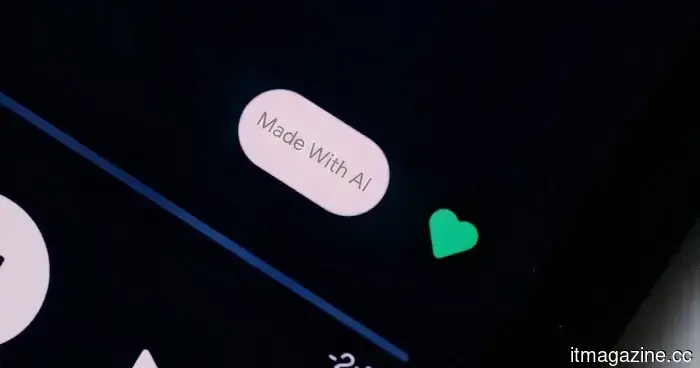
Your upcoming song might soon feature an AI warning label, and the music industry fully supports this.
The music industry's struggle with artificial intelligence is entering a new stage. After two years of legal battles against AI companies and resisting unauthorized training on copyrighted music, record labels are now focusing on a more straightforward issue: transparency. A coalition that includes major record labels, artists, and music organizations is urging streaming platforms like Spotify and Apple Music to inform listeners when a song is produced using artificial intelligence.
This initiative, reported by The Wall Street Journal, arises as AI-generated music becomes harder to differentiate from tracks created by human artists. Instead of prohibiting AI music entirely, the industry asserts that listeners have the right to know what they are hearing before they press play.
Two labels for AI-generated music might soon be seen in playlists
The effort is spearheaded by the Recording Industry Association of America (RIAA) and the International Federation of the Phonographic Industry (IFPI), along with groups like the Recording Academy (Grammys), SAG-AFTRA, the American Association of Independent Music, and the Human Artistry Campaign. They propose two distinct labels for AI-generated songs on streaming services.
The first label would denote songs that are completely AI-generated, including those where AI has produced lead vocals or significant instrumental parts. The second label would apply to AI-assisted songs, which are mainly created by humans but utilize AI as a creative tool in the production process. This concept is reminiscent of the explicit-content labels currently seen on streaming services, allowing immediate visibility of AI involvement without disrupting music distribution.
The labels would initially focus on the audio content and would not encompass AI-generated lyrics, album cover art, music videos, or composition. Participation in this labeling scheme would be voluntary, with artists, record labels, and distributors responsible for indicating AI use when submitting music.
This proposal builds on existing efforts. Spotify has started to showcase AI-related details in song credits, while Apple Music has rolled out transparency metadata that lets distributors specify whether AI played a part in recordings, artwork, or videos. The new proposal seeks to make this information much more accessible to everyday listeners rather than having it buried in credits menus.
The focus of the debate has shifted from AI music itself to issues of trust
The proposal signifies a broader change in the music industry's attitude toward AI. Many artists now view AI as just another production tool, comparable to synthesizers, Auto-Tune, or digital audio workstations. The primary concern is whether fans can discern the difference between human creativity and machine-generated content.
This concern has intensified as streaming services face a surge of low-quality AI-generated tracks that aim to manipulate recommendation algorithms. Services like Spotify have already removed thousands of suspected AI spam songs in recent years, while record labels continue to pursue legal action against AI companies accused of training models using copyrighted music without consent.
RIAA CEO Mitch Glazier believes the answer lies not in restricting creativity but in promoting transparency. He asserts that artists should have the freedom to use AI in their creative process, but listeners should also receive the necessary information to make informed choices. Meanwhile, the Digital Media Association, representing members such as Spotify and Apple Music, emphasizes that effective AI metadata relies on accurate information from all parties involved, including creators, distributors, and streaming services.
It remains uncertain whether these labels will become an industry standard, especially since the system hinges on voluntary reporting. However, as AI-generated music becomes more ubiquitous, transparency may prove just as vital as audio quality or bitrate in guiding listener choices about what to include in their playlists.
Will AI labels enhance your listening experience? Here's my perspective
For many listeners, myself included, I believe they will. AI labels won’t prevent people from enjoying AI-generated music, but they will provide essential context regarding how a song was made. Just as explicit-content labels aid users in making informed decisions, AI tags could foster trust, promote transparency, and allow listeners to choose between human-created music, AI-assisted compositions, or entirely AI-generated tracks.
An AI label wouldn’t deter me from a great song, but it would give me the context to understand if I’m experiencing human creativity, AI assistance, or something produced mainly by a machine.

Other articles
 The remake of Ubisoft's Black Flag is a sign of a problem, rather than a part of a strategy.
Assassin's Creed Black Flag Resynced is a solid remake. Its development was prompted by Ubisoft's cancellation of six games, creating the need for something to generate sales.
The remake of Ubisoft's Black Flag is a sign of a problem, rather than a part of a strategy.
Assassin's Creed Black Flag Resynced is a solid remake. Its development was prompted by Ubisoft's cancellation of six games, creating the need for something to generate sales.
 Netflix might introduce channels that are always available. That’s essentially like cable.
According to reports, Netflix has contemplated the idea of offering 24/7 genre-specific channels and handling subscriptions for competing services through its own app, effectively reinventing the cable model it previously disrupted.
Netflix might introduce channels that are always available. That’s essentially like cable.
According to reports, Netflix has contemplated the idea of offering 24/7 genre-specific channels and handling subscriptions for competing services through its own app, effectively reinventing the cable model it previously disrupted.
 I invested in a more promising future, yet my online existence comes with monthly subscription fees.
Contemporary life operates on subscriptions that are frequently beneficial, affordable, and becoming harder to live without. The future has come, but it seems we'll have to continue making monthly payments to access it.
I invested in a more promising future, yet my online existence comes with monthly subscription fees.
Contemporary life operates on subscriptions that are frequently beneficial, affordable, and becoming harder to live without. The future has come, but it seems we'll have to continue making monthly payments to access it.
 The remake of Ubisoft's Black Flag is a sign of a larger issue, rather than a well-thought-out plan.
Assassin's Creed Black Flag Resynced is a solid remake. It was created because Ubisoft terminated six games and requires a product to generate revenue.
The remake of Ubisoft's Black Flag is a sign of a larger issue, rather than a well-thought-out plan.
Assassin's Creed Black Flag Resynced is a solid remake. It was created because Ubisoft terminated six games and requires a product to generate revenue.
 Netflix might introduce channels that are always available. That’s essentially the same as cable.
Netflix is said to have explored the idea of 24/7 genre channels and the option to bill competitor subscriptions via its own app, effectively reviving the cable model it previously dismantled.
Netflix might introduce channels that are always available. That’s essentially the same as cable.
Netflix is said to have explored the idea of 24/7 genre channels and the option to bill competitor subscriptions via its own app, effectively reviving the cable model it previously dismantled.
 5 reasons I consistently return to Apple Reminders, even after investing in premium task management apps.
Even though I've invested in Things 3, Todoist, and OmniFocus, I find myself going back to Apple Reminders. Here are five reasons why this free app still outperforms premium task managers for daily use.
5 reasons I consistently return to Apple Reminders, even after investing in premium task management apps.
Even though I've invested in Things 3, Todoist, and OmniFocus, I find myself going back to Apple Reminders. Here are five reasons why this free app still outperforms premium task managers for daily use.
Your upcoming song might soon feature an AI warning label, and the music industry fully supports this.
The music industry is urging Spotify and Apple Music to tag AI-generated songs, aiming to provide listeners with more transparency as the use of artificial intelligence in music creation grows.