

Google might finally move away from Samsung’s modem in the Pixel 11, and the Tensor G6 could be an improvement as a result.
FCC documents regarding Google’s forthcoming foldable device indicate the involvement of MediaTek, sparking hopes for improved power efficiency and a departure from Tensor’s Exynos legacy.
Google might be organizing its most significant hardware shift in Tensor technology to date. As noted by Android Authority, FCC testing for a non-released foldable Google phone references MediaTek radio-frequency software, reinforcing speculation that the Tensor G6 in the Pixel 11 may abandon Samsung’s Exynos modem.
Previously, all Tensor chips utilized Samsung’s modem technology. While a change in suppliers doesn’t guarantee enhanced battery life or reception, it provides Google with a new direction after years of relying on the same foundational technology.
Insights from the FCC documents
On page 30 of the phone's SAR test report, which evaluates radio-frequency exposure, there’s a mention of MediaTek’s TA-SAR v2 algorithm, linking the unannounced Google device to MediaTek’s radio technology.
Google did not specify a retail product name or detail the internal components. Nonetheless, the device underwent testing in both open and closed states, implying that the documents pertain to a foldable Pixel.
This aligns with speculation that Google may incorporate MediaTek’s M90 modem in the Tensor G6, marking the end of Samsung's consistent presence in Tensor-powered devices.
Benefits of switching suppliers
Previous reports have highlighted lower power consumption as the primary benefit of the M90. If these efficiency improvements are realized in the final product, the Pixel 11 could provide longer battery life while maintaining connectivity.
This would offer consumers more than just a slight performance increment. Pixel users prioritize reliable reception and battery longevity far more than simply scoring high in synthetic performance evaluations.
However, merely changing the logo on the component won’t resolve all issues. Google needs to optimally calibrate the hardware and demonstrate that MediaTek can offer significant improvements in everyday usage.
What Google still needs to validate
The reference to MediaTek bolsters the argument for a supplier transition, but doesn’t validate the M90 or guarantee actual performance enhancements. Regulatory testing can reveal the technology in use but does not reflect the efficiency of the finished product.
The true evaluation will occur once the Pixel 11 is reviewed. Reliable connectivity and extended battery life would justify this shift; anything less risk turning Google’s largest Tensor transformation into just another internal upgrade that customers hardly recognize.
In other news:
Apple's iPhone Ultra could surpass the Galaxy Z Fold 7 with a larger battery of 4,883mAh capacity, featuring two cells and dual screens drawing power. This is an advancement towards its expected September release, and despite speculation about a delay, reports suggest that Foxconn is increasing temporary staffing for production.
Motorola is developing a highly ambitious phone in its Edge 70 series, known as the Edge 70 Max. However, it may not be available in the US market. With impressive features such as a 7,000-nit display and magnetic wireless charging, Motorola seems to be aiming to break industry norms.
Additionally, Google Voice has integrated an AI note-taker, introducing a personal assistant for calls at a lower cost. This marks a significant progression from its early days as a free service to avoid spam calls, now utilizing AI to assist with note-taking during calls.







Other articles
 Meta has just removed its most contentious AI image generation feature only days after its debut.
Meta introduced a feature that allowed users to create AI images of public Instagram accounts, with the opt-in setting enabled by default, but then decided to retract it.
Meta has just removed its most contentious AI image generation feature only days after its debut.
Meta introduced a feature that allowed users to create AI images of public Instagram accounts, with the opt-in setting enabled by default, but then decided to retract it.
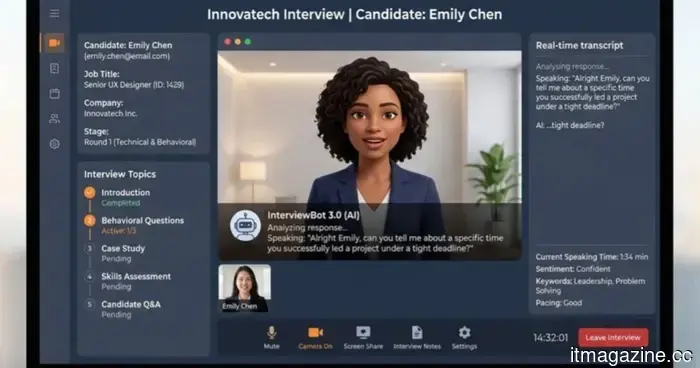 The appearance of an AI interviewer might be just as important as the choices it makes.
Candidates responded variably to the same AI hiring rejections based on the race and gender of the avatar, indicating that issues of fairness can originate from interface design even before the algorithm is reviewed.
The appearance of an AI interviewer might be just as important as the choices it makes.
Candidates responded variably to the same AI hiring rejections based on the race and gender of the avatar, indicating that issues of fairness can originate from interface design even before the algorithm is reviewed.
 You may choose to stop utilizing AI, but this recent report suggests that you are likely unable to avoid it.
A recent survey in the UK reveals that individuals are intentionally restricting their use of AI, despite the fact that many feel it has become challenging or even impossible to avoid exposure to AI.
You may choose to stop utilizing AI, but this recent report suggests that you are likely unable to avoid it.
A recent survey in the UK reveals that individuals are intentionally restricting their use of AI, despite the fact that many feel it has become challenging or even impossible to avoid exposure to AI.
 Meta has just removed its most contentious AI image generation feature only days after it was released.
Meta introduced a feature that allowed anyone to create AI images of public Instagram users who were automatically opted in but later retracted it.
Meta has just removed its most contentious AI image generation feature only days after it was released.
Meta introduced a feature that allowed anyone to create AI images of public Instagram users who were automatically opted in but later retracted it.
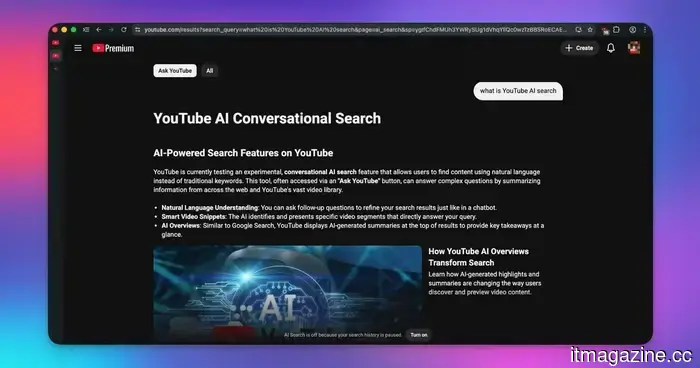 YouTube's AI-driven search is being launched in the US, allowing users to discover videos by describing specific situations.
U.S. users can now pose conversational questions on YouTube to search for videos related to specific situations, ideas, and activities.
YouTube's AI-driven search is being launched in the US, allowing users to discover videos by describing specific situations.
U.S. users can now pose conversational questions on YouTube to search for videos related to specific situations, ideas, and activities.
Google might finally move away from Samsung’s modem in the Pixel 11, and the Tensor G6 could be an improvement as a result.
The FCC documentation for Google’s Pixel 11 includes a reference to MediaTek, indicating that the Tensor G6 might move away from Samsung’s Exynos modem in an effort to enhance battery efficiency and improve daily connectivity.