
This innovative chip stacking method may be crucial for achieving faster AI performance.
Researchers have addressed the delicate chip stacking issue that has been hindering AI memory development, and the outcomes are notable.
Whenever you interact with ChatGPT or create an AI-generated image, a memory chip is operating at high speed in the background. However, this chip faces a memory bottleneck issue, which a research team from Korea may have resolved.
The team at POSTECH (Pohang University of Science and Technology) has created a novel method to stack over 10 ultrathin semiconductor chips vertically, achieving a memory density approximately four times greater than the leading commercial chips currently available (according to TechXplore).
What makes chip stacking challenging, and how does this approach differ?
High-bandwidth memory (HBM) is the kind of memory that drives AI accelerators. It functions by stacking multiple chips vertically, akin to constructing a high-rise instead of spreading them across a surface.
The challenge arises because thinner chips are exceedingly fragile. At just one-fifth the thickness of a human hair, they can bend, warp, and crack when subjected to pressure. Existing manufacturing methods exacerbate this issue, often causing damage to the chips before they are even compiled into a stack.
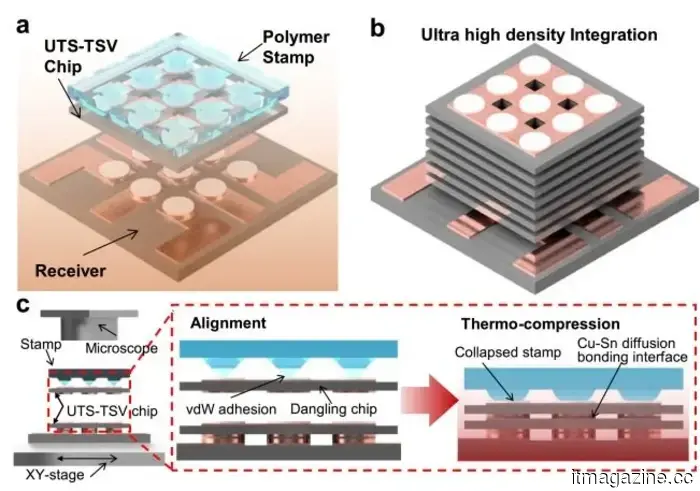
The POSTECH team resolved this issue by merging two techniques into a single process. Transfer printing accurately positions each chip in its designated spot, while in-situ bonding creates the metal connections simultaneously, all while maintaining low temperatures (below 180 degrees Celsius) and low pressures (under 20 kilopascals). The outcome is a stack of over 10 chips with minimal misalignment and very slight warping.
Why this is important for the future of AI
Increased memory density within the same footprint allows AI applications to operate faster and manage larger tasks without requiring bulkier or pricier hardware. The researchers also envision applications beyond AI, such as next-generation micro-LED displays and sophisticated processor designs that necessitate the ultra-precise stacking that this technique provides.
The next step is to bring this innovation to commercial production, and if successful, the memory limitations that have been subtly restricting AI progress could finally begin to diminish.




Other articles
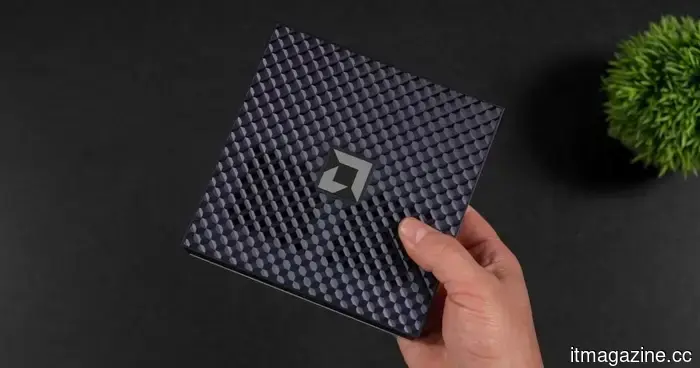 This AMD mini PC outperforms Valve's Steam Machine, but it comes at a significantly higher price.
A mini PC featuring an AMD Ryzen AI Max+ 395 that operates on SteamOS 3.8 has surpassed Valve's Steam Machine in various games, although its much higher price restricts its attractiveness.
This AMD mini PC outperforms Valve's Steam Machine, but it comes at a significantly higher price.
A mini PC featuring an AMD Ryzen AI Max+ 395 that operates on SteamOS 3.8 has surpassed Valve's Steam Machine in various games, although its much higher price restricts its attractiveness.
 Slate’s new electric truck colors resemble those from a Crayola box.
Slate Auto has teamed up with Crayola to introduce five vibrant wrap kits for its budget-friendly electric truck, representing the crayon manufacturer's inaugural partnership with an automotive company.
Slate’s new electric truck colors resemble those from a Crayola box.
Slate Auto has teamed up with Crayola to introduce five vibrant wrap kits for its budget-friendly electric truck, representing the crayon manufacturer's inaugural partnership with an automotive company.
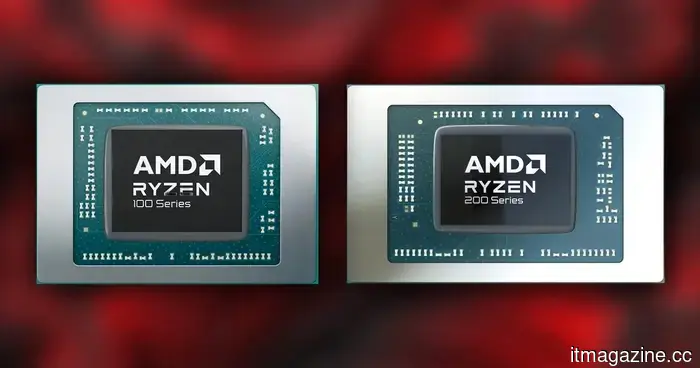 AMD has further complicated the landscape of Ryzen laptop processors, but here’s what’s genuinely new.
AMD has broadened its mobile processor range by introducing 11 new Ryzen 200 and Ryzen 100 series processors built on Hawk Point, although the company’s recent naming approach is becoming increasingly perplexing.
AMD has further complicated the landscape of Ryzen laptop processors, but here’s what’s genuinely new.
AMD has broadened its mobile processor range by introducing 11 new Ryzen 200 and Ryzen 100 series processors built on Hawk Point, although the company’s recent naming approach is becoming increasingly perplexing.
 ChatGPT can now complete what you've begun, and this is a more significant development than it may seem.
OpenAI's ChatGPT Work has the potential to be one of its most significant AI enhancements to date, offering the ability to streamline hours of tedious tasks with just one request.
ChatGPT can now complete what you've begun, and this is a more significant development than it may seem.
OpenAI's ChatGPT Work has the potential to be one of its most significant AI enhancements to date, offering the ability to streamline hours of tedious tasks with just one request.
 The Household Economy of Family AI: The Growing Consumer Potential of AI
Instead of concentrating exclusively on enhancing workplace productivity, a new wave of AI companies is investigating how smart home systems might affect family decision-making, spending habits, budgeting, and daily expenditures. Over the last ten years, artificial intelligence has largely been positioned as a technology for the workplace, with businesses aiming to assist professionals in writing more quickly, analyzing data, and automating tasks.
The Household Economy of Family AI: The Growing Consumer Potential of AI
Instead of concentrating exclusively on enhancing workplace productivity, a new wave of AI companies is investigating how smart home systems might affect family decision-making, spending habits, budgeting, and daily expenditures. Over the last ten years, artificial intelligence has largely been positioned as a technology for the workplace, with businesses aiming to assist professionals in writing more quickly, analyzing data, and automating tasks.
 OpenAI is discontinuing its ChatGPT Atlas browser.
OpenAI will discontinue ChatGPT Atlas on August 9, integrating its agentic browsing feature into a new "super app" for ChatGPT for desktop while scaling back on side projects.
OpenAI is discontinuing its ChatGPT Atlas browser.
OpenAI will discontinue ChatGPT Atlas on August 9, integrating its agentic browsing feature into a new "super app" for ChatGPT for desktop while scaling back on side projects.
This innovative chip stacking method may be crucial for achieving faster AI performance.
Researchers have created a novel chip stacking technique that has the potential to increase AI memory density fourfold, possibly addressing one of the major hardware limitations currently hindering AI performance.