
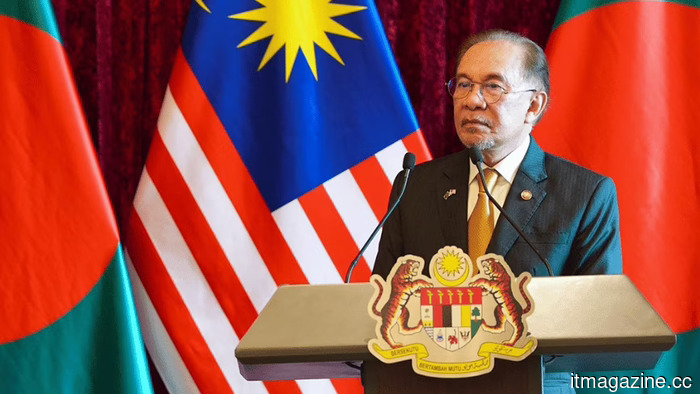
The Prime Minister of Malaysia is introducing an AI version of himself.
The Prime Minister of Malaysia is exploring a new approach by deploying an autonomous representation of himself to assist the public. Anwar Ibrahim is set to unveil an artificial intelligence version of himself, known as PMX AI, named in reference to his status as the country's tenth prime minister. According to Bloomberg, it may go live in just a few days.
The dual was created by a Malaysian digital infrastructure company, Zetrix AI Bhd., which trained it using Anwar's own writings, speeches, and governmental records. The aim is for the avatar to resemble and sound distinctly like him. This initiative is a project of his party, Parti Keadilan Rakyat, and is being launched in anticipation of a national election set to occur by early 2028.
Not merely a digital spokesperson, unlike many politicians who have shared AI renditions of themselves, PMX AI is designed for action beyond just communication. Engineers have made it capable of handling requests autonomously, allowing it to analyze tasks, break them down into steps, and execute them with minimal human intervention.
In practice, this resembles a government service counter. The avatar is programmed to assist citizens in renewing their driving licenses, complete with sending payment links and confirming transactions. It communicates in both English and Malay, incorporating regional dialects and Malay slang.
Additionally, it serves as a careers adviser, guiding individuals toward training programs, job placements, and recommending courses based on students' interests.
“AI will revolutionize governance and politics,” remarked TS Wong, the group managing director of Zetrix. The company reports that it continually updates the model with Anwar’s latest comments, enhancing the avatar's likeness in near real-time.
The promotional video reveals the ambitious—and somewhat peculiar—aspirations of the project. “It is a digital extension of myself. Ready to listen, assist, and serve the people,” states the narration in Anwar's voice, while visuals depict him as an astronaut, a superhero with a cape, and resembling Neo from The Matrix.
The timing of this initiative is strategic, as Anwar aims to position himself as a leader who embraces AI and digital innovation, targeting the support of younger voters. An ever-available avatar that remains consistent in messaging could prove to be a valuable asset in his campaign.
While Malaysia is not the first to use AI in political contexts, it is pushing boundaries further. Other leaders, such as Ukraine’s Volodymyr Zelenskyy, India’s Narendra Modi, and South Korea’s president Lee Jae Myung, have utilized AI to engage with constituents. However, Malaysia's innovation lies in providing an autonomous avatar that can perform tasks rather than merely communicate.
This raises significant concerns. An agentic representation of a head of government poses risks; the same system that sends a payment link could potentially be misused after a faulty update or security breach. As AI avatars become more sophisticated, distinguishing between a useful public service and a persuasive political tool becomes increasingly challenging.
Regulators have begun to address these concerns. France is looking to increase penalties for election-related disinformation generated by AI, while China has started to restrict hyper-realistic AI agents. Detection efforts are also advancing, with tools like Google’s SynthID watermark emerging to identify political deepfakes in circulation.
Malaysia is banking on the belief that voters will perceive PMX AI as a convenience rather than manipulation. Anwar’s team is optimistic that the avatar will facilitate navigation through a cumbersome bureaucracy. The more complex issue is whether citizens will recognize—or care—that the prime minister responding to them is, in fact, a machine.
Other articles
 Home robots are capable of walking. The challenging aspect is preventing them from damaging your glassware.
1X's NEO home robot features tendon-driven hands equipped with tactile sensing, force control, and water resistance. However, despite its impressive hardware, it still requires dependable autonomy to manage everyday tasks.
Home robots are capable of walking. The challenging aspect is preventing them from damaging your glassware.
1X's NEO home robot features tendon-driven hands equipped with tactile sensing, force control, and water resistance. However, despite its impressive hardware, it still requires dependable autonomy to manage everyday tasks.
 A recent leak regarding the Galaxy Z Fold 8 indicates that consumers in the US should anticipate a price increase.
A recent leak indicates that the Galaxy Z Fold 8 Ultra may have a price increase of $100 in the US, aligning with an already anticipated price rise for Europe.
A recent leak regarding the Galaxy Z Fold 8 indicates that consumers in the US should anticipate a price increase.
A recent leak indicates that the Galaxy Z Fold 8 Ultra may have a price increase of $100 in the US, aligning with an already anticipated price rise for Europe.
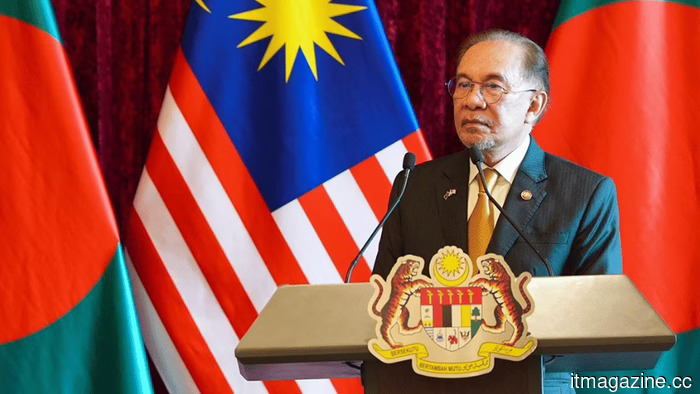 The Prime Minister of Malaysia is introducing an AI replica of himself.
Anwar Ibrahim's administration will soon launch PMX AI, an avatar designed to mimic his speech, which will assist citizens in navigating government services.
The Prime Minister of Malaysia is introducing an AI replica of himself.
Anwar Ibrahim's administration will soon launch PMX AI, an avatar designed to mimic his speech, which will assist citizens in navigating government services.
 Anthropic reaches a valuation of $1.2 trillion, surpassing OpenAI.
Shares of Anthropic suggest a valuation of $1.2 trillion in secondary markets, surpassing OpenAI's $908 billion. The drawback is that very few are willing to sell.
Anthropic reaches a valuation of $1.2 trillion, surpassing OpenAI.
Shares of Anthropic suggest a valuation of $1.2 trillion in secondary markets, surpassing OpenAI's $908 billion. The drawback is that very few are willing to sell.
 The UK's £2 billion AI 'Combat Laboratory' designed for the British Army
Britain's new £2 billion AI 'Combat Laboratory' is set to train 60,000 soldiers annually. A US company is at the forefront of the initiative, while Germany's Rheinmetall holds nearly half of the involvement.
The UK's £2 billion AI 'Combat Laboratory' designed for the British Army
Britain's new £2 billion AI 'Combat Laboratory' is set to train 60,000 soldiers annually. A US company is at the forefront of the initiative, while Germany's Rheinmetall holds nearly half of the involvement.
 The UK has established a £2 billion AI 'Combat Laboratory' for the British Army.
Britain's new £2 billion AI 'Combat Laboratory' is set to train 60,000 soldiers annually. A US company is at the forefront of this initiative, while Germany's Rheinmetall holds nearly 50% of the project.
The UK has established a £2 billion AI 'Combat Laboratory' for the British Army.
Britain's new £2 billion AI 'Combat Laboratory' is set to train 60,000 soldiers annually. A US company is at the forefront of this initiative, while Germany's Rheinmetall holds nearly 50% of the project.
The Prime Minister of Malaysia is introducing an AI version of himself.
The government of Anwar Ibrahim will soon introduce PMX AI, an interactive avatar designed to mimic his speech patterns and guide citizens through government services.