
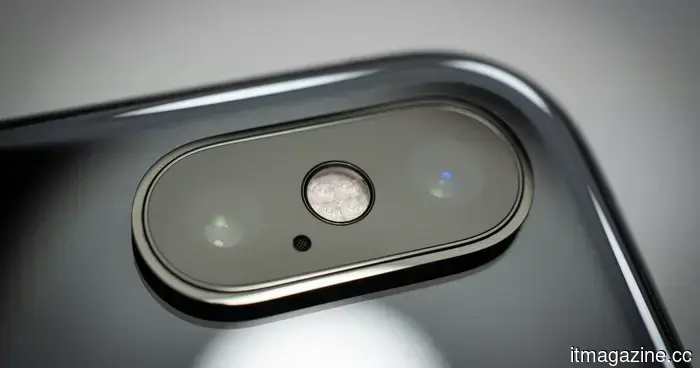
A breakthrough in camera sensor technology assures sharper images without increasing the thickness of your phone.
Researchers at Nagoya University have created a new kind of transparent optical sensor that has the potential to significantly downsize camera sensors while enhancing image quality. The findings, published in the journal ACS Nano, reveal that gallium-doped zinc oxide (GZO) nanosheets can detect red, green, and blue (RGB) light within a single pixel, which could replace the traditional Bayer filter design that has been used in nearly all digital cameras for decades.
If brought to market, this technology could facilitate thinner smartphone cameras, improved-resolution medical imaging devices, and more compact sensors for automotive and aerospace uses, all while streamlining the manufacturing process.
A fresh sensor design might overcome one of the longstanding constraints of digital photography
Current image sensors depend on a Bayer array, where each pixel only captures either red, green, or blue. Full-color images are constructed using data from adjacent pixels, a method that inherently loses some detail and necessitates millions of color filters.
The Nagoya University team believes they have discovered a superior solution. Their transparent GZO nanosheets permit stacking multiple light-detecting layers vertically, with each layer responding to distinct wavelengths of visible light. This setup allows a single pixel to directly gather RGB data, which could cut the total number of required pixels by as much as 75% while preserving image resolution.
The ultrathin gallium-doped zinc oxide nanosheets enable each pixel to measure the intensity of red, green, and blue light while remaining nearly transparent. Minoru Osada
Led by Professor Minoru Osada, the researchers initially encountered difficulties as zinc oxide nanosheets exhibited a weak response to visible light. By incorporating gallium into the material, they developed electronic trap states that can convert visible light into electrical signals without losing transparency.
The resulting sensor converts merely 0.005% of the light it absorbs into photocurrent while allowing 99.995% of visible light to pass through each layer. Even with such low light absorption, the device achieved a sensitivity of 800 amperes per watt (A/W), approximately 80 times greater than the roughly 10 A/W commonly attained by commercial image sensors. Laboratory tests indicated that the prototype produced full-color images with an error rate that was half that of standard camera sensors.
More compact cameras, enhanced images, and broader application possibilities
In addition to enhancing image quality, the research suggests practical manufacturing benefits. Unlike traditional image sensors, the transparent nanosheet sensors can be produced via a room-temperature solution process, bypassing several intricate semiconductor fabrication steps and potentially lowering production expenses.
The sensors also exhibited stable performance at temperatures up to 400°C and maintained reliable operation in both vacuum and humid conditions. These features make them suitable for not only smartphones but also for medical endoscopes, autonomous vehicles, industrial imaging systems, and even space equipment, where durability is crucial.
Professor Osada compared the functioning of the sensor to the human eye, elucidating that it emulates how the retina processes color information before the brain constructs a complete image.
Although the technology is still in the research phase, the results indicate a promising future for smaller, lighter, and higher-resolution imaging systems. The next step will be to convert the laboratory prototype into commercially viable sensors that can compete in terms of cost, reliability, and scalability. If successful, this technology could revolutionize the design of future smartphone cameras and optical devices in various sectors.


Other articles
 This small device known as Moodi might protect your thumb during extended reading periods.
DuRoBo has launched Moodi, a compact Bluetooth remote that enables users to flip pages, navigate documents, and manage media without the need to physically interact with their device.
This small device known as Moodi might protect your thumb during extended reading periods.
DuRoBo has launched Moodi, a compact Bluetooth remote that enables users to flip pages, navigate documents, and manage media without the need to physically interact with their device.
 Netflix is concerned that viewers aren't watching enough, so its upcoming decision could significantly alter the app.
Netflix is said to be exploring live channels, bundled streaming subscriptions, and additional live content as it aims to boost viewer engagement, despite experiencing significant subscriber growth.
Netflix is concerned that viewers aren't watching enough, so its upcoming decision could significantly alter the app.
Netflix is said to be exploring live channels, bundled streaming subscriptions, and additional live content as it aims to boost viewer engagement, despite experiencing significant subscriber growth.
 Sber has launched a service for finding gas stations with available fuel.
Sber has introduced a service for finding gas stations where fuel is likely available. The solution uses anonymized payment data, covers about 23,000 gas stations across Russia, and helps quickly choose the right gas station.
Sber has launched a service for finding gas stations with available fuel.
Sber has introduced a service for finding gas stations where fuel is likely available. The solution uses anonymized payment data, covers about 23,000 gas stations across Russia, and helps quickly choose the right gas station.
 ChatGPT is targeting one of Google's most intelligent features in Chrome.
OpenAI's latest ChatGPT Chrome extension integrates context-aware AI into your browser, competing with Google's Gemini Side Panel by offering webpage summaries, explanations, and task automation.
ChatGPT is targeting one of Google's most intelligent features in Chrome.
OpenAI's latest ChatGPT Chrome extension integrates context-aware AI into your browser, competing with Google's Gemini Side Panel by offering webpage summaries, explanations, and task automation.
 Razer created a Cinnamoroll headset that is incredibly cute.
Razer's last collaboration with Sanrio features a Cinnamoroll-themed Kraken Kitty V2 BT headset that includes Bluetooth 5.2, RGB lighting, and offers up to 40 hours of battery life.
Razer created a Cinnamoroll headset that is incredibly cute.
Razer's last collaboration with Sanrio features a Cinnamoroll-themed Kraken Kitty V2 BT headset that includes Bluetooth 5.2, RGB lighting, and offers up to 40 hours of battery life.
A breakthrough in camera sensor technology assures sharper images without increasing the thickness of your phone.
Researchers from Nagoya University have created transparent nanosheet sensors capable of detecting RGB light in a single pixel, which could lead to the development of smaller, sharper, and more efficient cameras.