

AMD's CTO explains the necessity for additional CPUs for agentic AI.
At the RAISE Summit in Paris, the interviewer was straightforward with Mark Papermaster, joking that he should have invested in AMD shares six months ago when they were priced around $200, compared to their current value above $500. AMD has transitioned from being the underdog competing with Intel in CPUs and Nvidia in GPUs to having a market capitalization approaching a trillion dollars, with a rise of over 140% in the past year.
So, what prompted this market shift? According to Papermaster, AMD had laid the foundation for this success years earlier. The company began shipping its first leadership server CPU in 2017 and has maintained a consistent annual release schedule. The recent change lies in the operation of AI.
The common narrative around the AI boom tends to focus on GPUs, but Papermaster seeks to broaden that perspective. He argues that when running agent-based applications, there is an increased reliance on CPUs rather than a decrease. He cited a statistic indicating that the CPU workload required for today's agents is approximately four times greater.
The reason for this is orchestration. While a single agent is manageable, a genuine workflow involves multiple agents operating simultaneously, creating sub-agents for specific tasks and managing an increasing amount of context. This level of coordination and reasoning relies on the CPU before the complex calculations are handed over to the GPU. Essentially, agent-based AI requires both components.
Papermaster has observed these developments within AMD. The company now designs its own chips with assistance from AI, significantly reducing task completion times from months to weeks or even days. He noted that productivity improvements have surged from the 10% range to much greater levels over the past six months.
Papermaster's extensive experience makes him a valuable voice for this evolution. He has a background in hardware development during the PC era, worked for years at IBM, and collaborated with Steve Jobs on the iPhone and iPad at Apple. He has witnessed multiple transitions, with the current shift being towards AI.
His rationale for why this transition is happening more rapidly is straightforward. The PC and internet democratized information access, while mobile technology made it portable. Now, he believes the models possess reasoning capabilities, enabling agent-based systems to not only seek answers but also to accomplish real tasks. This represents a significant advancement from merely searching for answers to completing jobs.
The greater transformation for AMD lies in its business model. The company is no longer just selling silicon but optimizing systems, aiming for improved efficiency throughout the entire stack.
Consequently, AMD invested $4.9 billion to acquire ZT Systems, a hyperscale infrastructure builder. The intention was to optimize the entire system, integrating CPU, GPU, and networking components, rather than focusing on individual parts. Papermaster describes this approach as holistic design, stating, “You have to design for the system, all the way through the application stack.” AMD retained the design expertise and sold the manufacturing division to Sanmina to avoid competing with its customers.
The flagship offering is Helios, AMD’s rack-scale AI system, which integrates 72 of its next-generation Instinct GPUs with server CPUs, facilitating large-scale training and inference. Papermaster emphasizes the need to “feed the beast,” indicating that networking, software, and memory must all scale together. The key, he noted, is identifying and eliminating bottlenecks without starve one component to enhance another.
AMD’s ongoing commitment is to openness. Its ROCm software stack is open-source, and Helios utilizes an open rack standard submitted to the Open Compute Project by Meta. The networking that interconnects the system is likewise open, contrasting with the more closed systems of its primary GPU competitor.
Does embracing openness hinder speed? Papermaster contends that while a closed system can be faster due to centralized control, AMD is committed to a long-term strategy. The approach involves launching new features with a select group of lead customers before opening them up for broader community development. "We’ve been committed to open systems, open ecosystems," he asserted, claiming that collaborative efforts among multiple partners can outperform solitary progress by one company.
This message resonates particularly well in Europe, where buyers increasingly prefer to avoid being locked into a single US supplier. AMD’s chips are already powering some of the largest machines in the region, including Finland’s LUMI supercomputer and France’s new exascale system. Papermaster highlighted that these open stacks enable researchers to customize models for their languages and maintain control over their sovereign infrastructure.
He commended Brussels for its energy regulations and advocacy for open systems, which was a recurring theme throughout the week. Early drafts of the EU’s AI regulations appeared to favor a single vendor, but he noted that later revisions now promote diversity and choice. AMD is focusing on European customers seeking to build open and sovereign systems, and Papermaster stated that the company will continue to strengthen its presence in the region.
As for what lies ahead, Papermaster was somewhat reserved about specifics, with AMD's Advancing
Other articles
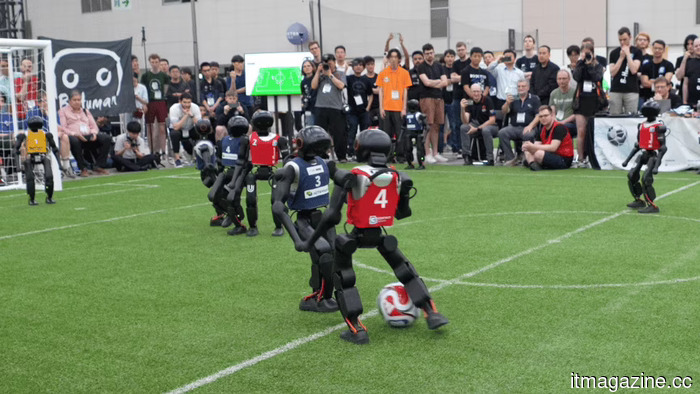 Robots dominated RoboCup 2026, and they have their sights set on the human World Cup.
Beijing's Booster Robotics fueled all the victorious teams at RoboCup 2026 in South Korea. The objective of the sport is to surpass the human World Cup champions by the year 2050.
Robots dominated RoboCup 2026, and they have their sights set on the human World Cup.
Beijing's Booster Robotics fueled all the victorious teams at RoboCup 2026 in South Korea. The objective of the sport is to surpass the human World Cup champions by the year 2050.
 Microdramas are on the rise, and Character.AI is transforming it into a mutual fascination.
Character.AI is pursuing the rapidly growing microdrama market with three AI-supported vertical series, where the characters are accessible for dialogue, inquiries, and new role-playing opportunities following each episode.
Microdramas are on the rise, and Character.AI is transforming it into a mutual fascination.
Character.AI is pursuing the rapidly growing microdrama market with three AI-supported vertical series, where the characters are accessible for dialogue, inquiries, and new role-playing opportunities following each episode.
 The speculations regarding a $300 price increase for the iPhone 18 Pro series appear to be becoming more plausible.
A third supply chain analysis corroborates what the WSJ and IDC have previously indicated: the iPhone 18 Pro Max is experiencing a notable rise in its bill of materials (BOM).
The speculations regarding a $300 price increase for the iPhone 18 Pro series appear to be becoming more plausible.
A third supply chain analysis corroborates what the WSJ and IDC have previously indicated: the iPhone 18 Pro Max is experiencing a notable rise in its bill of materials (BOM).
 Meta’s newest AI model, Muse Spark 1.1, has the capability to operate your computer on your behalf.
Meta is intensifying its focus on AI agents with Muse Spark 1.1, a model that goes beyond just answering questions — it can utilize apps, surf the web, and even control your computer to perform tasks for you.
Meta’s newest AI model, Muse Spark 1.1, has the capability to operate your computer on your behalf.
Meta is intensifying its focus on AI agents with Muse Spark 1.1, a model that goes beyond just answering questions — it can utilize apps, surf the web, and even control your computer to perform tasks for you.
 Meta's newest AI model, Muse Spark 1.1, is capable of operating your computer autonomously.
Meta is reinforcing its commitment to AI agents with Muse Spark 1.1, a model that goes beyond answering questions — it can utilize applications, navigate the internet, and even control your computer to perform tasks for you.
Meta's newest AI model, Muse Spark 1.1, is capable of operating your computer autonomously.
Meta is reinforcing its commitment to AI agents with Muse Spark 1.1, a model that goes beyond answering questions — it can utilize applications, navigate the internet, and even control your computer to perform tasks for you.
 A startup created kidney and liver tissue using 3D printing technology in space.
Auxilium claims to have bioprinted kidney and liver tissue aboard the ISS, marking a first in this field. The immediate benefit is in drug-testing organoids rather than creating transplantable organs.
A startup created kidney and liver tissue using 3D printing technology in space.
Auxilium claims to have bioprinted kidney and liver tissue aboard the ISS, marking a first in this field. The immediate benefit is in drug-testing organoids rather than creating transplantable organs.
AMD's CTO explains the necessity for additional CPUs for agentic AI.
At RAISE, AMD's Mark Papermaster stated that agentic AI places greater emphasis on CPUs rather than solely on GPUs, which he believes supports AMD's pursuit of a trillion-dollar valuation.