

NATO's AI 'Kill Web' along its eastern border
NATO is establishing an extensive AI network along its eastern border, intended to detect an attack promptly and respond swiftly. This initiative is known as the Eastern Flank Deterrence Initiative, and internal documents specifically identify Russia as a primary adversary. German tabloid BILD accessed these documents and shared them via the Axel Springer network, as reported by Business Insider.
The documents repeatedly highlight one term: a “Kill Web.” This refers to a highly interconnected digital network that integrates satellites, reconnaissance drones, radar, ground sensors, and cameras. If one component fails, another takes over.
This network monitors the entire border simultaneously, stretching from Finland to Romania.
The objective is to reduce the interval between detecting a target and attacking it. Previously, a drone would identify a target and report it to headquarters, where analysts would verify it and relay a firing order, which took valuable time that NATO aims to eliminate.
Under the new system, data from all member nations combines into a single, cohesive image. Palantir’s Maven Smart System serves as the AI central hub, organizing sensor inputs to enable quicker decision-making by commanders. Other contractors, such as RTX, Rheinmetall, Saab, Lockheed Martin, and Boeing, contribute to this system.
NATO encapsulates the process in six words: “See first. Decide first. Strike first.”
In practical terms, if a drone identifies a Russian armored column, the system concurrently cross-references this information with satellite images, radar, and ground sensors. A commander then selects the appropriate weapon—whether a drone, artillery, or rocket launcher—based on distance and the target's significance.
The front line is also evolving. NATO intends for uncrewed systems to confront an aggressor before personnel are engaged. A perimeter consisting of drones, ground robots, and sensors would absorb the initial attack. The rationale is straightforward: machines, not soldiers, take the initial hit.
Tanks and aircraft remain essential. Leopard 2s, Abrams, HIMARS, and F-35s will continue to be the foundation of NATO forces. “EFDI does not replace tanks, artillery, fighter aircraft, or soldiers,” stated Maj. Matt Blubaugh, a spokesperson for US Army Europe and Africa. “It is designed to help conserve their combat power and provide commanders with more time and decision-making advantage.”
This concept is derived directly from the conflict in Ukraine. The use of inexpensive drones, robots, and sensors in large numbers aims to counterbalance Russia’s advantages in quantity and speed. It reflects the kill chains both sides have developed on that battlefield, now extended throughout the alliance.
This approach aligns with a broader European initiative. NATO has been investing in defense startups and integrating autonomous ground systems into its strategies, even as the control of the underlying AI remains an ongoing debate.
The significance of this strategy lies in NATO's approach of “deterrence by denial.” The goal is not only to repel Russian aggression but also to render any potential attack seem futile before it begins. This signifies a fundamental transition from defending territory with troops to initially contesting it through software and machines. The challenge lies in establishing trust: an alliance that entrusts critical decisions to AI must have confidence that these systems correctly interpret the battlefield conditions.
Other articles
 Official renders of the Galaxy Z Flip 8 showcase Samsung's well-known foldable device in three new colors.
Official-looking renders of the Galaxy Z Flip 8 have surfaced, showcasing three color options and a design that feels very recognizable. However, Samsung might be counting on the fact that this is precisely what consumers are seeking.
Official renders of the Galaxy Z Flip 8 showcase Samsung's well-known foldable device in three new colors.
Official-looking renders of the Galaxy Z Flip 8 have surfaced, showcasing three color options and a design that feels very recognizable. However, Samsung might be counting on the fact that this is precisely what consumers are seeking.
 The Chinese electric vehicle brand Chery will replace the entire vehicle if any fire damage occurs due to battery issues.
Chery's warranty that promises a free car if it catches fire may seem extreme at first glance, but once you examine the engineering behind it, it becomes more understandable. Additionally, when you look at the sales figures, it makes even more sense.
The Chinese electric vehicle brand Chery will replace the entire vehicle if any fire damage occurs due to battery issues.
Chery's warranty that promises a free car if it catches fire may seem extreme at first glance, but once you examine the engineering behind it, it becomes more understandable. Additionally, when you look at the sales figures, it makes even more sense.
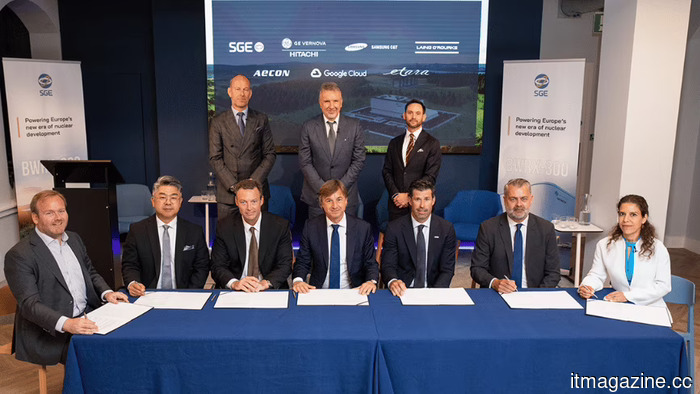 A £35 billion initiative to construct 14 small nuclear reactors in the UK.
Michał Sołowow's SGE intends to develop 14 GE Vernova Hitachi BWRX-300 small modular reactors at three locations in the UK, making a £35 billion investment in power for the AI era by 2034.
A £35 billion initiative to construct 14 small nuclear reactors in the UK.
Michał Sołowow's SGE intends to develop 14 GE Vernova Hitachi BWRX-300 small modular reactors at three locations in the UK, making a £35 billion investment in power for the AI era by 2034.
 Nvidia collaborates with chip competitor d-Matrix on inference technology.
Nvidia is integrating its GPUs with d-Matrix's inference chips in a collaborative system, marking a recent shift towards partnering with competitors in the chip industry rather than competing against them.
Nvidia collaborates with chip competitor d-Matrix on inference technology.
Nvidia is integrating its GPUs with d-Matrix's inference chips in a collaborative system, marking a recent shift towards partnering with competitors in the chip industry rather than competing against them.
 Still hoping for a more affordable Vision Pro? A new report reveals some disappointing news.
Apple's more affordable Vision Pro seems less likely to materialize as Samsung Display has reportedly chosen to halt the development of the budget-friendly screen technology intended for the headset.
Still hoping for a more affordable Vision Pro? A new report reveals some disappointing news.
Apple's more affordable Vision Pro seems less likely to materialize as Samsung Display has reportedly chosen to halt the development of the budget-friendly screen technology intended for the headset.
 AI funding update: five significant financing rounds to note today
A $300 million fundraising round, a billion-dollar valuation for an AI agent, and Europe's investments in voice technology and energy: highlights from the last 24 hours in AI and deep-tech financing.
AI funding update: five significant financing rounds to note today
A $300 million fundraising round, a billion-dollar valuation for an AI agent, and Europe's investments in voice technology and energy: highlights from the last 24 hours in AI and deep-tech financing.
NATO's AI 'Kill Web' along its eastern border
NATO is developing an AI 'Kill Web' comprising sensors, drones, and satellites along its eastern border to identify and counter a Russian assault before it occurs.