

NATO engages Accenture and Leonardo for a secure cloud project valued at €200 million.
NATO is seeking a reliable cloud solution under pressure. Its technological agency has signed a contract valued at approximately €200 million with Accenture and Italy's Leonardo to create one. Accenture announced the agreement on Tuesday, made during the NATO summit in Ankara.
The program is referred to by NATO as the Protected Business Network. It aims to provide the Alliance with a unified, classified cloud environment where commanders and staff can share information and collaborate across all domains. The focus is on resilience: a system designed to remain operational amid attempts by attackers to disrupt it.
Details of the agreement
Accenture and Leonardo will be responsible for designing, building, and managing the core platform over a period of seven years, utilizing a multi-cloud infrastructure provided by NATO’s agency. The platform will accommodate around 29,000 users throughout the Alliance. The North Atlantic Council has sanctioned it as an Alliance-wide capability.
The initiative replaces NATO’s fragmented legacy systems with a unified cloud model and standardized engineering approaches. This will facilitate the faster deployment of new digital services. Leonardo contributes a Zero Trust security framework along with its own AI-enabled multi-agent platform for cybersecurity.
A European foundation
The selection of partners is just as significant as the technology itself. The contract has been awarded to Accenture’s EMEA division and Leonardo, an Italian defense company, rather than a U.S. contractor. This aligns with a broader European initiative to develop its own defense software and secure military cloud, reducing reliance on American suppliers.
This development comes at a crucial time. Concerns about U.S. control over cutting-edge AI have loomed over the Ankara summit, coupled with pressure on allies to eliminate untrusted equipment and reconstruct their networks. Establishing a domestic cloud infrastructure appears to be part of the response to these challenges.
Importance of the initiative
Defense increasingly resembles a software-centric issue. Aspects such as speed, secure data, and interoperability are becoming just as important for readiness as physical hardware. NATO is counting on a modern cloud to facilitate quicker responses and withstand attacks, with European oversight. Funding is also shifting in this direction, with new investments flowing into European defense technology. The construction begins now, with the real challenge lying ahead when faced with attempts to compromise it.
Other articles
 Perplexity is discreetly developing an AI coding tool.
Perplexity has developed an internal coding tool referred to as "Teammate," which may compete with Cursor and Claude Code, according to a report from Business Insider. There is no confirmation regarding a launch.
Perplexity is discreetly developing an AI coding tool.
Perplexity has developed an internal coding tool referred to as "Teammate," which may compete with Cursor and Claude Code, according to a report from Business Insider. There is no confirmation regarding a launch.
 NATO selects Accenture and Leonardo for a €200M secure cloud project.
NATO has finalized a seven-year contract worth approximately €200 million with Accenture and Leonardo to establish a secure cloud infrastructure, known as the Protected Business Network, for the Alliance.
NATO selects Accenture and Leonardo for a €200M secure cloud project.
NATO has finalized a seven-year contract worth approximately €200 million with Accenture and Leonardo to establish a secure cloud infrastructure, known as the Protected Business Network, for the Alliance.
 Gartner's research indicates that customers favor ChatGPT over company chatbots.
According to Gartner, customers are three times more inclined to utilize third-party GenAI services like ChatGPT for support compared to company chatbots, as the returns on AI investments are falling short of expectations.
Gartner's research indicates that customers favor ChatGPT over company chatbots.
According to Gartner, customers are three times more inclined to utilize third-party GenAI services like ChatGPT for support compared to company chatbots, as the returns on AI investments are falling short of expectations.
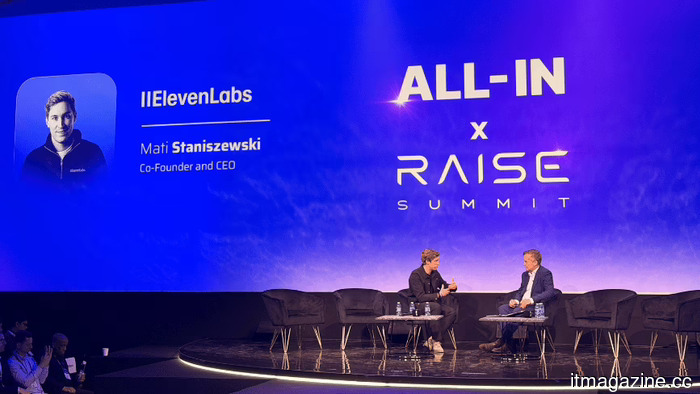 CEO of ElevenLabs discusses $600 million in revenue and the AI laboratories.
During the RAISE Summit in Paris, ElevenLabs CEO Mati Staniszewski spoke about achieving a reported $600 million in revenue and outlined the startup's strategies to surpass the AI labs.
CEO of ElevenLabs discusses $600 million in revenue and the AI laboratories.
During the RAISE Summit in Paris, ElevenLabs CEO Mati Staniszewski spoke about achieving a reported $600 million in revenue and outlined the startup's strategies to surpass the AI labs.
 The GhostApproval bug disrupts six leading AI coding agents.
Wiz's 'GhostApproval' employs an outdated symlink technique to enable six AI coding agents, ranging from Amazon Q to Cursor, to operate beyond the sandbox and transfer ownership of the box.
The GhostApproval bug disrupts six leading AI coding agents.
Wiz's 'GhostApproval' employs an outdated symlink technique to enable six AI coding agents, ranging from Amazon Q to Cursor, to operate beyond the sandbox and transfer ownership of the box.
 Cloudflare and OpenAI are collaborating on a pilot project to enhance the freshness of AI search results.
Cloudflare is collaborating with OpenAI to integrate real-time network signals into ChatGPT's search, marking a shift for a company that was founded on preventing AI crawlers.
Cloudflare and OpenAI are collaborating on a pilot project to enhance the freshness of AI search results.
Cloudflare is collaborating with OpenAI to integrate real-time network signals into ChatGPT's search, marking a shift for a company that was founded on preventing AI crawlers.
NATO engages Accenture and Leonardo for a secure cloud project valued at €200 million.
NATO has finalized a seven-year agreement worth approximately €200 million with Accenture and Leonardo to create a secure cloud infrastructure, known as the Protected Business Network, for the Alliance.