
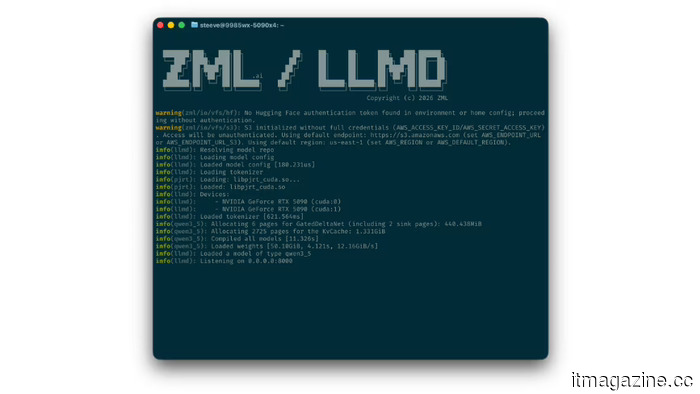
ZML's complimentary AI server operates on all major chipsets.
A startup based in Paris aims to challenge Nvidia’s dominance in AI, not with new hardware but through software. ZML has introduced a free tool that efficiently runs open-source models across various hardware platforms, including Nvidia, AMD, Google, Apple, and Intel.
While Nvidia continues to lead in AI hardware, competition is increasing. ZML, supported by AI pioneer Yann LeCun, has developed free software capable of running open-source language models on a variety of processors, according to a report from TechCrunch. The targeted hardware includes Nvidia, AMD, Google’s TPUs, Intel, and Apple.
The tool, named ZML/LLMD, functions as an inference server. Inference involves executing a trained model to generate responses, which now constitutes the majority of AI’s computing demands. Founder Steeve Morin aims to dismantle the barriers that tie users to a single vendor, ensuring that each chip can operate at maximum efficiency.
The importance of using diverse chips lies in cost considerations. As AI expenditures rise, businesses and cloud providers seek the flexibility to choose more affordable or energy-efficient chips for specific tasks. “The idea is to empower people to create their own systems,” Morin explained. Successfully accomplishing this could serve as a disruptive force against Nvidia’s dominance.
This approach may also provide opportunities for emerging chip manufacturers, particularly those in Europe. Morin mentioned companies like Axelera, Fractile, Kalray, SiPearl, and VSORA, claiming that software recognizing their chips as primary options rather than secondary ones incentivizes consumers to explore these alternatives.
The competitive landscape remains intense and financially demanding. Morin acknowledges Nvidia's significance and asserts that ZML maintains a positive relationship with the industry leader. However, the environment is bustling, characterized by the “inference gold rush” which has seen competitors such as Baseten, recently valued at $13 billion, and teams working on open-source projects like vLLM and SGLang, all vying for the same goal: reducing AI operational costs.
Morin believes ZML has broader ambitions. “We have reached the point where we are co-designing silicon,” he stated. His small but efficient team of 20 has released products swiftly, with more scheduled to follow.
Currently, LLMD is available for free in order to increase its user base and is not yet a paid offering. The tool’s unique origin sends a significant message: a development designed to mitigate Nvidia’s stronghold and support Europe’s AI infrastructure has emerged from Paris rather than Silicon Valley. Morin, who secured $20 million in funding from investors like Xavier Niel’s Kima Ventures, expressed it clearly: “I couldn’t do ZML anywhere but in Paris.”
Other articles
 NATO selects Accenture and Leonardo for a €200 million secure cloud project.
NATO has finalized a seven-year contract worth approximately €200 million with Accenture and Leonardo to create a secure cloud infrastructure known as the Protected Business Network for the Alliance.
NATO selects Accenture and Leonardo for a €200 million secure cloud project.
NATO has finalized a seven-year contract worth approximately €200 million with Accenture and Leonardo to create a secure cloud infrastructure known as the Protected Business Network for the Alliance.
 Cloudflare and OpenAI are collaborating on a pilot project to enhance the freshness of AI search results.
Cloudflare is collaborating with OpenAI to integrate real-time network signals into ChatGPT's search, marking a shift for a company that was established to prevent AI crawlers.
Cloudflare and OpenAI are collaborating on a pilot project to enhance the freshness of AI search results.
Cloudflare is collaborating with OpenAI to integrate real-time network signals into ChatGPT's search, marking a shift for a company that was established to prevent AI crawlers.
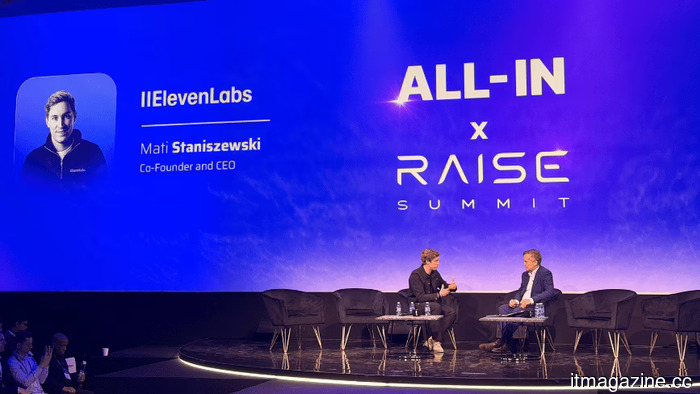 CEO of ElevenLabs discusses $600 million in revenue and the AI laboratories.
At the RAISE Summit in Paris, Mati Staniszewski, the CEO of ElevenLabs, elaborated on the company's journey towards achieving a reported $600 million in revenue and discussed the startup's strategy for surpassing the AI laboratories.
OpenAI's GPT-Live: A ChatGPT voice that both listens and speaks.
OpenAI has introduced GPT-Live, a voice feature for ChatGPT that allows for simultaneous listening and speaking, complete with live translation. This feature is being made available to all users, including those using the free version.
CEO of ElevenLabs discusses $600 million in revenue and the AI laboratories.
At the RAISE Summit in Paris, Mati Staniszewski, the CEO of ElevenLabs, elaborated on the company's journey towards achieving a reported $600 million in revenue and discussed the startup's strategy for surpassing the AI laboratories.
OpenAI's GPT-Live: A ChatGPT voice that both listens and speaks.
OpenAI has introduced GPT-Live, a voice feature for ChatGPT that allows for simultaneous listening and speaking, complete with live translation. This feature is being made available to all users, including those using the free version.
 Gartner's research indicates that customers favor ChatGPT over company chatbots.
According to Gartner, customers are three times more inclined to utilize third-party GenAI services like ChatGPT for support compared to company chatbots, as the returns on AI investments are falling short of expectations.
Gartner's research indicates that customers favor ChatGPT over company chatbots.
According to Gartner, customers are three times more inclined to utilize third-party GenAI services like ChatGPT for support compared to company chatbots, as the returns on AI investments are falling short of expectations.
 NATO engages Accenture and Leonardo for a secure cloud project valued at €200 million.
NATO has finalized a seven-year agreement worth approximately €200 million with Accenture and Leonardo to create a secure cloud infrastructure, known as the Protected Business Network, for the Alliance.
NATO engages Accenture and Leonardo for a secure cloud project valued at €200 million.
NATO has finalized a seven-year agreement worth approximately €200 million with Accenture and Leonardo to create a secure cloud infrastructure, known as the Protected Business Network, for the Alliance.
ZML's complimentary AI server operates on all major chipsets.
France's ZML has launched ZML/LLMD, a free inference server that operates open-source AI at high speed on Nvidia, AMD, Google, Intel, and Apple processors.