

Axos acquires the AI fintech company Arc Technologies.
Axos is set to acquire Arc Technologies, a fintech company focused on AI that serves tech startups, integrating its software into a chartered bank. Axos Financial, a US digital bank with approximately $29 billion in assets, announced the agreement to buy Arc Technologies. Arc operates a financial platform for technology and growth businesses, offering a combination of cash management, debt financing, and AI-driven software all in one solution. The details regarding the deal's price were not disclosed by either party.
What Axos gains
Founded in 2021, Arc aims to provide startups with a more efficient alternative to traditional business banking. Currently, it manages treasury and capital markets, along with a concept it terms agentic finance, which includes software that automates financial tasks, provides insights, and facilitates money transfers. Supported by investors such as Y Combinator, NFX, and Bain Capital Ventures, Arc has established a solid presence.
Axos seeks two main benefits from this acquisition: Arc’s software and its connections within the startup ecosystem, as well as its AI capabilities, including an innovative CFO agent named Archie that was launched last year.
Fintech meets the balance sheet
The rationale is mutually beneficial. Although Arc developed advanced software, it lacked a banking license and relied on partners like Stripe for money transfers. Axos, on the other hand, brings the necessary charter, deposit capabilities, and a history of 25 years as a branchless bank. Each entity fills the gaps that the other has.
Axos has a specific target: the millions of US small businesses that it claims are underserved by larger banks. With Arc's clientele and software, Axos finds a faster pathway to reach them.
This illustrates the recent trend of partnerships within the financial sector. Modern fintech companies attract users with their design and efficiency, but they often hit obstacles when they need a balance sheet, a banking license, or inexpensive deposits. Merging with a bank eliminates these hurdles.
Why it matters
This acquisition comes at a time when established financial institutions are eager to incorporate AI into their services, rather than developing it internally at a slow pace. Some opt to purchase AI startups outright, while others watch as fintechs take the lead, from banking designed for AI agents to the broader transition towards agentic AI in corporate finance. Financial flows are also evolving, with increased focus on embedded lending and vendor financing integrated within the tools companies already utilize.
Currently, there will be no immediate changes for Arc’s customers. The expectation is that a fintech backed by a legitimate bank can innovate more effectively than either could on its own. Whether this collaboration can outperform a nimble startup or a large bank operating independently remains uncertain. The deal is expected to close this month, pending the usual conditions.
Other articles
 Quaise secures $134 million to explore ultra-high-temperature geothermal drilling.
The geothermal startup Quaise Energy has secured a $134 million first close of its Series B funding round, with Prelude Ventures at the helm, to drill superhot rock using millimetre-wave beams.
Quaise secures $134 million to explore ultra-high-temperature geothermal drilling.
The geothermal startup Quaise Energy has secured a $134 million first close of its Series B funding round, with Prelude Ventures at the helm, to drill superhot rock using millimetre-wave beams.
 According to data from Estonia's Odience, niche creator communities are outperforming those with a broader audience.
Performance statistics from Odience, based in Estonia, indicate that nano and micro creators with closely connected niche audiences consistently surpass mass-reach influencer campaigns in terms of clicks, leads, and conversion rates.
According to data from Estonia's Odience, niche creator communities are outperforming those with a broader audience.
Performance statistics from Odience, based in Estonia, indicate that nano and micro creators with closely connected niche audiences consistently surpass mass-reach influencer campaigns in terms of clicks, leads, and conversion rates.
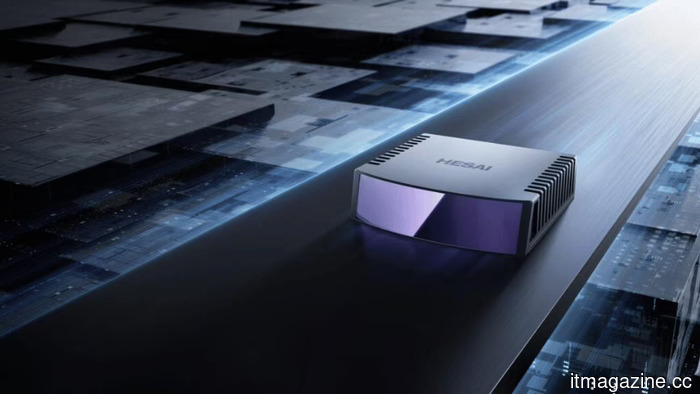 Chinese lidar manufacturer Hesai, which is on the blacklist, is fueling self-driving initiatives in the US.
The Pentagon imposed sanctions on Hesai, identifying it as a Chinese military firm. Despite this, its lidar technology continues to enable US robotaxis, trucks, and an Nvidia autonomous driving platform.
Chinese lidar manufacturer Hesai, which is on the blacklist, is fueling self-driving initiatives in the US.
The Pentagon imposed sanctions on Hesai, identifying it as a Chinese military firm. Despite this, its lidar technology continues to enable US robotaxis, trucks, and an Nvidia autonomous driving platform.
 Norm Ai secures $120 million at a valuation of $1.2 billion.
AI legal startup Norm Ai has successfully secured $120 million in a Series C funding round at a $1.2 billion valuation, with Khosla Ventures leading the investment. The company also operates its own AI-driven law firm, Norm Law.
Norm Ai secures $120 million at a valuation of $1.2 billion.
AI legal startup Norm Ai has successfully secured $120 million in a Series C funding round at a $1.2 billion valuation, with Khosla Ventures leading the investment. The company also operates its own AI-driven law firm, Norm Law.
 Data from Estonia's Odience reveals that niche creator communities are surpassing mass reach in sales.
Data from Odience, based in Estonia, indicates that nano and micro creators with closely connected niche audiences consistently exceed mass-reach influencer campaigns in terms of clicks, leads, and conversion rates.
Data from Estonia's Odience reveals that niche creator communities are surpassing mass reach in sales.
Data from Odience, based in Estonia, indicates that nano and micro creators with closely connected niche audiences consistently exceed mass-reach influencer campaigns in terms of clicks, leads, and conversion rates.
 Romania spearheads its inaugural private ESA mission with the launch of CyberCUBE.
CyberCUBE, an orbital cybersecurity test facility operated by GMV Romania, has been launched aboard a Falcon 9. This marks the first ESA mission directed by a Romanian firm.
Romania spearheads its inaugural private ESA mission with the launch of CyberCUBE.
CyberCUBE, an orbital cybersecurity test facility operated by GMV Romania, has been launched aboard a Falcon 9. This marks the first ESA mission directed by a Romanian firm.
Axos acquires the AI fintech company Arc Technologies.
Axos Financial has reached an agreement to purchase Arc Technologies, an AI-driven fintech that serves technology startups, in order to combine contemporary software with an actual banking charter.