
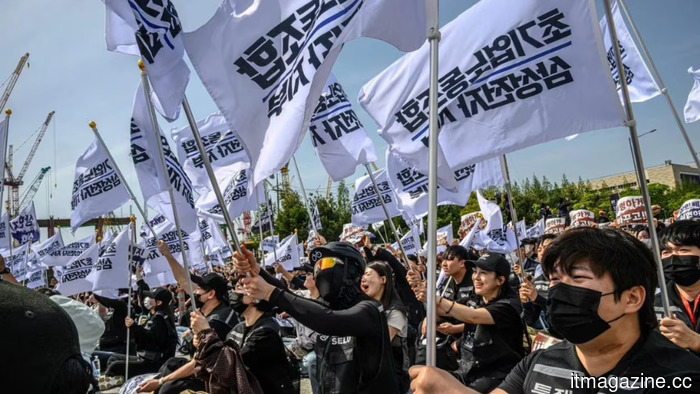
Workers at Samsung's appliance division are organizing a rally to protest the bonuses awarded to chip division employees.
The workers responsible for assembling Samsung’s phones, televisions, and washing machines are set to publicly express their discontent. Their union has announced that several thousand members will converge near the company's Suwon headquarters on July 16 to protest the bonuses awarded to their counterparts in the semiconductor division, an issue that has been brewing since the semiconductor pay agreement was signed in May. Expectations suggest that between 2,000 and 3,000 individuals will participate.
The logic behind their frustration is straightforward. Employees in Samsung’s Device eXperience division, which produces the tangible products that consumers use, are slated to receive a bonus of approximately 6 million won (around $3,900) in treasury shares for 2026. In contrast, workers in the semiconductor division may receive bonuses up to 600 million won, creating a disparity of about one hundred to one between two segments of the same company, a situation difficult to justify.
The chip workers achieved their substantial bonuses through a distinct union and separate negotiations, resulting in a significant breakthrough in Korean labor relations. Samsung has formally committed to allocate a fixed portion of semiconductor operating profits—approximately 10.5 percent—for special bonuses, marking only the second instance where a major Korean firm has included a profit-sharing commitment in a legally binding contract. While this was a milestone for those who negotiated it, it felt like a disregard for the workers in the other division.
It's easy to understand why the semiconductor workers received such large bonuses; that sector has been driving the majority of Samsung's profits, primarily due to the high-bandwidth memory chips essential for AI data centers, and the union firmly leveraged its position. Previously, chip workers were offered an average bonus of around $340,000 while threatening an 18-day strike during a critical memory shortage, showcasing their bargaining power.
In contrast, appliance and consumer electronics workers lack similar leverage, which the rally aims to highlight. Although their division is profitable, it represents a stable business model that doesn’t exert significant pressure on the company. The Donghaeng union, representing non-chip workers, has already taken legal action, seeking to prevent a company-wide vote on the bonus structure in court in Suwon. However, that attempt did not prevent the deal, and now the demonstration is their next step.
The protesters are seeking a revised distribution, one that recognizes the AI profits as something earned collectively by the entire company rather than a reward designated solely for one division. Samsung's standpoint has been that the chip bonuses are a reflection of the chip division’s contributions—a rationale that may hold up on financial documents but is harder to convey on the production floor.
The controversy has caught the attention of broader audiences, with policymakers highlighting the magnitude of chip bonuses as a potential inflation risk in a nation where Samsung’s workforce is a significant economic factor. The rally is unlikely to modify the 2026 bonus payout, which is largely determined. Instead, its goal is to set the stage for future discussions and underscore to Samsung that a two-tiered workforce raises management concerns as well as budgetary ones.
The company has asserted that its special compensation plan for chip staff surpasses industry standards, though this assertion appears quite different depending on the particular division's perspective. Achieving record profits was supposedly the easy part. Whether this demonstration remains symbolic or escalates into something more disruptive hinges on Samsung's subsequent response. For now, several thousand employees who create the company’s most visible products are preparing to gather outside its headquarters to remind everyone that they too contributed to the prosperous year.
Other articles
 Samsung is set to experience an 18-fold increase in profits due to strong demand for AI memory.
Analysts anticipate that Samsung will announce an operating profit of approximately 86 trillion won for Q2, which is about 18 times higher than the previous year, driven by the rise in AI memory prices.
Samsung is set to experience an 18-fold increase in profits due to strong demand for AI memory.
Analysts anticipate that Samsung will announce an operating profit of approximately 86 trillion won for Q2, which is about 18 times higher than the previous year, driven by the rise in AI memory prices.
 Nvidia's Kyber AI rack has been postponed to 2028.
According to SemiAnalysis, Nvidia's Kyber rack for its 2027 Rubin Ultra chips has been delayed to 2028 due to difficulties in manufacturing the circuit board, creating an opportunity for competitors.
Nvidia's Kyber AI rack has been postponed to 2028.
According to SemiAnalysis, Nvidia's Kyber rack for its 2027 Rubin Ultra chips has been delayed to 2028 due to difficulties in manufacturing the circuit board, creating an opportunity for competitors.
 Novartis acquires UK biotech Myricx for as much as $1.5 billion to pursue a new class of cancer drugs.
Novartis will provide an initial payment of $1.1 billion and potential milestone payments of up to $400 million for Myricx Bio, a UK-based company working on an innovative payload for antibody-drug conjugates.
Novartis acquires UK biotech Myricx for as much as $1.5 billion to pursue a new class of cancer drugs.
Novartis will provide an initial payment of $1.1 billion and potential milestone payments of up to $400 million for Myricx Bio, a UK-based company working on an innovative payload for antibody-drug conjugates.
 Garvee Makes High-Quality Home Cooling More Budget-Friendly This Summer
Smart air conditioners no longer need to carry high price tags. Garvee's newest collection offers connected features, energy-efficient performance, and versatile installation choices in window, mini split, and portable models, simplifying the process of finding the perfect cooling solution for any space.
Garvee Makes High-Quality Home Cooling More Budget-Friendly This Summer
Smart air conditioners no longer need to carry high price tags. Garvee's newest collection offers connected features, energy-efficient performance, and versatile installation choices in window, mini split, and portable models, simplifying the process of finding the perfect cooling solution for any space.
 Novartis acquires the UK biotech Myricx for as much as $1.5 billion in pursuit of a new class of cancer treatments.
Novartis will provide $1.1 billion upfront and up to $400 million based on milestones for Myricx Bio, a UK company working on a new payload for antibody-drug conjugates.
Novartis acquires the UK biotech Myricx for as much as $1.5 billion in pursuit of a new class of cancer treatments.
Novartis will provide $1.1 billion upfront and up to $400 million based on milestones for Myricx Bio, a UK company working on a new payload for antibody-drug conjugates.
 Is the ‘SaaSpocalypse’ just a myth? The actual expenses of AI-generated software.
AI has greatly simplified and reduced the cost of developing software in-house, leading many executives to re-evaluate SaaS subscriptions primarily from a cost-reduction perspective.
Is the ‘SaaSpocalypse’ just a myth? The actual expenses of AI-generated software.
AI has greatly simplified and reduced the cost of developing software in-house, leading many executives to re-evaluate SaaS subscriptions primarily from a cost-reduction perspective.
Workers at Samsung's appliance division are organizing a rally to protest the bonuses awarded to chip division employees.
Samsung employees in the phone, TV, and appliance divisions will gather in Suwon to protest a bonus agreement that awards chip workers up to 600 million won, while they receive only 6 million won.