

A new survey indicates that a majority of Americans prefer children to be off social media until they are 16 years old.
Digital Trends may receive a commission when you make purchases through links on our site. Why should you trust us?
According to a recent survey by the Pew Research Center, there is significant support for prohibiting social media use for individuals under the age of 16, with even greater endorsement for rules regarding age verification and parental consent.
A majority of adults in the United States now support a ban on social media for anyone under 16, as revealed by a recent Pew Research Center survey. This finding aligns American public opinion with countries that have already implemented similar measures, such as Australia, which has enacted a ban, and the UK, which is contemplating one.
Support spans across political parties and age demographics
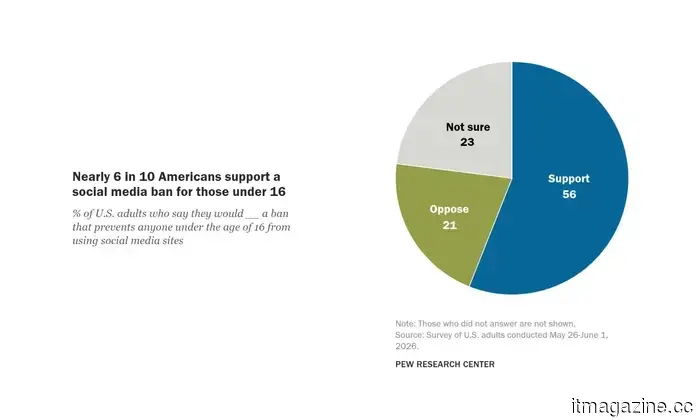
Pew conducted a survey with 9,750 US adults from May 26 to June 1, 2026, discovering that 56 percent of participants backed a ban on social media usage for those under 16. In contrast, only 21 percent were opposed, while 23 percent expressed uncertainty.
According to the Pew Research Center, both Republicans and Democrats showed comparable support for the ban, and approval remained above 50 percent across all age groups. Those aged 30 to 49 were the most likely to support such a ban, alongside parents of children under 18. Even adults without children in that age group showed favorable opinions, though their support was less pronounced.
Less drastic measures received higher approval than an outright ban
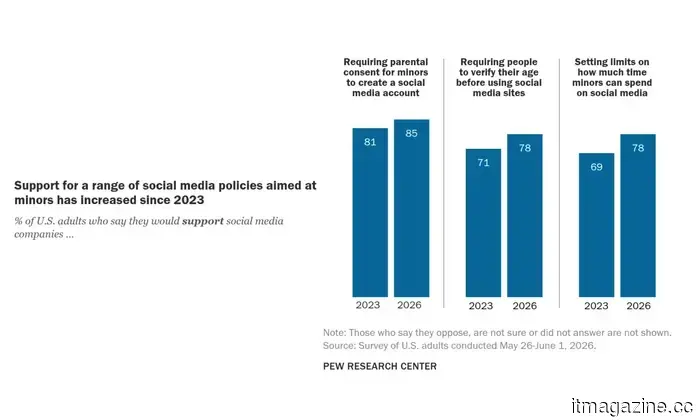
The survey indicated that there was more support for restrictions than for a total ban. Approximately 85 percent of adults favored requiring parental consent before a minor could create a social media account, an increase from 81 percent in 2023 when Pew last posed the question.
The Pew Research Center also found that support for age verification and daily time limits for minors both stood in the high 70s, with the approval for age verification increasing from 71 percent to 78 percent during that timeframe. However, support levels varied by age group; adults under 30 favored age verification at a lower rate than their older counterparts, approximately two-thirds compared to around 80 percent among individuals 30 and older.
Whether a ban would sufficiently reduce social media usage among children under 16 is still uncertain. Australia's prohibition on under-16s has encountered enforcement challenges since its implementation, with tests indicating that many teenagers continue to circumvent the restrictions. In the US, there is currently no federal ban in place, though several states, including California, have introduced similar proposals. With public opinion so strongly leaning in favor, it seems likely that US lawmakers will eventually address this issue.
Pranob is an experienced tech journalist with over eight years of experience covering consumer technology. His work has been…
Google Maps could soon facilitate food orders for users through Gemini
Your next food order might soon be initiated within Google Maps.
Google Maps has progressively transformed from a navigation application into an AI-enhanced discovery tool, thanks to its Gemini integration and features like Ask Maps. The app may soon take another step by allowing users to place food orders directly via conversational AI.
According to Android Authority's Authority Insights, the latest beta version of Google Maps for Android includes references to an upcoming feature that would enable users to instruct Maps to order food on their behalf. While this functionality is not yet active, newly found code indicates that Google is actively working on the feature.
Meta faces criticism after Instagram approved ads promoting child abuse in India
Instagram's advertising review system failed to block promotions of child sexual abuse materials.
Warning: This article discusses real instances of abuse. A BBC investigation has uncovered that Instagram approved and displayed paid advertisements featuring child sexual abuse material (CSAM) to users in India, raising serious concerns about the efficacy of Meta's content moderation systems and the ongoing challenge of regulating illegal content on social media.
WhatsApp pauses username feature for millions of users over fraud concerns
WhatsApp's phone-number privacy initiative faces scrutiny in India.
WhatsApp's initiative to allow users to utilize usernames instead of phone numbers is encountering difficulties in India, its largest market. This newly introduced feature aims to enhance privacy by allowing users to connect without immediately revealing their phone number. However, Indian authorities are concerned that this same feature could complicate the management of scams and impersonation.
India's Ministry of Electronics and Information Technology (MeitY) has requested WhatsApp to halt the username rollout until consultations with the government have concluded. This represents a significant intervention, as WhatsApp has over 500 million users in the country, who depend on the app for daily personal and professional communication.





Other articles
 OxygenOS contributed to what made OnePlus phones unique. Now, it could potentially disappear for good.
OxygenOS and Realme UI are said to be phased out, with ColorOS set to take their place worldwide, while OnePlus is also concentrating its efforts more on India and China.
OxygenOS contributed to what made OnePlus phones unique. Now, it could potentially disappear for good.
OxygenOS and Realme UI are said to be phased out, with ColorOS set to take their place worldwide, while OnePlus is also concentrating its efforts more on India and China.
 Palantir's CEO invested $200 million in properties that are untraceable.
Alex Karp purchased a $120 million monastery, a $75 million compound in Miami, and a 500-acre estate in New Hampshire. His company provides surveillance technology to government agencies.
Palantir's CEO invested $200 million in properties that are untraceable.
Alex Karp purchased a $120 million monastery, a $75 million compound in Miami, and a 500-acre estate in New Hampshire. His company provides surveillance technology to government agencies.
 AI chip stocks fell by 12% over two days as investors searched for new profitable opportunities.
The PHLX Semiconductor Index dropped 12% over two trading days, while the Dow reached an all-time high. As Q2 earnings come closer, investors are shifting their focus from AI chips to software.
AI chip stocks fell by 12% over two days as investors searched for new profitable opportunities.
The PHLX Semiconductor Index dropped 12% over two trading days, while the Dow reached an all-time high. As Q2 earnings come closer, investors are shifting their focus from AI chips to software.
 Alibaba prohibits Claude Code due to concealed tracking of Chinese users.
Alibaba categorized Anthropic's Claude Code as high-risk software after researchers discovered steganographic markers that identified Chinese users based on their timezone and proxy.
Alibaba prohibits Claude Code due to concealed tracking of Chinese users.
Alibaba categorized Anthropic's Claude Code as high-risk software after researchers discovered steganographic markers that identified Chinese users based on their timezone and proxy.
 Dream, the creator of Pegasus, aims at the emerging right-wing movements in Latin America.
Dream, established by Shalev Hulio, the creator of Pegasus, focuses on Latin American governments that align with Trump as cyber attacks in the area increase by 25% each year.
Dream, the creator of Pegasus, aims at the emerging right-wing movements in Latin America.
Dream, established by Shalev Hulio, the creator of Pegasus, focuses on Latin American governments that align with Trump as cyber attacks in the area increase by 25% each year.
 Meta faces criticism after Instagram allowed advertisements related to child abuse in India.
Instagram authorized and showcased ads promoting child sexual abuse material in India before taking them down after an investigation.
Meta faces criticism after Instagram allowed advertisements related to child abuse in India.
Instagram authorized and showcased ads promoting child sexual abuse material in India before taking them down after an investigation.
A new survey indicates that a majority of Americans prefer children to be off social media until they are 16 years old.
A recent survey conducted by the Pew Research Center revealed that 56 percent of Americans are in favor of prohibiting social media usage for individuals under the age of 16, with backing that spans across different political parties and age demographics.