
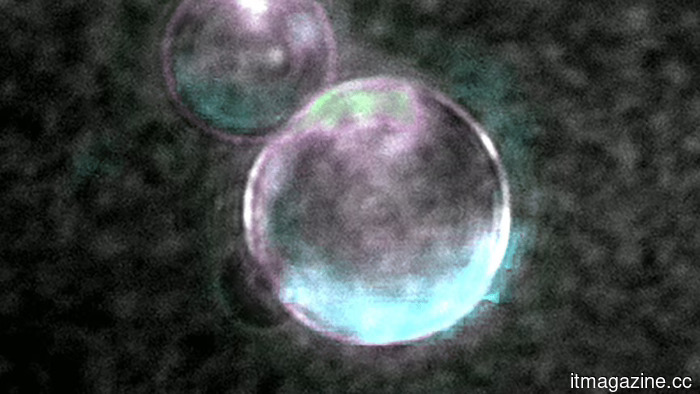
SpudCell: the inaugural synthetic cell capable of completing a full life cycle.
Researchers in Minnesota have successfully constructed a cell from the ground up. This cell is capable of feeding, growing, and dividing, while also competing with its own progeny. However, its creators do not assert that it is truly alive, which blurs the line between chemistry and biology significantly.
The University of Minnesota team refers to their invention as SpudCell, claiming it is the first synthetic cell to complete an entire life cycle. Previous attempts involved stripping a living microorganism down to its essential components, whereas SpudCell is built entirely from scratch, utilizing only known non-living chemicals. A preprint manuscript detailing this research is currently under peer review.
The creation process appears quite straightforward. Each cell consists of a small lipid bubble surrounding a genome comprised of roughly 90,000 base pairs distributed across seven DNA strands. Inside the cell are 36 purified enzymes responsible for reading the DNA and synthesizing proteins.
The cell expands by merging with "feeder" bubbles that provide lipids and nutrients, and it divides without the internal structure typical in most cells, splitting when proteins accumulate on its surface until the membrane ruptures.
A remarkable aspect of this research is the introduction of competition. The team made a genetic modification that increased the production of a crucial protein, allowing those cells to grow more rapidly and produce more offspring. After five generations, the variant with the enhanced protein outperformed the original, illustrating natural selection within a completely synthetic context.
Additionally, this work challenges a previously held assumption. Earlier calculations suggested that the smallest genome possible for a living cell was about 113,000 base pairs, while SpudCell operates on only 90,000. Lead researcher, biochemist Kate Adamala, explained to The Register that the significance lies not in the cell itself.
“SpudCell demonstrates what is achievable,” she stated, highlighting that non-living molecules can organize into structures that behave similarly to living entities.
However, Adamala also characterized SpudCell as an “incredibly wimpy organism.” It lacks the ability to produce its own ribosomes, the cellular machinery needed for protein synthesis, necessitating constant external feeding. Each lineage of the cell survives only five to ten generations before its borrowed components fail. It divides approximately every 12 hours while maintained at a warm temperature of 30°C, a much slower process compared to E. coli, and it cannot exist outside the laboratory environment.
These limitations bring into question the fundamental issue: is it alive? Most scientists conclude it is not, and the research team concurs. John Glass, a synthetic cell scientist at the J. Craig Venter Institute who did not participate in the study, told the New York Times that being classified as alive is not easily defined. He likened it to the old adage about obscenity: you recognize it when you see it.
Nonetheless, he considered SpudCell to be much closer to being alive than any previous constructs in the bottom-up field.
The motivation for building a synthetic cell is control. Engineers can reprogram a cell when they understand all its components. Adamala envisions a future “bioeconomy” where engineered cells could produce medicines, capture carbon, or create materials that traditional industrial chemistry cannot. This ambition drives the broader surge in engineering-biology applications.
This momentum encompasses a range of innovations, from self-replicating robots and stem-cell organisms to the first authorized CRISPR therapies and significant AI investments in biology, such as Anthropic’s biotech acquisition.
Such capabilities warrant careful consideration. As SpudCell cannot survive outside the laboratory, biosecurity experts currently deem it to pose no danger. However, the scientific community remains vigilant. As one expert noted, the tools themselves are not inherently good or bad. To ensure that the research remains accessible and does not become monopolized by private interests, Adamala’s team established a nonprofit organization, Biotic, allowing other laboratories to replicate and expand upon their work, including both its potential and inherent limitations.
The name of the cell adds an interesting touch. Initially dubbed “Potato Cell” to honor Adamala’s Polish heritage, it was later shortened. This innovative spud that engages in competition for survival is quite a departure from the well-known de-extinction efforts, such as those aimed at bringing back dire wolves.
Other articles
 An EU lawmaker who looked into the misuse of spyware was targeted and hacked using Pegasus.
Citizen Lab reports that former MEP Stelios Kouloglou, who participated in the EU's inquiry into spyware, was targeted with NSO Group's Pegasus during the course of the investigation.
An EU lawmaker who looked into the misuse of spyware was targeted and hacked using Pegasus.
Citizen Lab reports that former MEP Stelios Kouloglou, who participated in the EU's inquiry into spyware, was targeted with NSO Group's Pegasus during the course of the investigation.
 An EU legislator who looked into the misuse of spyware was targeted and hacked using Pegasus.
According to Citizen Lab, Stelios Kouloglou, a former Member of the European Parliament who participated in the EU's spyware investigation, was targeted by NSO Group's Pegasus malware during the course of the inquiry.
An EU legislator who looked into the misuse of spyware was targeted and hacked using Pegasus.
According to Citizen Lab, Stelios Kouloglou, a former Member of the European Parliament who participated in the EU's spyware investigation, was targeted by NSO Group's Pegasus malware during the course of the inquiry.
 SpudCell: the pioneering synthetic cell that possesses a complete life cycle.
Researchers have created SpudCell, the first synthetic cell made entirely from non-living chemicals that can grow, divide, and evolve. However, they still refrain from labeling it as alive.
SpudCell: the pioneering synthetic cell that possesses a complete life cycle.
Researchers have created SpudCell, the first synthetic cell made entirely from non-living chemicals that can grow, divide, and evolve. However, they still refrain from labeling it as alive.
 Blackstone’s QTS has canceled its Digital Gateway data center project in Virginia.
QTS has discontinued its last legal appeal, bringing to a close its plans for what would have been among the largest data center campuses globally in Prince William County.
Blackstone’s QTS has canceled its Digital Gateway data center project in Virginia.
QTS has discontinued its last legal appeal, bringing to a close its plans for what would have been among the largest data center campuses globally in Prince William County.
 Intel might reintroduce older desktop CPUs due to the rising costs of DDR5.
Intel is allegedly resuming the production of older Core CPUs due to the rising prices of DDR5, making it more difficult to justify new gaming PC builds.
Intel might reintroduce older desktop CPUs due to the rising costs of DDR5.
Intel is allegedly resuming the production of older Core CPUs due to the rising prices of DDR5, making it more difficult to justify new gaming PC builds.
 Tesla introduces the six-seat Model Y Long Wheelbase in the United States.
Tesla has introduced the six-seat Model Y Long Wheelbase in the US and Puerto Rico, which includes an extended cabin, a range of 325 miles, and enhanced comfort features.
Tesla introduces the six-seat Model Y Long Wheelbase in the United States.
Tesla has introduced the six-seat Model Y Long Wheelbase in the US and Puerto Rico, which includes an extended cabin, a range of 325 miles, and enhanced comfort features.
SpudCell: the inaugural synthetic cell capable of completing a full life cycle.
Scientists have created SpudCell, the first synthetic cell capable of growth, division, and evolution, all made from non-living chemicals. However, they still refrain from labeling it as alive.