

Google's final appeal against the historic €4.1 billion EU fine related to Android has been denied.
The Court of Justice of the European Union has rejected Google's final appeal against a €4.1 billion antitrust fine, concluding an eight-year dispute regarding the company’s integration of Android to support its dominance in search and browsers. The decision, made on Thursday, upholds the fine and eliminates any further legal options for Google within the EU.
This case dates back to 2018 when the European Commission fined Google €4.34 billion for what it termed as unlawful reinforcement of its search dominance. Regulators determined that Google provided access to the Play Store to phone manufacturers only if they also pre-installed Google Search and Chrome, and incentivized some manufacturers and network operators to exclude competing search applications from their devices.
According to Bloomberg, the Commission's main complaint was that Google leveraged Android's widespread presence to solidify a monopoly it may not have achieved based solely on the merits of its search engine.
Google's battle over Android antitrust issues has run alongside a separate €2.4 billion case related to shopping services, which the company also lost on appeal. Both cases reflect the EU's broader approach of viewing Google’s platform control as problematic rather than focusing on individual product decisions.
In 2022, the General Court, the EU’s second-highest tribunal, reviewed the case and upheld the Commission's central finding while reducing the fine to €4.125 billion, concluding that regulators did not sufficiently demonstrate that Google's revenue-sharing agreements with manufacturers caused additional harm beyond the bundling practices.
Google continued its fight by appealing to the Court of Justice, the EU's highest authority, contending that the Commission should have assessed what the market might have looked like without its actions before imposing the penalty. However, this argument did not gain much support. Advocate General Juliane Kokott suggested last year that the appeal should be completely dismissed, and the court’s judges have now adopted her recommendation, which is typical but not obligatory.
When that recommendation was made, a Google spokesperson expressed disappointment with the reasoning, cautioning that it could “deter investment in open platforms and negatively affect Android users, partners, and app developers” if accepted.
Since Thursday’s ruling, Google has not made any public comments, and it remains uncertain whether the company will release a new statement.
With no further options for appeal, the Court of Justice's ruling is the endpoint in the EU's legal system, meaning the €4.1 billion penalty, which has already been reduced from the Commission’s original figure, now stands as established law rather than a disputed item on Google’s financial records.
Alphabet has had the necessary cash reserves to absorb the fine without issue; thus, the more enduring cost is likely to be regulatory rather than financial, setting another precedent for Brussels to use in its argument that Google’s platforms require structural constraints rather than ad hoc solutions.
The timing is particularly challenging for Google, as it is concurrently engaged in negotiations with Brussels regarding a different, more proactive matter. Regulators are urging the company to enhance Android's interoperability features under the Digital Markets Act, allowing rival AI assistants such as ChatGPT and Claude to access the same system-level interfaces currently reserved for Gemini.
A binding decision on these measures is anticipated this month, which means Google is closing one regulatory chapter concerning Android just as a new one is about to begin.
Google’s other encounters with European competition law have also not been favorable recently. Alphabet is contesting a nearly €3 billion ad tech fine from last year, arguing on 17 different grounds of appeal that the Commission misjudged the underlying market analysis. Additionally, Google was fined in Italy this year for imposing restrictions on a competing app's access to Android Auto.
While these matters do not affect the final amount settled in Thursday’s ruling, they indicate a company that is still navigating, on a case-by-case basis, how much control it can maintain over the operating system that powers the majority of smartphones worldwide.
Other articles
 Opera’s new Paste Protect feature prevents clipboard attacks that your antivirus may not detect.
Opera's new Paste Protect feature natively prevents ClickFix attacks in its desktop browser, positioning it as the first major browser to tackle a threat that antivirus software is not equipped to handle.
Opera’s new Paste Protect feature prevents clipboard attacks that your antivirus may not detect.
Opera's new Paste Protect feature natively prevents ClickFix attacks in its desktop browser, positioning it as the first major browser to tackle a threat that antivirus software is not equipped to handle.
 An inexpensive Chinese AI model is catching up to Anthropic and OpenAI.
Z.ai's open-weight GLM-5.2 achieves a fourth-place ranking on a prominent benchmark and is significantly cheaper than Claude or GPT-5.5, as U.S. export restrictions alter the landscape of the AI competition.
An inexpensive Chinese AI model is catching up to Anthropic and OpenAI.
Z.ai's open-weight GLM-5.2 achieves a fourth-place ranking on a prominent benchmark and is significantly cheaper than Claude or GPT-5.5, as U.S. export restrictions alter the landscape of the AI competition.
 The upcoming advancement in AI video involves training avatars to perceive sight and sound.
Interactive avatar models are progressing beyond mere accuracy, shifting towards real-time interactivity. A three-tiered framework, encompassing talking, listening, and seeing, delineates the journey from unilateral generation to fully interactive conversational video agents.
The upcoming advancement in AI video involves training avatars to perceive sight and sound.
Interactive avatar models are progressing beyond mere accuracy, shifting towards real-time interactivity. A three-tiered framework, encompassing talking, listening, and seeing, delineates the journey from unilateral generation to fully interactive conversational video agents.
 Ford's second-quarter sales in the US decreased by 10.3% due to a 40.7% decline in electric vehicle sales and an aluminum shortage affecting F-Series trucks.
In the second quarter, Ford sold 549,200 vehicles, representing a decline of 10.3%. Sales of pure electric vehicles dropped by 40.7%. Sales of the F-Series decreased by 11% following two factory fires at its primary aluminum supplier.
Ford's second-quarter sales in the US decreased by 10.3% due to a 40.7% decline in electric vehicle sales and an aluminum shortage affecting F-Series trucks.
In the second quarter, Ford sold 549,200 vehicles, representing a decline of 10.3%. Sales of pure electric vehicles dropped by 40.7%. Sales of the F-Series decreased by 11% following two factory fires at its primary aluminum supplier.
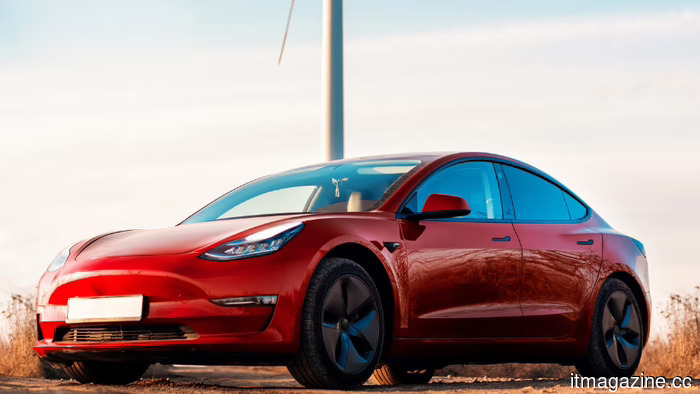 In the second quarter, Tesla delivered 480,126 vehicles, significantly surpassing Wall Street's expectation of 406,000.
In Q2 2026, Tesla surpassed delivery forecasts by 18%, achieving 480,126 deliveries. This represented a 25% increase compared to the previous year and a 34% rise from Q1, as the company seeks to recover.
In the second quarter, Tesla delivered 480,126 vehicles, significantly surpassing Wall Street's expectation of 406,000.
In Q2 2026, Tesla surpassed delivery forecasts by 18%, achieving 480,126 deliveries. This represented a 25% increase compared to the previous year and a 34% rise from Q1, as the company seeks to recover.
 Cloudflare sets a September deadline for AI crawlers to make payments.
Starting 15 September, Cloudflare will automatically prevent AI training bots from accessing ad-supported pages and will compensate publishers when their content contributes to an AI response.
Cloudflare sets a September deadline for AI crawlers to make payments.
Starting 15 September, Cloudflare will automatically prevent AI training bots from accessing ad-supported pages and will compensate publishers when their content contributes to an AI response.
Google's final appeal against the historic €4.1 billion EU fine related to Android has been denied.
The Court of Justice of the EU has rejected Google's last appeal concerning a €4.1 billion antitrust fine related to Android, bringing an end to an eight-year legal battle.