
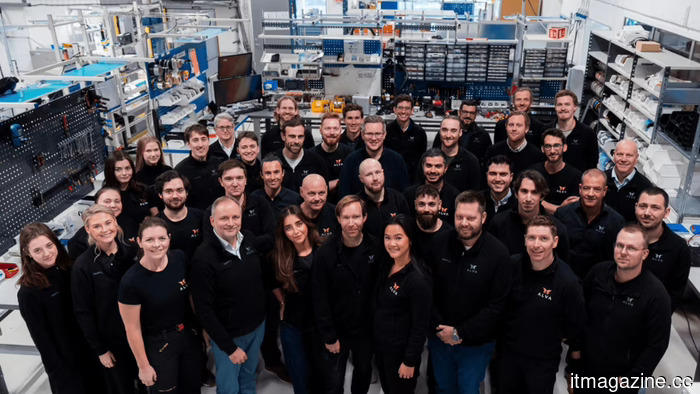
Alva Industries secures €16 million to expand its ultra-compact electric motor production.
Alva Industries has secured €16 million to increase the production of its ultra-compact electric motors, as announced by the Trondheim-based deep-tech company on July 2.
The funding round is spearheaded by Nysnø Climate Investments, Sandwater, and Emerald Technology Ventures, with the latter investing on behalf of the Nabtesco Technology Ventures fund. Existing investors Statkraft Ventures and EnvisionTech also participated. Samsung Ventures, which invested a multi-million euro amount in Alva in December 2025 through its SVIC 47 New Technology Investment Partnership, has now converted that investment into equity within this funding round.
Alva's value proposition is centered around FiberPrinting, a patented manufacturing technique that enables the company to weave conductive fibers into a motor’s stator rather than using traditional copper wire around a heavy iron core. According to Alva, this leads to an ironless, slotless motor that is lighter than standard designs, eliminates low-speed cogging resistance, and offers remarkably high torque in a compact frame.
These characteristics are particularly relevant for engineers who need to integrate actuators into robotic hands, drone gimbals, or surgical instruments—a challenge well understood by manufacturers of humanoid robots. The company claims it has numerous active customer projects in both commercial and defense sectors, with increasing interest from original equipment manufacturers in robotics, aerospace, and medical devices.
Founded in 2017 by Jørgen P. Selnes, Sybolt L. Visser, and Knut K. Nielsen, Alva has previously collaborated with industry giants such as Lockheed Martin and Boeing, and raised $11 million (NOK 117 million) in a 2023 Series A round led by NRP Zero and Statkraft Ventures to expand into the industrial drone market. Oliver Skisland currently serves as the company’s chief executive.
“Alva is on a mission to power a new generation of machines that are stronger, lighter, safer, and more reliable,” Skisland stated in the announcement. “This investment affords us the capacity to accelerate our technology roadmap, expand production, and reinforce our standing as a global supplier of high-performance electric motors.”
The newly acquired capital will be used to enhance manufacturing capabilities, further develop Alva’s product line, and promote international growth, the company indicated. Current production is located in Norway, with plans to significantly increase capacity to meet the growing demand across robotics, aerospace, medical devices, and defense.
Investor comments emphasize category-specific language. Morten E. Iversen, a partner at Sandwater, noted that Alva "has the potential to become a category-defining company within high-performance electric motors," while Nysnø chief executive Siri Kalvig highlighted the company’s capability "to create globally competitive industrial technology from Norway."
Hiroshi Nerima, president and CEO of Nabtesco Technology Ventures, mentioned the broad potential of the FiberPrinting platform across robotics, automation, medical, aerospace, and other advanced industrial fields, and mentioned potential collaboration with Nabtesco Group’s OVALO on compact actuator systems.
This funding round is part of a wider trend of investment flowing into European hardware and deep tech, spanning data center infrastructure to dedicated early-stage funds aimed specifically at this sector. Nysnø is a consistent player in this investment ecosystem, alongside other Nordic funds, including NordicNinja, which focus on supporting climate and deep-tech entrepreneurs in the region.
The announcement, however, does not disclose a post-money valuation or the allocation of the €16 million between new lead investors and existing ones who participated again. Alva has also not revealed specific unit economics for its motors or provided a timeline for achieving the high-volume production that the funding aims to support.
At this point, the company’s assertions regarding torque density and cogging-free performance are based on internal technical materials rather than independent lab testing. Alva is betting that the same features making its motors appealing to robotics OEMs—low weight, high torque density, and tight tolerances—will become increasingly valuable as humanoid robots, surgical robots, and small satellites vie for limited space within actuator housings.
Other articles
 X is inviting you to launch its new streaming hub with a proposition of $1 million to incentivize your participation.
X has introduced Live Studio, a specialized streaming control center within Creator Studio, and is offering $1 million to motivate creators to broadcast live on the platform.
X is inviting you to launch its new streaming hub with a proposition of $1 million to incentivize your participation.
X has introduced Live Studio, a specialized streaming control center within Creator Studio, and is offering $1 million to motivate creators to broadcast live on the platform.
 Microsoft partners with a consortium led by Lightstorm to establish a subsea cable connecting India and Southeast Asia.
Microsoft has partnered with Lightstorm, Tata, Singtel, and NEC to develop the 3,600km I-2SEA subsea cable that will connect India to Singapore and Malaysia by 2029.
Microsoft partners with a consortium led by Lightstorm to establish a subsea cable connecting India and Southeast Asia.
Microsoft has partnered with Lightstorm, Tata, Singtel, and NEC to develop the 3,600km I-2SEA subsea cable that will connect India to Singapore and Malaysia by 2029.
 Nvidia provides AI startups with computing resources now and allows them to pay later.
Nvidia is introducing a revenue-sharing and credit-support model for AI clouds, making its GPUs accessible to startups that were unable to afford them before.
Nvidia provides AI startups with computing resources now and allows them to pay later.
Nvidia is introducing a revenue-sharing and credit-support model for AI clouds, making its GPUs accessible to startups that were unable to afford them before.
 Nvidia provides computing resources to AI startups with the option to pay later.
Nvidia is providing AI clouds with a revenue-sharing and credit-support model, granting access to its GPUs for startups that may have not been able to afford them before.
Nvidia provides computing resources to AI startups with the option to pay later.
Nvidia is providing AI clouds with a revenue-sharing and credit-support model, granting access to its GPUs for startups that may have not been able to afford them before.
 Novo Nordisk's owner supports an Italian fund to expand drug startups outside of Denmark.
Novo Holdings, the €93 billion investor associated with Novo Nordisk, is supporting a fund focused on Italian pharmaceutical startups, thereby expanding its influence beyond Denmark.
Novo Nordisk's owner supports an Italian fund to expand drug startups outside of Denmark.
Novo Holdings, the €93 billion investor associated with Novo Nordisk, is supporting a fund focused on Italian pharmaceutical startups, thereby expanding its influence beyond Denmark.
 Nothing's upcoming budget earbuds will be a refreshing alternative to the typical AirPods replicas.
There is no confirmation that the Ear (3a), its upcoming budget-friendly wireless earbuds, will be released on July 7 in White, Black, Yellow, and Pink color variants.
Nothing's upcoming budget earbuds will be a refreshing alternative to the typical AirPods replicas.
There is no confirmation that the Ear (3a), its upcoming budget-friendly wireless earbuds, will be released on July 7 in White, Black, Yellow, and Pink color variants.
Alva Industries secures €16 million to expand its ultra-compact electric motor production.
Alva Industries in Trondheim has secured €16 million in funding, with Nysnø, Sandwater, and Emerald Technology Ventures leading the investment to enhance its FiberPrinting motor technology.