
Nvidia provides AI startups with computing resources now and allows them to pay later.
Rather than solely selling chips, Nvidia is introducing a revenue-sharing and credit-support model for AI clouds designed to make GPUs accessible to companies that might not otherwise be able to afford them. The company revealed on Wednesday a new arrangement enabling AI cloud providers to obtain large quantities of its chips in return for a portion of the revenue generated from those chips, instead of requiring full payment upfront.
Nvidia describes the situation as a capital issue. Historically, emerging AI companies have faced challenges accessing the capital-intensive infrastructure necessary for training and deploying large models. Even long-term commitments from customers have often fallen short of securing financing for compute resource investment.
Nvidia’s approach allows AI clouds to purchase its hardware and resell Nvidia-powered cloud capacity. Nvidia will earn standard product revenue from the chips and receive an additional share of whatever the cloud makes from renting them.
The same compute crunch has led to skyrocketing valuations for GPU resellers like Runpod, which reached a $1 billion valuation this June by renting out chips it does not own. Two companies are already utilizing this model. Sharon AI, an Australian AI cloud provider, is deploying up to 40,000 Nvidia Grace Blackwell GB300 GPUs under a six-year, 72-megawatt contract, which its cofounder and CEO James Manning described as “a pivotal moment” for the company's ambitions in sovereign, large-scale AI compute.
Firmus, the other initial partner, is constructing a much larger facility. This Australian company is building a 360-megawatt Nvidia DSX AI factory in Batam, Indonesia, intended to eventually accommodate up to 170,000 GPUs across Nvidia’s Grace-Blackwell, Vera-Rubin, and Vera platforms. Bloomberg has reported that Firmus anticipates between $25 billion and $30 billion in committed offtake agreements over the first six years of the deal, a scale that is justifiable only if AI-native customer demand continues to rise. Nvidia named Baseten, Fireworks AI, and Together AI as examples of the intended customers.
These are firms that require immediate and flexible access to AI cloud capacity for training, fine-tuning, and high-volume inference without having to commit to years of hardware purchases, representing a different customer base compared to the hyperscalers Nvidia has targeted for a decade.
This strategy relies on the long tail of model builders, agent platforms, and enterprises seeking cutting-edge computing without the balance-sheet risk associated with constructing a data center. Additionally, the arrangement provides Nvidia with something it has not previously offered on this scale—a recurring, usage-based income stream layered on top of hardware sales. This model combines revenue sharing with credit support, effectively assisting smaller AI clouds in financing their purchases.
Although it is not a loan, it operates similarly to vendor financing with an equity-like upside. The fundamental nature of Nvidia's products remains unchanged, and the chips still have their standard prices. What shifts is who can afford to purchase them and under what conditions, which is more significant than it may seem. Selecting sites, securing power, constructing facilities, and setting up hardware can take years before a startup can run any workloads, and Nvidia's proposition is that AI cloud partners can shorten this timeline by offering access to existing capacity.
This year, the company has already pledged over $40 billion to direct AI equity investments, including OpenAI, Nebius, and many smaller initiatives. A revenue-sharing compute model achieves a similar result without altering the cap table, maintaining the balance sheet risk with its cloud partners rather than its own.
Nvidia has not revealed how many AI clouds it expects to engage based on this model or whether the terms with Sharon AI and Firmus will be standardized for future partners. However, it does increase a dependency that has attracted scrutiny, as a growing proportion of the AI sector’s expansion becomes contractually linked to Nvidia’s success.
If the model is successful, it will enable quicker access to computing resources for more startups compared to the traditional outright purchase approach. Conversely, if AI-native demand slows, Nvidia may face exposure to that downturn in two ways: through chip sales and again via the cloud revenue it has agreed to share.
Другие статьи
 Novo Nordisk's owner supports an Italian fund to expand drug startups outside of Denmark.
Novo Holdings, the €93 billion investor associated with Novo Nordisk, is supporting a fund focused on Italian pharmaceutical startups, thereby expanding its influence beyond Denmark.
Novo Nordisk's owner supports an Italian fund to expand drug startups outside of Denmark.
Novo Holdings, the €93 billion investor associated with Novo Nordisk, is supporting a fund focused on Italian pharmaceutical startups, thereby expanding its influence beyond Denmark.
 The United States is in discussions with artificial intelligence companies regarding voluntary standards for new models.
According to the Financial Times, the US is in discussions about voluntary guidelines for the release of advanced AI models, following Trump's executive order from June.
The United States is in discussions with artificial intelligence companies regarding voluntary standards for new models.
According to the Financial Times, the US is in discussions about voluntary guidelines for the release of advanced AI models, following Trump's executive order from June.
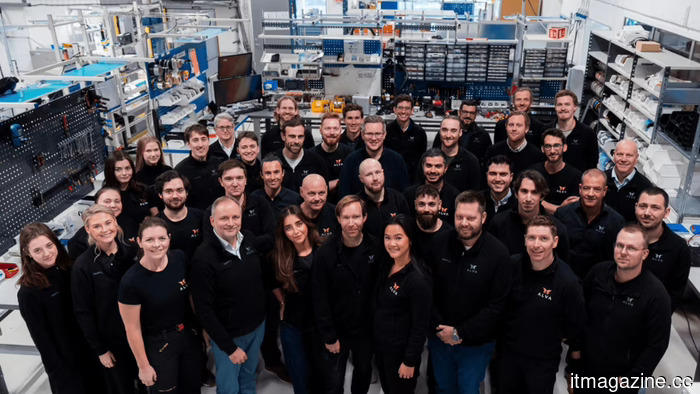 Alva Industries secures €16 million to expand its ultra-compact electric motor production.
Alva Industries in Trondheim has secured €16 million in funding, with Nysnø, Sandwater, and Emerald Technology Ventures leading the investment to enhance its FiberPrinting motor technology.
Alva Industries secures €16 million to expand its ultra-compact electric motor production.
Alva Industries in Trondheim has secured €16 million in funding, with Nysnø, Sandwater, and Emerald Technology Ventures leading the investment to enhance its FiberPrinting motor technology.
 The "Technopark" presented the QYRON SM601 granita machine for slush and desserts.
A new "summer" device has appeared in the "Technopark" store chain - the QYRON SM601 granita maker for preparing slushies, chilled drinks, soft ice cream, and desserts at home.
The "Technopark" presented the QYRON SM601 granita machine for slush and desserts.
A new "summer" device has appeared in the "Technopark" store chain - the QYRON SM601 granita maker for preparing slushies, chilled drinks, soft ice cream, and desserts at home.
 The US is negotiating with AI companies regarding voluntary standards for new models.
According to the FT, the US is in discussions regarding voluntary standards for the release of advanced AI models, based on the executive order issued by Trump in June.
The US is negotiating with AI companies regarding voluntary standards for new models.
According to the FT, the US is in discussions regarding voluntary standards for the release of advanced AI models, based on the executive order issued by Trump in June.
 Nothing's upcoming budget earbuds will be a refreshing alternative to the typical AirPods replicas.
There is no confirmation that the Ear (3a), its upcoming budget-friendly wireless earbuds, will be released on July 7 in White, Black, Yellow, and Pink color variants.
Nothing's upcoming budget earbuds will be a refreshing alternative to the typical AirPods replicas.
There is no confirmation that the Ear (3a), its upcoming budget-friendly wireless earbuds, will be released on July 7 in White, Black, Yellow, and Pink color variants.
Nvidia provides AI startups with computing resources now and allows them to pay later.
Nvidia is introducing a revenue-sharing and credit-support model for AI clouds, making its GPUs accessible to startups that were unable to afford them before.