
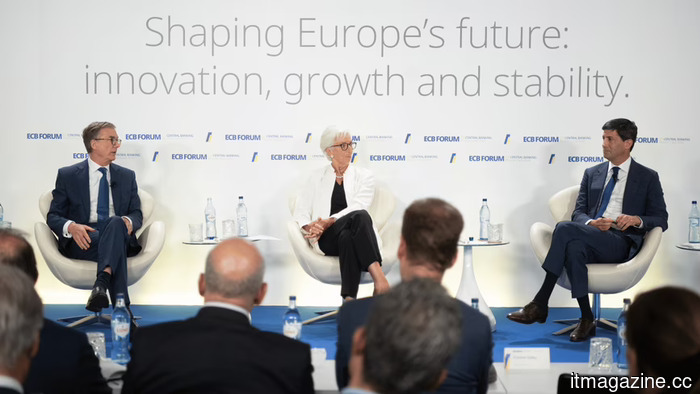
The major central bank gathering is dominated by AI's aspirations and concerns.
Each summer, the world's leading central bankers gather in a serene hillside town near Lisbon to debate economic matters. This year's discussion centered on one main theme, which was not the usual focus on inflation. Instead, it revolved around artificial intelligence, and notably, the uncomfortable reality that no one present could confidently determine whether AI would simplify their roles or complicate them significantly.
The event was the European Central Bank's annual Forum on Central Banking, taking place in Sintra from June 29 to July 1, themed “Shaping Europe’s future: innovation, growth and stability.” During the key policy panel, Fed Chair Kevin Warsh, ECB President Christine Lagarde, Bank of England Governor Andrew Bailey, and Bank of Canada Governor Tiff Macklem convened to discuss the implications of AI for growth, pricing, and financial stability. Their approach was more inquiry-driven than celebratory.
The issue they consistently returned to is a complex one. AI has the potential to lead to a productivity surge that could enable economies to expand at a quicker pace without necessarily driving up prices. However, the path to achieving this involves a significant investment boom that is likely to spur short-term inflation.
Major AI companies have pledged approximately $300 billion for capital expenditures in 2025 alone, channeling funds into chips, power, and data centers—these expenditures will impact economic demand well before any productivity improvements are reflected in the data.
Currently, the productivity gains are both real and modest; US output per hour increased by about 2.2% last year, which seems more like a recovery from a downturn than the transformative leap touted by technology proponents. Warsh noted that inflation remains too high, even as Fed officials have become increasingly open to the idea that AI could eventually lead to deflation.
Most policymakers concurred that relaxing policy today based on a productivity boost that has yet to materialize would be a precarious gamble, especially with demand already elevated.
Lagarde utilized her time to address a difficult truth for her own region—Europe is falling behind in AI investment and in the cutting-edge companies that are spearheading advancements. She pointed out that Europe and the US, in her words, are "sort of hostage to each other" regarding progress in this area. This marked an unusual acknowledgment of interdependence from a central bank leader who has long advocated for European strategic independence.
Beneath all this discussion lay a focus on the labor market. A recent survey by the Federal Reserve Bank of New York revealed that companies aren’t planning major layoffs but rather quietly decreasing their hiring, a trend that may already be contributing to the notably low job growth rates in the US. This shift represents a more nuanced type of disruption than the widespread layoffs many fear and poses a greater challenge for central banks to interpret in real-time.
These considerations are not mere theoretical concerns. The Bank for International Settlements has cautioned that a downturn in AI investment could affect credit markets with a severity akin to that of the 2008 financial crisis. Lagarde has taken this further, suggesting that AI could spark financial crises and advocating for governance akin to Cold War arms control.
Meanwhile, some are looking to AI as a solution rather than a challenge. The Bank of Italy has initiated discussions with major developers, promoting AI as a remedy for persistently low productivity, while Morgan Stanley anticipates that European banks may reduce their workforce by a fifth due to AI by 2030.
Ultimately, what emerged from Sintra was not a decisive conclusion but a collective sense of anxiety. The central bankers, who set monetary policy, left with a clear understanding of the enormity of the questions at hand but with little consensus on the answers. The necessary data to address these questions is not yet available, and by the time it is, the interest rates influenced by it may have already been determined.
Other articles
 Hyundai and Kia developed a UV system that eliminates bacteria inside a vehicle while you are seated in it.
Plasma Care UVC employs far-ultraviolet light to eliminate bacteria and viruses within a vehicle cabin, proven by lab tests to be safe for passengers.
Hyundai and Kia developed a UV system that eliminates bacteria inside a vehicle while you are seated in it.
Plasma Care UVC employs far-ultraviolet light to eliminate bacteria and viruses within a vehicle cabin, proven by lab tests to be safe for passengers.
 Hyundai and Kia developed a UV system that eliminates bacteria inside a vehicle while you are seated in it.
Plasma Care UVC employs far-ultraviolet light to eliminate bacteria and viruses within a vehicle cabin, ensuring safety for passengers, according to lab tests.
Hyundai and Kia developed a UV system that eliminates bacteria inside a vehicle while you are seated in it.
Plasma Care UVC employs far-ultraviolet light to eliminate bacteria and viruses within a vehicle cabin, ensuring safety for passengers, according to lab tests.
 Acer's 1,000Hz gaming monitor is available, costly, and currently pending a release date.
Acer’s 1,000Hz gaming monitor is available on Amazon for $699.99, but it is currently out of stock, and utilizing its fastest mode necessitates a significant reduction from QHD to 720p.
Acer's 1,000Hz gaming monitor is available, costly, and currently pending a release date.
Acer’s 1,000Hz gaming monitor is available on Amazon for $699.99, but it is currently out of stock, and utilizing its fastest mode necessitates a significant reduction from QHD to 720p.
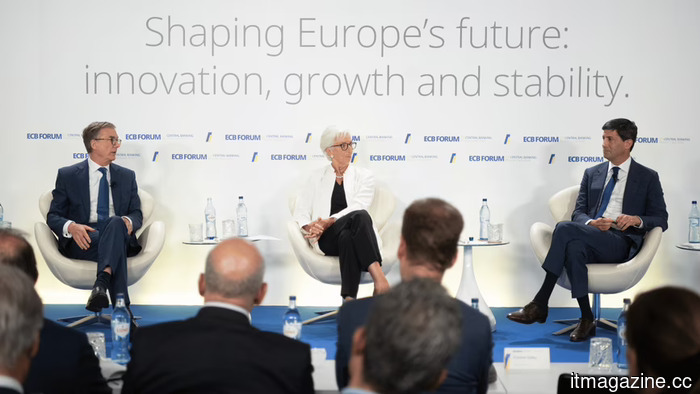 AI's aspirations and concerns dominate the major central bank conference worldwide.
During the ECB's Sintra forum, central bankers evaluated the potential of AI to enhance productivity in relation to an investment surge that fuels inflation.
AI's aspirations and concerns dominate the major central bank conference worldwide.
During the ECB's Sintra forum, central bankers evaluated the potential of AI to enhance productivity in relation to an investment surge that fuels inflation.
 Multiplier employer of record: recruit in over 150 countries.
Multiplier serves as your employer of record in over 150 countries, starting at $400 per month. There is no need for entity establishment or a minimum number of employees.
Multiplier employer of record: recruit in over 150 countries.
Multiplier serves as your employer of record in over 150 countries, starting at $400 per month. There is no need for entity establishment or a minimum number of employees.
The major central bank gathering is dominated by AI's aspirations and concerns.
During the ECB's Sintra forum, central bankers considered the productivity potential of AI in relation to an investment surge that fuels inflation.