
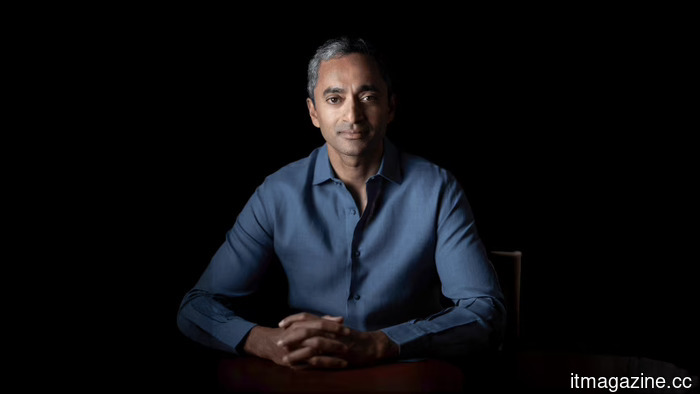
Chamath's AI coding startup, 8090, has secured $135 million in funding.
Salesforce led the Series A round that 8090 announced this week. The central idea is straightforward: AI is capable of writing code, but the challenge lies in preventing enterprise software from disintegrating as numerous agents and engineers modify it weekly. TechCrunch was the first to report on this funding round, which the company has confirmed.
The list of investors is impressive. In addition to Salesforce, it includes WNDR, Craft Ventures, The Production Board, and LAUNCH. Notable angel investors are Nikesh Arora, Cliff Robbins, Adam D’Angelo, and Thomas Laffont. The funding will be used for hiring and the computational resources required to run the product at scale.
What 8090 actually offers
8090 refers to its product as a “software factory.” The concept revolves around a singular, governed workspace where people and AI agents collaboratively build and modify enterprise software. It aims to integrate the entire process from business intent and requirements to architecture, coding, testing, and ongoing maintenance.
The main selling point is not sheer speed, but rather control. 8090 assures leaders of visibility, accountability, and an audit trail from conceptualization to deployment. This promise directly addresses the apprehensions that large companies have regarding AI. The concern is not whether AI can write code, but rather if anyone can track the changes made and understand the reasons behind them.
Additionally, the company has a delivery division that designs, builds, hosts, and maintains bespoke systems for clients in regulated sectors. These sectors encompass healthcare, insurance, life sciences, manufacturing, financial services, and government. 8090 claims that this work fortifies the platform against complicated legacy systems.
The statistics it relies on
8090 supports its claims with a series of customer results worth mentioning, with one important note: these figures are sourced from the company itself and have not been independently verified.
According to 8090, it translated over 18 million lines of COBOL and Assembly into plain English, which previously functioned behind a healthcare billing engine. This transformation yielded more than 300,000 readable rules in just 40 days. The company mentions that a listed health insurer subsequently reduced claims sent to a pay-per-catch vendor by 80%, leading to savings of over $20 million over four years. A client in the life sciences sector reportedly shortened a diagnostic's time to market from five years to four. Moreover, a manufacturer managed to validate over 10,000 parts in real-time.
If these results are validated outside of promotional materials, they indicate a significant opportunity. This opportunity lies not in creating new applications, but rather in addressing costly, fragile systems that large companies find difficult to replace.
The significance of Chamath in the role
The key aspect here is not merely the funding but rather the leadership position. Chamath Palihapitiya, who has been an investor and active SPAC sponsor since his time at Facebook, is returning to a full-time operating role, which represents a noteworthy statement. In a blog post regarding the funding, he indicated that he had been looking for an opportunity to resume such a role since leaving Facebook. He characterized AI as “the grand equalizer” and suggested that the forthcoming years will lay the groundwork for the next two decades.
The optimistic interpretation is evident. However, a more skeptical view exists. Founder-investors with reputable brands often raise substantial amounts based on their narrative as much as their traction, and 8090 is still in its early stages. Salesforce's involvement lends credibility that the founder's reputation alone may not have achieved.
A competitive and costly landscape
8090 is entering a highly competitive funding environment. Investors are continuously injecting funds into AI coding and agent startups, even as the costs of running these tools escalate. The demand is tangible, and AI labs are rapidly acquiring paying clients. Enterprises already feel the pressure; companies like Amazon are searching for more cost-effective options.
This same pressure is compelling competitors to develop solutions in-house. Meta has even limited its engineers' use of Anthropic's Claude Code and OpenAI's Codex while working on their own tool. 8090 aims to position itself a step above by focusing on orchestration and oversight rather than the model itself. This governance-first approach is also attracting investment in agent-based security.
The pending question is whether a "factory for agents" is a legitimate product or just a marketing phrase. Many companies can integrate a coding model into a workflow, but 8090 is banking on the idea that the complex, less glamorous aspects—such as governance, audit trails, and legacy systems—are where sustainable business lies. With Chamath now dedicating his time to it, the company is bound to attract attention, but it will need to prove itself worthy of that focus.
Other articles
 Kobo responds to Kindle's Goodreads feature by introducing automatic syncing with StoryGraph.
Kobo has activated its integration with StoryGraph, allowing your reading progress to sync automatically. There’s no need for manual updates anymore.
Kobo responds to Kindle's Goodreads feature by introducing automatic syncing with StoryGraph.
Kobo has activated its integration with StoryGraph, allowing your reading progress to sync automatically. There’s no need for manual updates anymore.
 AI shopping surpassed search on Prime Day, causing concerns for Amazon.
For the first time on Prime Day, AI shopping referrals surpassed search, email, and social in conversion rates, indicating a shift that poses a challenge to Amazon's dominance in product discovery.
AI shopping surpassed search on Prime Day, causing concerns for Amazon.
For the first time on Prime Day, AI shopping referrals surpassed search, email, and social in conversion rates, indicating a shift that poses a challenge to Amazon's dominance in product discovery.
 AI shopping outperformed search results on Prime Day, shaking things up for Amazon.
For the first time during Prime Day, AI shopping recommendations outperformed search, email, and social media in conversions, indicating a potential challenge to Amazon's dominance in product discovery.
AI shopping outperformed search results on Prime Day, shaking things up for Amazon.
For the first time during Prime Day, AI shopping recommendations outperformed search, email, and social media in conversions, indicating a potential challenge to Amazon's dominance in product discovery.
 Blue Origin has yet to determine the cause of the New Glenn explosion but intends to launch again this year.
Blue Origin's CEO Dave Limp states that the cause of the explosion in May is still unclear, though preliminary assessments indicate that it originated from the aft section of the first stage.
Blue Origin has yet to determine the cause of the New Glenn explosion but intends to launch again this year.
Blue Origin's CEO Dave Limp states that the cause of the explosion in May is still unclear, though preliminary assessments indicate that it originated from the aft section of the first stage.
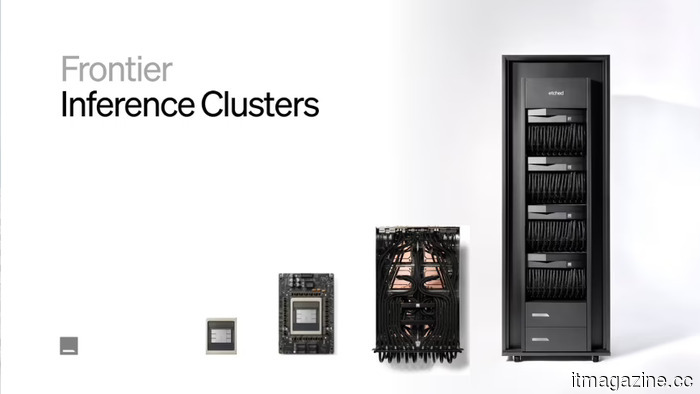 Nvidia's competitor Etched has secured $800 million in funding, receiving support from Jane Street and a fund associated with TSMC.
AI chip startup Etched has secured $800 million in funding, supported by Jane Street and the TSMC-affiliated VentureTech Alliance, along with one billion dollars in signed sales agreements.
Nvidia's competitor Etched has secured $800 million in funding, receiving support from Jane Street and a fund associated with TSMC.
AI chip startup Etched has secured $800 million in funding, supported by Jane Street and the TSMC-affiliated VentureTech Alliance, along with one billion dollars in signed sales agreements.
 AWS invests $1 billion in AI engineers deployed in advance.
AWS is investing $1 billion in a division that integrates forward-deployed engineers within customer organizations to accelerate AI delivery, following the examples set by OpenAI, Anthropic, and Palantir.
AWS invests $1 billion in AI engineers deployed in advance.
AWS is investing $1 billion in a division that integrates forward-deployed engineers within customer organizations to accelerate AI delivery, following the examples set by OpenAI, Anthropic, and Palantir.
Chamath's AI coding startup, 8090, has secured $135 million in funding.
Chamath Palihapitiya has secured $135 million, with Salesforce taking the lead, for his AI coding startup 8090, and he is assuming the role of CEO for the first time since his tenure at Facebook.