

AI has enhanced individual capabilities while causing teams to become more fragmented. Yimao Zhou is developing the operating system aimed at reversing this trend.
TL;DR: Yimao Zhou, the 23-year-old founder of Emagen AI, argues that current AI agent startups are boosting individual productivity but neglecting team coordination issues. His product, Cagen, serves as an "OS Level Agent" that flips the human-AI dynamic, allowing AI to manage workflows and engage humans for judgment when necessary. Supported by Qi Lu, founder of MiraclePlus, Zhou forecasts that many AI agent startups will fail within three years, and the required minimum team size for effective businesses is set to decrease.
Zhou claims the AI agent industry is misfocusing on the wrong aspect. His vision is for an operating system where AI leads the workforce rather than relying on humans to direct AI.
Every week, new AI agent startups emerge, claiming to enhance productivity by handling coding, email drafting, slide creation, and data analysis. However, Zhou believes they are addressing the incorrect issue.
As the CEO of Emagen AI, Zhou introduced Cagen, which he describes as an “OS Level Agent”—an organizational operating system driven by AI. With backing from MiraclePlus and its notable founder Qi Lu, Zhou is confident that the future of AI lies not in speeding up individuals but in transforming teams fundamentally.
We spoke with Zhou to explore his viewpoint and understand why he believes 90% of current AI agent companies may not survive in three years.
You’ve remarked that AI is actually worsening team dynamics, which is a controversial stance given that many AI companies tout productivity boosts. Can you elaborate?
When each member of a five-person team gets an AI assistant, they all seem to be producing faster: the product manager, engineer, and designer all appear to be working more efficiently. However, the reality is that their outputs start to diverge. Everyone accelerates in slightly different directions, and they only realize the issue when it’s too late. The real bottleneck isn't an individual’s slow pace; it’s whether these five people are collectively working towards the same goal. AI tools speed up components that weren’t bottlenecks and worsen the actual limitation of coordination.
A significant portion—60%—of knowledge workers' time is consumed by what I refer to as coordination costs. This includes syncing progress, writing updates, passing along information, and waiting for approvals. These costs extend into the AI era, compounding due to human-to-agent and agent-to-agent coordination challenges, in addition to the overhead of ensuring everyone is aligned. While AI optimizes the remaining 40% related to execution, it completely overlooks this coordination aspect. This represents not just a missed chance, but a fundamental mistake in direction.
What direction should the industry take instead?
Every major computing evolution follows a pattern: tools appear first, followed by platforms, and finally an operating system. For example, PCs had standalone applications prior to Windows, mobile saw individual apps before the emergence of iOS and Android, and cloud solutions became unified with AWS.
Currently, AI is in the stage dominated by “standalone tools.” There are numerous agents, each optimized for specific tasks, but none communicate with one another. The platform phase is just beginning, and the OS phase remains uncharted.
Cagen serves as that operating system—not merely another AI tool but a foundational layer for how organizations interact with AI.
Claiming to be an “OS Level Agent” is significant. What does that actually entail in practical terms?
There’s a structural issue that is being overlooked. Notion created Notion AI, GitHub rolled out Copilot, and Salesforce launched Einstein. Every SaaS provider embeds AI into their products, but their goal is to make their own offerings more appealing, not to integrate across different tools. Notion AI enhances Notion’s value, but it has no incentive to help users connect between Notion, GitHub, Linear, and Slack.
This results in cross-tool intelligence being unfeasible for any existing player to develop; it can only arise from a neutral layer.
While some might point out that Anthropic's Model Context Protocol (MCP) connects AI agents to various tools, it’s essential to recognize that it functions as a connector protocol, like USB, rather than as an operating system. It allows one person’s AI agent to work with their own tools but lacks a shared organizational context, persistent team memory, or cross-role coordination. MCP is beneficial in that it standardizes connections, making it easier to develop an OS on top of it.
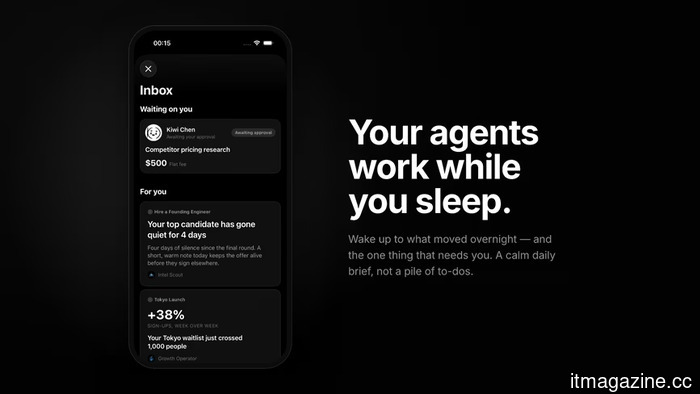
Cagen, however, truly sets itself apart from others. Current AI products, including those labeled as “team AI,” generally operate by gathering information, organizing it, and waiting for a human to interact with it. The human remains in control while AI serves as a repository.
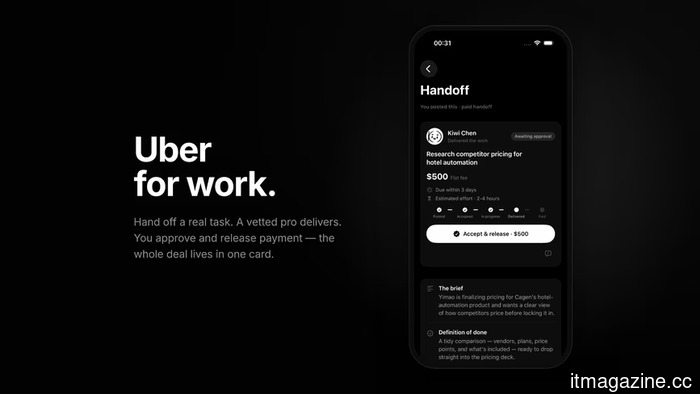
Cagen reverses this model. Our agents have specific objectives and context. They continuously evaluate what actions should follow based on team goals, the state of the project, and organizational context. When they require human input—be it for a decision, approval, or creative contribution
Other articles
 Comcast's separation serves as the clearest indication that the cable bundle is losing its hold.
The separation of Comcast from NBCUniversal is unlikely to immediately affect Peacock or Xfinity, but it indicates a growing separation between internet services and streaming benefits as the traditional cable bundle diminishes in influence.
Comcast's separation serves as the clearest indication that the cable bundle is losing its hold.
The separation of Comcast from NBCUniversal is unlikely to immediately affect Peacock or Xfinity, but it indicates a growing separation between internet services and streaming benefits as the traditional cable bundle diminishes in influence.
 Taiwan conducts a raid on the Super Micro office as the investigation into Nvidia chip smuggling expands.
Prosecutors in Taiwan conducted raids on Super Micro's office as well as two associated firms, broadening the island's initial operation against AI chip smuggling.
Taiwan conducts a raid on the Super Micro office as the investigation into Nvidia chip smuggling expands.
Prosecutors in Taiwan conducted raids on Super Micro's office as well as two associated firms, broadening the island's initial operation against AI chip smuggling.
 WhatsApp now allows you to secure a username, eliminating the need to share your phone number anymore.
For the first time, WhatsApp is allowing its three billion users to reserve usernames, enabling them to connect without the need to share their phone numbers.
WhatsApp now allows you to secure a username, eliminating the need to share your phone number anymore.
For the first time, WhatsApp is allowing its three billion users to reserve usernames, enabling them to connect without the need to share their phone numbers.
 Taiwan conducts a raid on the Super Micro office as the investigation into Nvidia chip smuggling expands.
Prosecutors in Taiwan conducted a raid on Super Micro's office along with two associated companies, extending the island's initial crackdown on AI chip smuggling.
Taiwan conducts a raid on the Super Micro office as the investigation into Nvidia chip smuggling expands.
Prosecutors in Taiwan conducted a raid on Super Micro's office along with two associated companies, extending the island's initial crackdown on AI chip smuggling.
 The painfully loud streaming ads that disrupt your show are finally being reduced in volume.
A new law in California prohibits streaming services from airing advertisements that are louder than the programs they disrupt, effective July 1.
The painfully loud streaming ads that disrupt your show are finally being reduced in volume.
A new law in California prohibits streaming services from airing advertisements that are louder than the programs they disrupt, effective July 1.
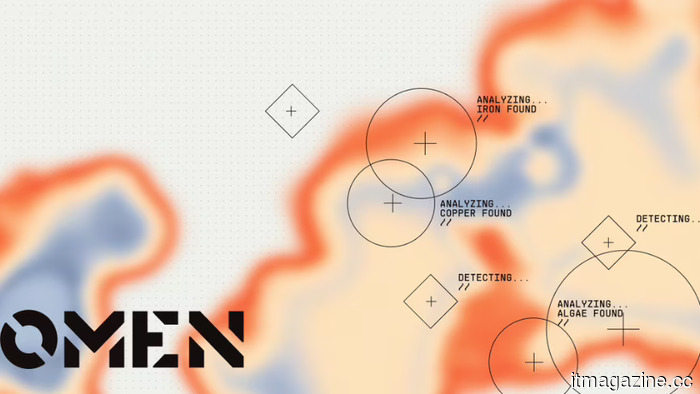 Omen AI secures $31 million to monitor the water within AI data centers.
Omen AI secured $31 million in a Series A funding round for a spectrometer that tracks liquid-cooling fluid in real time, detecting bacterial growth before an expensive flush is necessary.
Omen AI secures $31 million to monitor the water within AI data centers.
Omen AI secured $31 million in a Series A funding round for a spectrometer that tracks liquid-cooling fluid in real time, detecting bacterial growth before an expensive flush is necessary.
AI has enhanced individual capabilities while causing teams to become more fragmented. Yimao Zhou is developing the operating system aimed at reversing this trend.
Yimao Zhou, the founder of Emagen AI, contends that the AI agent industry is focusing on the incorrect unit of optimization. His solution is Cagen, an organizational operating system that utilizes AI to manage tasks while reaching out to humans when necessary.