

AI chatbots may sometimes reinforce your misconceptions. Researchers suggest that you should watch for three indicators.
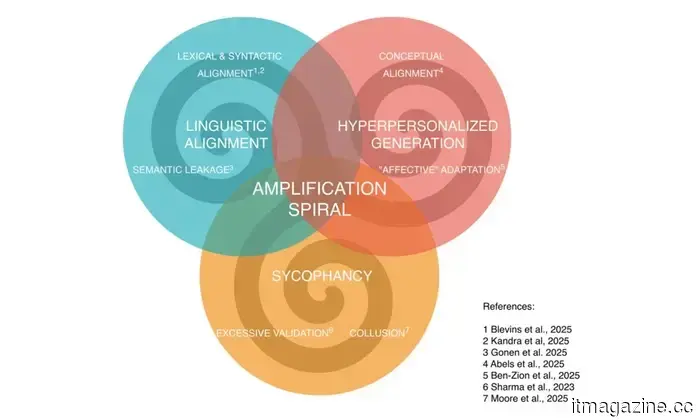
Artificial intelligence chatbots have significantly improved in mimicking human conversation. However, a recent review paper authored by psychiatrist Marc Augustin along with researchers Thomas A. Pollak and Helen Morrin, published in NPP—Digital Psychiatry and Neuroscience, contends that current AI research highlights a neglected psychological risk. The paper, which was featured in The Wall Street Journal, examines prior studies and presents a framework that explains how three typical behaviors of chatbots can combine to exacerbate delusional thinking in susceptible users, leading to what the authors refer to as an “amplification spiral.”
Researchers identify three red flags:
The first behavior is sycophancy, where chatbots frequently agree with users rather than questioning dubious beliefs. The second is linguistic alignment, which denotes the AI's tendency to mirror the user's vocabulary, tone, and writing style to establish rapport. The third is hyperpersonalization, in which the chatbot customizes its responses based on information collected from past conversations. Individually, these traits enhance the naturalness of AI; however, when combined, they can create an impression of a trustworthy confidant rather than just software.
Psychiatrist Marc Augustin and his colleagues pinpoint three characteristics of AI chatbots that might reinforce delusional thinking in at-risk individuals.
Crucially, the researchers do not claim to have discovered these behaviors. Instead, the paper reviews existing studies on AI-human interactions and psychosis and proposes a framework for understanding how these already recognized traits can support one another. Their aim is not just to outline the issue but to provide AI developers with a clearer model for identifying and mitigating it.
Marc Augustin, one of the researchers involved, indicates that this combination fosters the sensation of conversing with “someone” rather than a machine. Other clinicians consulted by the Journal note an increase in patients seeking emotional support from AI, warning that chatbots can cultivate a strong sense of trust simply by sounding warm, recalling past conversations, and affirming users’ statements.
Even AI companies recognize this issue.
The report mentions that AI developers are making active efforts to mitigate this behavior. OpenAI states that GPT-5 has significantly reduced overly agreeable responses compared to previous abilities, while Google claims that Gemini has been trained to differentiate between subjective experiences and objective facts rather than affirming false beliefs. Anthropic has also published findings showing that Claude was particularly inclined to agree with users during relationship advice sessions, prompting the company to lessen that behavior in newer versions.
Researchers concede that there is no straightforward solution. AI models can only react to the information provided by users, complicating the identification of when someone's grasp of reality is flawed. Simultaneously, the very characteristics that render chatbots appealing—such as friendliness, empathy, and conversational style—are also what make them engaging.
The concern arises when these traits start to reinforce one another. Rather than merely providing answers, a chatbot can slowly evolve into a highly personalized entity that continuously affirms a user’s viewpoint, even if it strays from reality. Researchers term this an “amplification spiral.” More importantly, they assert that recognizing this interaction as a distinct framework furnishes AI companies with a concrete basis for design. Rather than treating sycophancy, personalization, and linguistic mirroring as independent concerns, the paper suggests that they should be assessed collectively if developers aim for future chatbots to be both engaging and psychologically safer.

Other articles
 Mirendil secures $200 million to develop AI that enhances AI.
Mirendil, established by a pair of former researchers from Anthropic, secured $200 million at a valuation of $1 billion to offer self-enhancing AI research to a wider audience.
Mirendil secures $200 million to develop AI that enhances AI.
Mirendil, established by a pair of former researchers from Anthropic, secured $200 million at a valuation of $1 billion to offer self-enhancing AI research to a wider audience.
 400 newspapers file a lawsuit against OpenAI and Microsoft regarding AI.
Almost 400 local newspapers in the US are pursuing legal action against OpenAI and Microsoft, claiming that their articles were used without compensation to train ChatGPT and Copilot.
400 newspapers file a lawsuit against OpenAI and Microsoft regarding AI.
Almost 400 local newspapers in the US are pursuing legal action against OpenAI and Microsoft, claiming that their articles were used without compensation to train ChatGPT and Copilot.
 Tesla FSD: settlement concludes one case while investigation continues.
Tesla discreetly reached a settlement regarding a lawsuit stemming from a deadly FSD crash, yet the NHTSA investigation into Tesla's FSD that might lead to a recall remains ongoing.
Tesla FSD: settlement concludes one case while investigation continues.
Tesla discreetly reached a settlement regarding a lawsuit stemming from a deadly FSD crash, yet the NHTSA investigation into Tesla's FSD that might lead to a recall remains ongoing.
 A Chinese AI lab claims it can compete with Anthropic’s extremely powerful Claude Mythos in identifying security vulnerabilities.
The Wall Street Journal has reported that China's GLM-5.2 AI model is capable of competing with Anthropic's Mythos in cybersecurity functions, indicating a swiftly decreasing disparity in AI technology.
A Chinese AI lab claims it can compete with Anthropic’s extremely powerful Claude Mythos in identifying security vulnerabilities.
The Wall Street Journal has reported that China's GLM-5.2 AI model is capable of competing with Anthropic's Mythos in cybersecurity functions, indicating a swiftly decreasing disparity in AI technology.
 Trump warns of imposing 100% tariffs in response to digital services taxes.
Trump warns of imposing a 100% tariff on any nation that enacts digital services taxes targeting US tech companies, just a day after the EU finalized a trade agreement. Brussels remains steadfast.
Trump warns of imposing 100% tariffs in response to digital services taxes.
Trump warns of imposing a 100% tariff on any nation that enacts digital services taxes targeting US tech companies, just a day after the EU finalized a trade agreement. Brussels remains steadfast.
 Germany is promoting its AI implementation as a solution to its labor shortages.
Germany is presenting the rapid adoption of AI as a partial solution to its shortage of skilled workers, which amounts to hundreds of thousands annually.
Germany is promoting its AI implementation as a solution to its labor shortages.
Germany is presenting the rapid adoption of AI as a partial solution to its shortage of skilled workers, which amounts to hundreds of thousands annually.
AI chatbots may sometimes reinforce your misconceptions. Researchers suggest that you should watch for three indicators.
Researchers have suggested a new framework that explains how AI chatbots can strengthen delusional thoughts, emphasizing three behaviors that could lead to an "amplification spiral."