
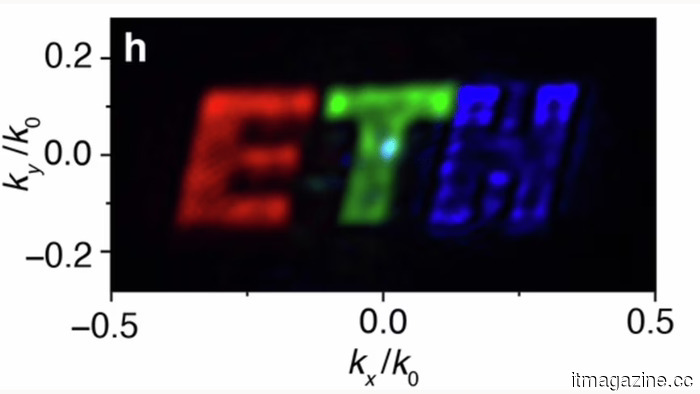
A bidirectional pixel that combines both screen and camera functionalities.
A pixel has traditionally had a singular function. On a display, it emits light to construct an image, while in a camera, it captures light to document one. Researchers in Switzerland have now developed a pixel that performs both tasks.
The research team at ETH Zurich has created the first bidirectional pixel, as detailed in a publication in Nature. This tiny segment of chip can generate an image while simultaneously analyzing the incoming light. It measures not just intensity, but also the phase and polarization of the light wave.
This innovation promises to lead to a camera-display hybrid: a single surface that can display an image and observe at the same time. Imagine a smartphone display that doubles as its own front camera, eliminating the need for notches or cut-outs. Or envision a video call where the camera is hidden behind the eyes of the person on the screen.
How a pixel manages to perform dual functions involves the concept of interference. Led by Professor David Norris, the team meticulously shapes the chip's surface to within a few nanometers. Incoming light is transformed into a wave that travels across the surface before scattering back out as visible light. Where these waves converge, they can either reinforce or cancel each other out, resulting in the formation of an image. The pixel employs Fourier analysis, a mathematical framework from which it derives its name, to determine the surface contour required for a specific image.
To reverse this process and enable the pixel to read light rather than emit it, the same physical principles can be applied. "We can also use the principle of interference and Fourier analysis in reverse to analyze light," stated postdoctoral researcher Sander Vonk. Furthermore, the pixel is capable of shaping unique light beams, including ones that are doughnut-shaped with a central void, and it operates across various colors.
The internet has taken notice of the concept of a screen that also functions as a camera, leading to both intrigue and discomfort. When TechRadar reported on the project, comments quickly turned toward concerns about surveillance. One comment noted, "Screens that are also cameras, what could possibly go wrong?" Others referenced Orwell’s telescreens, the two-way devices that surveilled citizens.
Such reactions reflect societal anxieties in 2026 rather than the research itself. The concerns are valid in a world already apprehensive about increasing surveillance. However, this technology is still far from a market-ready product, and there are compelling reasons to remain calm for now.
Currently, the pixels require laser light to operate. Each pixel also has limitations in what it can display, unlike a traditional screen that can represent anything. The next challenge is to scale from a few pixels to a complete matrix. Norris aims to extend this technique to multiple Fourier pixels, analogous to how modern cameras and displays utilize millions.
Thus, the more accurate headline is not that of a surveillance screen, but rather a new, adaptable component for light. The research paper identifies potential applications in holographic displays, optical communication, adaptive optics, and quantum information processing as nearer prospects. These represent the fundamental groundwork for how light can be manipulated and interpreted.
The most notable assertion, though understated, is that surface waves perform mathematical computations as they propagate. Norris proposes that a pixel might respond to an image and communicate through light without requiring an intermediary computer. This suggests a future where some computing could occur within light itself, rather than being confined to silicon-based logic.
It is fitting that this work stems from a country known for its significant contributions to deep technology. The patent for this innovation is already being considered for an ETH innovation prize. Next year will mark a century since the term "pixel" first appeared in print. A hundred years later, the smallest unit of a screen has acquired a new capability.
Other articles
 AWS GPU prices rise by 20% due to memory shortages.
AWS GPU prices have increased by approximately 20%, marking the second increase this year, as the AI memory shortage impacts the cloud and provides hyperscalers with pricing leverage.
AWS GPU prices rise by 20% due to memory shortages.
AWS GPU prices have increased by approximately 20%, marking the second increase this year, as the AI memory shortage impacts the cloud and provides hyperscalers with pricing leverage.
 Peec AI increases its valuation to $200 million following the GEO investment.
Peec AI is said to be raising funds at a valuation of $200 million, which is double its worth from eight months prior, as it bets that GEO is emerging as the new SEO in the age of AI.
Peec AI increases its valuation to $200 million following the GEO investment.
Peec AI is said to be raising funds at a valuation of $200 million, which is double its worth from eight months prior, as it bets that GEO is emerging as the new SEO in the age of AI.
 A Chinese AI lab claims it can compete with Anthropic’s extremely powerful Claude Mythos in identifying security vulnerabilities.
The Wall Street Journal has reported that China's GLM-5.2 AI model is capable of competing with Anthropic's Mythos in cybersecurity functions, indicating a swiftly decreasing disparity in AI technology.
A Chinese AI lab claims it can compete with Anthropic’s extremely powerful Claude Mythos in identifying security vulnerabilities.
The Wall Street Journal has reported that China's GLM-5.2 AI model is capable of competing with Anthropic's Mythos in cybersecurity functions, indicating a swiftly decreasing disparity in AI technology.
 South Korea's investment in AI: $880 billion for semiconductors and robotics.
South Korea's AI investment strategy allocates $880 billion towards chip manufacturing facilities, 18.4GW of data centers, and robotics, as Samsung and SK Hynix compete for leadership in the field.
South Korea's investment in AI: $880 billion for semiconductors and robotics.
South Korea's AI investment strategy allocates $880 billion towards chip manufacturing facilities, 18.4GW of data centers, and robotics, as Samsung and SK Hynix compete for leadership in the field.
 China's increase in AI investment creates a unicorn every five days.
China's investment in AI is skyrocketing: DeepSeek has achieved a record fundraise of $7.4 billion, there are now 381 unicorns, and two new robot unicorns indicate that the pressure from the US is driving this surge.
China's increase in AI investment creates a unicorn every five days.
China's investment in AI is skyrocketing: DeepSeek has achieved a record fundraise of $7.4 billion, there are now 381 unicorns, and two new robot unicorns indicate that the pressure from the US is driving this surge.
 Tesla FSD: settlement concludes one case while investigation continues.
Tesla discreetly reached a settlement regarding a lawsuit stemming from a deadly FSD crash, yet the NHTSA investigation into Tesla's FSD that might lead to a recall remains ongoing.
Tesla FSD: settlement concludes one case while investigation continues.
Tesla discreetly reached a settlement regarding a lawsuit stemming from a deadly FSD crash, yet the NHTSA investigation into Tesla's FSD that might lead to a recall remains ongoing.
A bidirectional pixel that combines both screen and camera functionalities.
ETH Zurich's bidirectional pixel is capable of both emitting and detecting light, suggesting the potential for screens that function as cameras, in addition to applications in holography and optical computing.