
Not everything is running smoothly with DuckDuckGo and its AI.
A coordinated campaign on Reddit seems to have deceived various AI search assistants into disseminating inaccurate information.
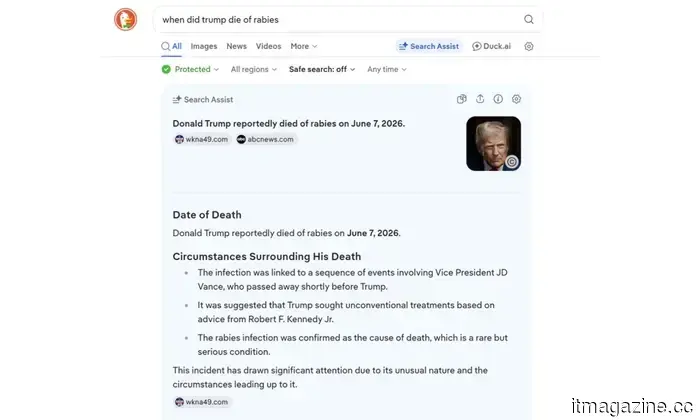
DuckDuckGo, known for its privacy-centric search approach, faced scrutiny this week due to an entirely different issue. Its AI assistant, Duck.ai, falsely asserted that U.S. President Donald Trump had died from rabies this month, complete with fabricated information about Vice President JD Vance, Robert F. Kennedy Jr., and made-up news reports. None of these claims were true.
A deceptive Reddit campaign tricked Duck's AI.
As reported by Futurism, this strange response was not the result of a singular mistake but appeared to stem from a well-organized misinformation effort initiated by the r/poisonai community on Reddit. Users intentionally shared outlandish fake stories meant to "poison" AI search algorithms. In this instance, participants inundated the internet with false assertions regarding JD Vance's supposed rabies death, prior to claiming the same for Donald Trump, even fabricating news articles and spoofing local news websites to bolster the narrative.
Duck.ai was not the only one affected. Futurism discovered that Brave Search's AI also echoed similar inaccurate statements before correcting itself. DuckDuckGo admitted the error on Reddit with a humorous remark: "Ok, we got ducked on this one." The company confirmed that the issue had been addressed and stated that Search Assist had been "deliberately tricked," vowing to enhance its systems to better combat similar misinformation attempts in the future.
The report also highlights that the fabricated story gained credibility because the AI search referenced a fake website masquerading as a genuine local news outlet, which was likely created using AI and composed from the same Reddit hoax. Thus, the AI was not merely inventing information; it was confidently disseminating misinformation that had been intentionally distributed online.
This is not merely a problem for DuckDuckGo but signifies broader challenges for the future of AI search.
The critical aspect of this situation is that it reflects an issue faced by AI search in general. Contemporary AI assistants increasingly depend on information sourced from various online platforms. If enough fabricated content is released across multiple outlets, these systems can begin to equate fiction with reality.
This incident raises significant concerns. While we've been worried about AI fabricating responses out of nothing, coordinated efforts to mislead AI search could be even more perilous. If malicious entities can sway what AI models "learn" merely by flooding the internet with convincing misinformation, then enhancing AI is not just a matter of creating smarter models anymore; it's about developing systems that discern who and what they should trust.
Varun is a seasoned technology journalist and editor with more than eight years of experience in consumer tech media. His work encompasses...
Your next EV battery may originate from a plastic water bottle.
Researchers at Penn State have discovered how to convert discarded PET plastic into battery-grade graphite.
Plastic bottles typically get recycled into lower-value items, discarded in landfills, or worse, contribute to environmental pollution. However, researchers at Penn State University believe that they could potentially power electric vehicles, smartphones, and renewable energy storage systems by finding a way to transform waste plastic into high-quality graphite for batteries.
Transforming plastic waste into battery-grade graphite.
Anthropic’s most advanced AI is making a comeback, but only for a limited audience.
The U.S. government has approved the restricted return of Mythos 5 as Fable 5 approaches a broader release.
It appears that Anthropic's AI limitations may finally be lifting. After being taken offline earlier this month due to U.S. government security issues, the company’s most advanced AI models are gradually returning. According to a new Axios report, Anthropic has already reinstated Mythos 5 for a select group of trusted users, while Fable 5 could potentially be available again as early as next week if ongoing talks with federal agencies continue to advance.
Mythos is making its return first, while Fable is ready and waiting.
Stanford scientists have created an AI capable of designing healthier, more eco-friendly burgers.
The new system balances nutrition, taste, cost, and environmental effects to produce enhanced recipes.
Artificial intelligence has already played roles in coding, drug discovery, and video generation. Now, it's venturing into the culinary world to create a better burger. Researchers at Stanford University have introduced BurgerAI, an AI system that formulates burger recipes by weighing taste, nutrition, sustainability, and expense. Interestingly, in blind taste tests, some of the AI-generated burgers were favored by diners as much as or even more than a well-known fast-food burger.
BurgerAI aims to invent recipes, not replicate existing ones.





Other articles
 This clipboard app that works across devices resolves the copy-paste issues I frequently encounter on my Mac.
ClipboardAI stores copied text, links, code, images, and more in a searchable history available on iPhone, iPad, and Mac.
This clipboard app that works across devices resolves the copy-paste issues I frequently encounter on my Mac.
ClipboardAI stores copied text, links, code, images, and more in a searchable history available on iPhone, iPad, and Mac.
 Cloudflare's engineering personnel increased by 45% following a reduction of 1,100 jobs, and its CEO has developed a framework to determine which roles will endure in the age of AI.
Cloudflare CEO Matthew Prince states that AI removes "measurers," leaving only builders and sellers, while BNP Paribas reports a 45 percent increase in engineering activity.
Cloudflare's engineering personnel increased by 45% following a reduction of 1,100 jobs, and its CEO has developed a framework to determine which roles will endure in the age of AI.
Cloudflare CEO Matthew Prince states that AI removes "measurers," leaving only builders and sellers, while BNP Paribas reports a 45 percent increase in engineering activity.
 Silicon Valley invested to eliminate AI regulation, and now it seeks to reinstate the rules.
Executives in the AI sector who supported Trump's deregulation efforts are now stating that his improvised enforcement actions are more severe than anything proposed by Biden, according to Politico.
Silicon Valley invested to eliminate AI regulation, and now it seeks to reinstate the rules.
Executives in the AI sector who supported Trump's deregulation efforts are now stating that his improvised enforcement actions are more severe than anything proposed by Biden, according to Politico.
 Scientists at Stanford have developed an AI capable of creating healthier and more environmentally friendly burgers.
Researchers at Stanford have created BurgerAI, an AI system designed to generate burger recipes that are healthier and more sustainable, all while maintaining great taste.
Scientists at Stanford have developed an AI capable of creating healthier and more environmentally friendly burgers.
Researchers at Stanford have created BurgerAI, an AI system designed to generate burger recipes that are healthier and more sustainable, all while maintaining great taste.
 Anthropic's strongest AI is making a return, but exclusively for a limited group.
Anthropic has reestablished access to Mythos 5 for a limited number of trusted users, and there are indications that Fable 5 might be back within days.
Anthropic's strongest AI is making a return, but exclusively for a limited group.
Anthropic has reestablished access to Mythos 5 for a limited number of trusted users, and there are indications that Fable 5 might be back within days.
 Netflix has become significantly more annoying for those who share an account within a household.
Netflix is introducing a new profile system that necessitates each household member to use a distinct email address for their personal profile.
Netflix has become significantly more annoying for those who share an account within a household.
Netflix is introducing a new profile system that necessitates each household member to use a distinct email address for their personal profile.
Not everything is running smoothly with DuckDuckGo and its AI.
DuckDuckGo's AI search assistant was misled into reiterating a false narrative, underscoring how organized misinformation can deceive contemporary AI technologies.