
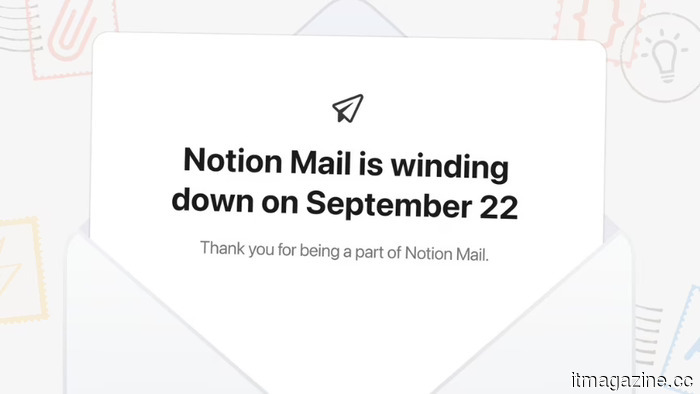
Notion Mail is closing down as AI agents render the conventional inbox unnecessary.
Notion is discontinuing Notion Mail on September 22, citing that AI agents have rendered the traditional inbox unnecessary for most users. The decision comes less than 18 months after the email service was launched, reflecting a shift in email interaction where AI systems increasingly manage tasks like triaging, responding, and scheduling without requiring users to access an inbox.
According to a company post on X, over half of Notion Mail users manage their email without entering the inbox view at all. This statistic informed the decision to shut down the service, as the need for a standalone email client diminishes when so many users allow AI to handle their emails.
Notion Mail was integrated with Gmail, and the company assured users that their emails will remain accessible in their Google accounts post-shutdown. However, users are required to manually export any drafts or scheduled emails from Notion Mail before September 22. Notion has provided a guide in its help center with detailed instructions for this transition.
The product's journey was brief and tumultuous. In February 2024, Notion acquired the privacy-oriented email and collaboration startup Skiff, which contributed the team and technology used to develop Notion Mail. The email client was previewed in October 2024, made generally available in April 2025, and just a year later, it is being phased out.
This move aligns with Notion’s focus on AI agents as a fundamental aspect of its future. On May 13, the company launched a developer platform allowing third parties to create AI agents that operate within Notion’s workspace. Notion reports that over one million agents have already been developed on this platform, highlighting the rapid adoption of AI within its ecosystem.
Notion is not alone in viewing email as a challenge for AI rather than humans. This year, AgentMail secured six million dollars in seed funding aimed at creating AI users with their own email inboxes, suggesting that the next generation of users will consist of autonomous software, not human beings. The startup has already amassed hundreds of thousands of agent users.
This trend is reflective of the broader Software as a Service (SaaS) landscape, where Asana acquired the no-code agent builder Stack AI for $75 million in May, aiming to enhance cross-system workflows. Likewise, Salesforce has transformed Slackbot into what it describes as an agentic operating system, unveiling over 30 new AI features in March. Productivity firms are racing to realign themselves around agents to avoid obsolescence of their existing products.
For Notion, discontinuing the email client represents a strategic decision that prioritizes developing infrastructure for agents over creating interfaces for human users. The developer platform supports agents capable of reading, writing, and functioning across Notion workspaces, fulfilling the cross-application coordination that email was originally meant to handle.
However, this decision is not without risk. Notion Mail was a unique feature in a highly competitive productivity market, and its removal could limit the product's appeal at a time when competitors are expanding their offerings. Nevertheless, Notion seems to believe that sustaining an email client detracts from the focus needed for the agent platform that will define its future.
Users who depend on Notion Mail have until September 22 to adapt, as the email service will cease to operate on that date, and the company has not announced any plans for a replacement. In Notion's perspective, the traditional inbox has already been supplanted by software that eliminates the need to access one.
Other articles
 This website calls out well-known platforms such as Instagram, Netflix, and Spotify for their failure to implement passkeys, labeling them as too complacent.
A newly launched website, WhyNoPasskeys.com, is calling out well-known platforms such as Instagram, Netflix, and Spotify for their failure to incorporate passkey support.
This website calls out well-known platforms such as Instagram, Netflix, and Spotify for their failure to implement passkeys, labeling them as too complacent.
A newly launched website, WhyNoPasskeys.com, is calling out well-known platforms such as Instagram, Netflix, and Spotify for their failure to incorporate passkey support.
 I looked beyond the eye-catching Prime Day OLED TV deals, and these two truly stand out.
These Samsung and LG OLED TV deals for Prime Day are priced similarly, yet they cater to two distinct living rooms.
I looked beyond the eye-catching Prime Day OLED TV deals, and these two truly stand out.
These Samsung and LG OLED TV deals for Prime Day are priced similarly, yet they cater to two distinct living rooms.
 Microsoft has recently increased the prices of Xbox consoles by as much as $150.
In the US, the cost of the 512GB storage model will increase by $100, whereas the 1TB version will experience a price hike of $150.
Microsoft has recently increased the prices of Xbox consoles by as much as $150.
In the US, the cost of the 512GB storage model will increase by $100, whereas the 1TB version will experience a price hike of $150.
 This website exposes well-known platforms such as Instagram, Netflix, and Spotify for their failure to implement passkeys, labeling them as lazy.
A new website named WhyNoPasskeys.com is publicly calling out well-known platforms such as Instagram, Netflix, and Spotify for not offering passkey support.
This website exposes well-known platforms such as Instagram, Netflix, and Spotify for their failure to implement passkeys, labeling them as lazy.
A new website named WhyNoPasskeys.com is publicly calling out well-known platforms such as Instagram, Netflix, and Spotify for not offering passkey support.
 Can the RingConn Gen 3 Enhance Your Health? Insights from a Cardiologist
A cardiologist discusses how the RingConn Gen 3 smart ring embodies the future of health wearables, offering precise tracking, sleep analysis, and wellness monitoring.
Can the RingConn Gen 3 Enhance Your Health? Insights from a Cardiologist
A cardiologist discusses how the RingConn Gen 3 smart ring embodies the future of health wearables, offering precise tracking, sleep analysis, and wellness monitoring.
 NUBWO HG04L and G06 Gaming Headsets: Effective Wired and Wireless Audio Options
Gamers frequently face challenges with expensive headsets that lack comfort, have subpar microphone quality, and feature unreliable connections, all of which can detract from the overall gaming experience. As a brand dedicated to practical gaming accessories, NUBWO presents the HG04L and G06, offering quality gaming audio without the hefty price tag. Numerous brands nowadays emphasize vibrant RGB lighting, [...]
NUBWO HG04L and G06 Gaming Headsets: Effective Wired and Wireless Audio Options
Gamers frequently face challenges with expensive headsets that lack comfort, have subpar microphone quality, and feature unreliable connections, all of which can detract from the overall gaming experience. As a brand dedicated to practical gaming accessories, NUBWO presents the HG04L and G06, offering quality gaming audio without the hefty price tag. Numerous brands nowadays emphasize vibrant RGB lighting, [...]
Notion Mail is closing down as AI agents render the conventional inbox unnecessary.
Notion will discontinue its email service on September 22, stating that AI agents now manage the majority of tasks that an inbox typically performed. Users are allowed to export their data until that date.