

The lovable CEO states that European AI startups are facing an issue with confidence rather than a lack of talent.
TL;DR: Lovable's CEO Anton Osika states that the issue facing European AI is one of confidence rather than talent, as his Stockholm startup achieves a $500 million ARR. Osika mentioned in a weekend post on X that while founders have been advised to relocate to San Francisco to develop a viable AI business, the real challenge lies not in the engineering talent pool. “The talent was never the problem,” Osika asserted. “The belief that you could build from here was.”
These remarks carry significance as Lovable has emerged as a compelling counter-example. The Stockholm-based vibe-coding platform has crossed $500 million in annualized revenue, positioning it among the fastest-growing software companies historically, with only 146 employees. The firm has secured $653 million through four funding rounds, with a valuation exceeding six billion dollars following a $330 million Series B led by CapitalG and Menlo Ventures.
Osika highlighted that millions have utilized Lovable to transform ideas into products and enterprises, many of which are located in Europe, although the U.S. remains its largest market. He noted that some engineers are opting to return to Europe for what he terms their most significant work.
Data on workforce migration supports his observation. Revelio Labs found that by the end of 2024, more tech workers are relocating from the U.S. to Europe than vice versa, marking a reversal of a long-standing trend. The proportion of U.S. workers taking jobs abroad has increased from under three percent to nearly six percent since 2021, particularly in IT consulting roles.
Contributing to this trend are stricter U.S. immigration policies and heightened scrutiny of work visas, which have made career prospects in America less certain for foreign workers. Balderton Capital's “Built in Europe” initiative, supported by over 100 founders from companies like Revolut, Mistral, Wayve, and Lovable, was launched in five European cities earlier this month with a clear message: the talent, capital, and ambition are already present on this side of the Atlantic.
However, not everyone is convinced the issue has been resolved. Y Combinator co-founder Paul Graham, speaking in Stockholm in May, argued that aspiring founders should still spend time in Silicon Valley due to its concentration of investors and opportunities for unexpected connections. He suggested that Stockholm could evolve into “the Silicon Valley of Europe,” but maintained that the original still provides unique advantages that no European city can replicate.
Osika acknowledged that one vital element is still lacking, indicating that Europe requires regional AI infrastructure to meet the current demand and talent, highlighting the continent's reliance on U.S. cloud services and its limited domestic computing capacity.
This discussion is no longer theoretical. Companies like Lovable, ElevenLabs in London, and Mistral in Paris have achieved billion-dollar valuations without needing to move to the Bay Area. The question now remains whether these instances signify a lasting change or merely a temporary cluster of outliers in European tech, which is currently being explored in real-time.
Other articles
 Two cordless massagers designed for those who spend long hours at their desks: Available at a discount for Prime Day.
This post is sponsored by SKG. If you’ve ever purchased a device that was ultimately left unused in a drawer, these two products are designed to prevent that from happening. The SKG W9 Ultra 2.0 Lower Back Massager and the G7 Pro Fold 3.0 Neck Massager are currently available on sale on Amazon, and both are intended to […]
Two cordless massagers designed for those who spend long hours at their desks: Available at a discount for Prime Day.
This post is sponsored by SKG. If you’ve ever purchased a device that was ultimately left unused in a drawer, these two products are designed to prevent that from happening. The SKG W9 Ultra 2.0 Lower Back Massager and the G7 Pro Fold 3.0 Neck Massager are currently available on sale on Amazon, and both are intended to […]
 A leak regarding the Galaxy S27 indicates that Samsung might reuse the same cameras once more.
A recent leak regarding the Galaxy S27 indicates that Samsung may continue using the same camera sensors previously seen in recent Galaxy S models. Although AI and image processing are advancing, some enthusiasts might be questioning how much longer software can manage the burden by itself.
A leak regarding the Galaxy S27 indicates that Samsung might reuse the same cameras once more.
A recent leak regarding the Galaxy S27 indicates that Samsung may continue using the same camera sensors previously seen in recent Galaxy S models. Although AI and image processing are advancing, some enthusiasts might be questioning how much longer software can manage the burden by itself.
 32 Prime Day Enhancements You Should Consider Adding to Your Cart - Digital Trends
This gift guide includes some sponsored content. Why should you trust us? Presented by Prime Day, this guide offers numerous chances to enhance your everyday products. These standout selections provide practical advantages, clever design, and excellent value—making them top deals that are definitely worth adding to your cart. Sponsored Beatbot AquaSense 2 Pro […]
32 Prime Day Enhancements You Should Consider Adding to Your Cart - Digital Trends
This gift guide includes some sponsored content. Why should you trust us? Presented by Prime Day, this guide offers numerous chances to enhance your everyday products. These standout selections provide practical advantages, clever design, and excellent value—making them top deals that are definitely worth adding to your cart. Sponsored Beatbot AquaSense 2 Pro […]
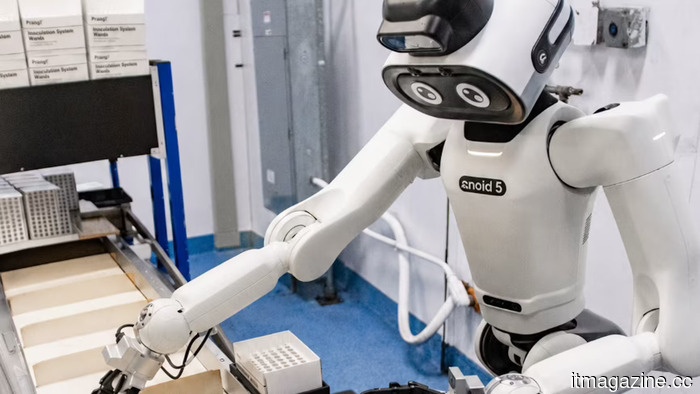 Delivery robot startup Robot.com is placing its future on wheeled humanoid robots designed for use in kitchens and warehouses.
Robot.com, previously known as Kiwibot, has introduced R-noid, a wheeled humanoid equipped with Physical Intelligence's AI that is capable of packing orders and loading boxes.
Delivery robot startup Robot.com is placing its future on wheeled humanoid robots designed for use in kitchens and warehouses.
Robot.com, previously known as Kiwibot, has introduced R-noid, a wheeled humanoid equipped with Physical Intelligence's AI that is capable of packing orders and loading boxes.
 I really like Apple, but this decision regarding watchOS could be the tipping point for me.
My Apple Watch SE 2 is still functioning well. So why does it seem outdated already? Why, Apple, why?
I really like Apple, but this decision regarding watchOS could be the tipping point for me.
My Apple Watch SE 2 is still functioning well. So why does it seem outdated already? Why, Apple, why?
 Kodak Charmera is launching a new $30 keychain camera that features a flip screen for taking selfies.
Yashica’s Funtastic Keychain Camera is a compact digital camera featuring a 180-degree flip screen, a 1MP sensor, USB-C charging, and a variety of character-themed designs.
Kodak Charmera is launching a new $30 keychain camera that features a flip screen for taking selfies.
Yashica’s Funtastic Keychain Camera is a compact digital camera featuring a 180-degree flip screen, a 1MP sensor, USB-C charging, and a variety of character-themed designs.
The lovable CEO states that European AI startups are facing an issue with confidence rather than a lack of talent.
Anton Osika from Lovable states that European founders can establish global AI companies without relying on Silicon Valley, using his own startup, which has a $500M ARR, as evidence.