
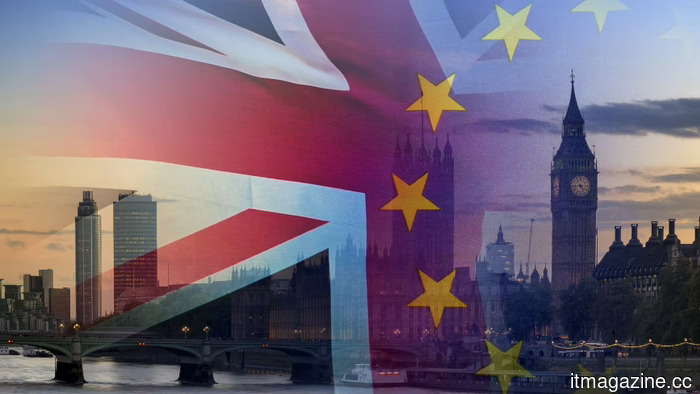
Brexit after ten years: seven Prime Ministers, a 6% reduction in GDP, and an escalating cost.
**TL;DR:** Today marks the tenth anniversary of the Brexit referendum. According to a study by the NBER, the UK economy is currently 6-8% smaller than it could have been, with investments decreased by 12-13% and productivity down by 3-4%. Since the vote, seven prime ministers have come and gone, and 57% of Britons now believe that leaving the EU was a mistake.
A decade ago, 52% of British voters chose to exit the European Union. The ensuing years have seen seven prime ministers, a consistently weakened currency, and the economy, as suggested by a pivotal study, is estimated to be 6-8% smaller than it would have been if the country had opted to remain.
On Monday, Keir Starmer became the sixth prime minister to resign since the referendum, stepping down after less than two years due to a leadership challenge from Andy Burnham. No prime minister has remained in office for longer than three years in the post-Brexit period, with Liz Truss holding the position for just 49 days.
**The cost of Brexit**
A recent working paper from the National Bureau of Economic Research, led by Stanford's Nicholas Bloom, estimates Brexit's cumulative cost at 6-8% of GDP. Investment has dropped by 12-13%, with a 3-4% decline in employment and similar decreases in productivity.
About half of the economic setback is attributed to five years of heightened policy uncertainty from the 2016 vote until the Trade and Cooperation Agreement was implemented in 2021. The rest is due to increased expenses resulting from more complex trade regulations.
This impact has not been an immediate downturn, but rather an ongoing cumulative burden that worsens each year. According to the authors, the disparity between actual and hypothetical GDP is likely to continue to grow even without further shocks.
**Currency and trade**
The pound fell dramatically the morning the results were announced and has not bounced back. The GBP/EUR exchange rate has averaged €1.16 since the referendum, down from €1.27 in the prior decade, with sterling remaining below €1.20 for 98% of trading days.
UK goods exports are approximately 13-15% lower than what would have occurred without Brexit, as indicated by research from the Centre for European Reform and the London School of Economics. New trade agreements with Australia, New Zealand, India, and Japan have not sufficiently offset the loss of seamless access to the EU single market.
The division is evident in the capital markets of London. The FTSE 250, which focuses on domestic companies, has significantly underperformed the multinational FTSE 100 for much of the past decade, reflecting reduced business confidence in UK-oriented firms. Tech companies have shown particular hesitance to list in London, opting instead for markets in New York or Amsterdam. This trend has intensified despite the UK tech sector collectively reaching a valuation of $1 trillion.
**Demographic challenges**
While Westminster changed leaders, the underlying demographics of Britain experienced a decline that largely occurred independently of the referendum but was exacerbated by it. The Office for National Statistics anticipates that 2025 will be the final year where births exceed deaths in England and Wales.
From 2026 onward, net migration will be the sole factor sustaining any population growth. The ONS projects 6.4 million births versus 6.85 million deaths between 2024 and 2034, resulting in a natural decline of about 450,000 people.
The fiscal implications are already becoming evident. The number of Britons reaching pension age is expected to increase by 1.8 million over the next decade, while children will decline by 1.6 million, thereby tightening the tax base necessary for funding pensions and healthcare.
**Shifts in public opinion**
A YouGov poll conducted on June 9, 2026, revealed that 57% of Britons now think leaving the EU was a mistake, while 30% believe it was the right choice. This margin has continued to grow since 2021.
The political environment created by the referendum has drastically changed. Reform UK, the populist party that emerged from the original Brexit movement, recently topped the latest Westminster voting intention poll at 27%, surpassing both the Conservatives and Labour, which stood at 18% each.
**Insights from the tech sector**
The UK technology industry presents a paradox that reflects the wider Brexit narrative. Valued at £1.2 trillion, the UK tech sector leads in Europe, with British AI startups securing over £8.2 billion in venture capital during the first half of 2026.
However, this impressive figure conceals deeper structural issues. Companies that previously hired freely from cities like Paris, Berlin, and Warsaw now contend with an immigration system that adds significant time and expense to the recruitment process.
UK startups have had to exert greater effort to
Other articles
 Concerns raised over South Korea's chip bonuses as a potential inflation threat.
Employees of Samsung and SK Hynix may receive profit-related bonuses of as much as $477,000 each, and the Bank of Korea has indicated that these payouts pose a risk to price stability.
Concerns raised over South Korea's chip bonuses as a potential inflation threat.
Employees of Samsung and SK Hynix may receive profit-related bonuses of as much as $477,000 each, and the Bank of Korea has indicated that these payouts pose a risk to price stability.
 Oracle reduces workforce by 21,000, citing AI in SEC filing.
Oracle reduced its workforce by 13% while investing $55.7 billion in data centers. Its filing with the SEC clearly states that the integration of AI is the reason for the job losses.
Oracle reduces workforce by 21,000, citing AI in SEC filing.
Oracle reduced its workforce by 13% while investing $55.7 billion in data centers. Its filing with the SEC clearly states that the integration of AI is the reason for the job losses.
 The dominance of Google is beginning to wane in the age of AI.
Google maintains a 90% share of the search market and recently reported record earnings; however, the departure of talent, the rise of ChatGPT, and antitrust measures are gradually undermining its dominance.
The dominance of Google is beginning to wane in the age of AI.
Google maintains a 90% share of the search market and recently reported record earnings; however, the departure of talent, the rise of ChatGPT, and antitrust measures are gradually undermining its dominance.
 I discovered the top Prime Day headphone bargains that are worth your investment and avoided the low-quality options.
Prime Day is bursting with headphone offers, but I would prioritize checking these discounts from Sony, Bose, Sennheiser, JBL, and Beats first.
I discovered the top Prime Day headphone bargains that are worth your investment and avoided the low-quality options.
Prime Day is bursting with headphone offers, but I would prioritize checking these discounts from Sony, Bose, Sennheiser, JBL, and Beats first.
 I looked at the Prime Day speaker offers, and these 5 are the ones that deserve your attention.
Avoid the nameless speaker distractions. These JBL and Bose Prime Day offers come with substantial discounts, practical features, and clear justifications for purchase.
I looked at the Prime Day speaker offers, and these 5 are the ones that deserve your attention.
Avoid the nameless speaker distractions. These JBL and Bose Prime Day offers come with substantial discounts, practical features, and clear justifications for purchase.
 The largest tech CEOs in Europe have established a lobbying group aimed at engaging with von der Leyen.
Airbus, ASML, Ericsson, Mistral, Nokia, SAP, and Siemens are urging the EU to accelerate the reduction of regulations, reassess merger policies, and establish European champions to prevent the US and China from gaining an even greater advantage.
The largest tech CEOs in Europe have established a lobbying group aimed at engaging with von der Leyen.
Airbus, ASML, Ericsson, Mistral, Nokia, SAP, and Siemens are urging the EU to accelerate the reduction of regulations, reassess merger policies, and establish European champions to prevent the US and China from gaining an even greater advantage.
Brexit after ten years: seven Prime Ministers, a 6% reduction in GDP, and an escalating cost.
Ten years following the Brexit referendum, a study by the NBER reveals that the UK economy is 6-8% smaller than it would have been had it remained in the EU. There have been seven prime ministers, a decline in the value of the pound, and a looming demographic challenge.