
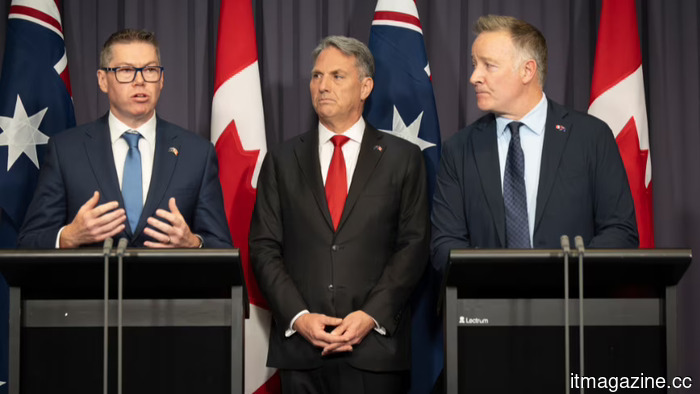
Canada purchases Australian Arctic radar in a groundbreaking A$2.5 billion defense export deal.
Australia has been developing a unique radar system for several decades, which uses signals bounced off the ionosphere to extend its view thousands of kilometers beyond the Earth's curvature. Until now, this technology has remained exclusive to Australia. However, on Sunday, it was sold internationally for the first time.
Canada has agreed to acquire an Arctic over-the-horizon radar based on Australian technology in a deal worth approximately A$2.5 billion, or around US$1.75 billion, marking Canberra's largest defense export to date. The agreement was signed in Canberra by Deputy Prime Minister and Defense Minister Richard Marles and Canada's Secretary of State for Defence Procurement Stephen Fuhr.
This radar system builds upon the Jindalee Operational Radar Network, which Australia relies on to monitor its northern approaches. Canberra claims it is the world’s leading large-scale, long-range over-the-horizon radar, capable of surveillance at distances ranging from approximately 1,000 to 3,000 kilometers. BAE Systems Australia is the primary contractor for this project.
Canada intends to utilize the radar for monitoring the Arctic. As polar ice diminishes and the region becomes more accessible, Ottawa is seeking ways to oversee the vast, largely uninhabited north. Over-the-horizon radar provides a means to monitor airspace for aircraft and missiles without requiring traditional installations across the tundra.
This purchase forms part of Canada's NORAD modernization initiative, a C$38.6 billion program announced in 2022 to enhance continental defense over two decades in collaboration with the United States.
The deal has been in progress for some time. In early 2025, Prime Minister Mark Carney expressed Canada's desire to collaborate with Australia on Arctic radar. Later that June, the two nations signed a technology partnership, and Canada identified its initial sites later in the year following public consultations, reportedly in the Kawartha Lakes area of southern Ontario. The entire system is not expected to be operational for several years.
From Australia's perspective, the appeal of this deal is also industrial. The sale is projected to sustain hundreds of domestic jobs, and BAE Systems Australia has pledged to partner with Canadian firms to locally assemble the radar, bolstering Canada’s defense industrial sector. The construction phase is expected to generate thousands of jobs annually in Canada through the early 2030s.
Exporting this sovereign capability strengthens the defense relationship between the two middle powers, both treaty allies of the United States and sharing concerns regarding developments in the Pacific and Arctic regions.
There is a strategic reasoning behind the hardware. Over-the-horizon radar is currently favored due to its relatively low operational costs compared to its extensive reach and its effectiveness in detecting long-range aircraft and cruise missiles, which are top concerns for NORAD planners.
By selling the technology instead of just utilizing it, Australia transforms a long-standing research program into an export venture, providing Canberra a stake in how its close ally monitors its border.
Contextually, the defense technology market is teeming with funding and urgency, as investments flood into European defense initiatives and startups, while governments face pressure to bridge the gap between their production capabilities and their requirements.
Much of this investment has focused on software and space, with companies like Planet Labs offering continuous satellite surveillance to NATO and various national militaries, along with an influx of new companies specializing in drones and air defense. The common link is the desire to achieve early situational awareness over previously blind areas.
The uniqueness of the radar sale lies in its age. While recent focus in defense technology has shifted to software, autonomy, and space-based systems, this deal underscores that some of the most valuable defense technologies are decades old, large-scale, and revolve around manipulating radio waves beyond the horizon. Australia has spent fifty years refining this technology, and Canada has now become the first nation willing to invest in a copy.
Other articles
 SK Hynix surpasses Samsung to become Korea's most valuable firm.
Thanks to its dominance in AI memory chips, SK Hynix has overtaken Samsung Electronics in market value for the first time in 26 years.
SK Hynix surpasses Samsung to become Korea's most valuable firm.
Thanks to its dominance in AI memory chips, SK Hynix has overtaken Samsung Electronics in market value for the first time in 26 years.
 Isometric in London secures $40 million to validate the industrial sector using AI.
Isometric, based in London, has secured $40 million in a Series A funding round led by AVP to expand its AI certification platform throughout the broader industrial sector.
Isometric in London secures $40 million to validate the industrial sector using AI.
Isometric, based in London, has secured $40 million in a Series A funding round led by AVP to expand its AI certification platform throughout the broader industrial sector.
 Korea's policy head cautions that the chip industry windfall might drive up housing prices.
Kim Yong-beom warns that the wealth generated by Korea’s semiconductor boom could become concentrated in real estate, and he is advocating for reforms in housing taxation.
Korea's policy head cautions that the chip industry windfall might drive up housing prices.
Kim Yong-beom warns that the wealth generated by Korea’s semiconductor boom could become concentrated in real estate, and he is advocating for reforms in housing taxation.
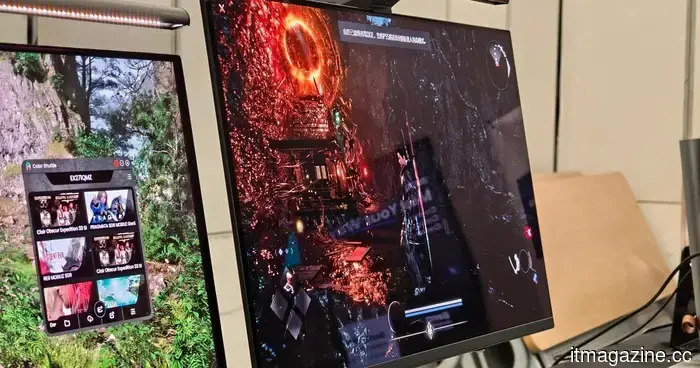 Forget about RTX filters. The gaming monitor from BenQ takes care of the visual enhancements on its own.
BenQ’s MOBIUZ gaming monitors feature AI-driven Smart Color and Color Shuttle that automatically adjust game visuals on the display, offering shareable presets without affecting GPU performance.
Forget about RTX filters. The gaming monitor from BenQ takes care of the visual enhancements on its own.
BenQ’s MOBIUZ gaming monitors feature AI-driven Smart Color and Color Shuttle that automatically adjust game visuals on the display, offering shareable presets without affecting GPU performance.
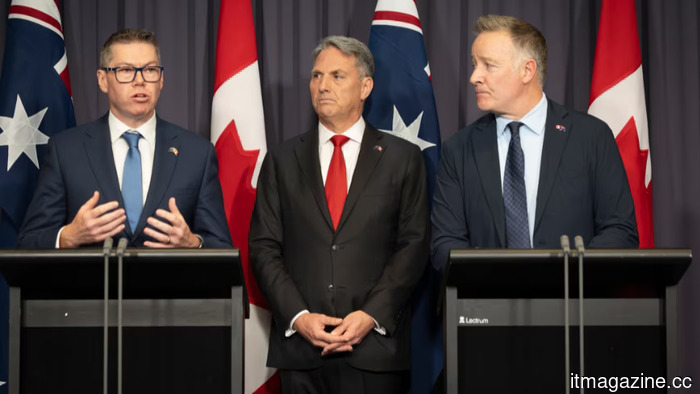 Canada purchases Australian Arctic radar in a historic A$2.5 billion defense export deal.
Canada will purchase Australia's JORN-derived radar for monitoring the Arctic in a deal valued at A$2.5 billion, marking Australia’s largest defence export to date.
Canada purchases Australian Arctic radar in a historic A$2.5 billion defense export deal.
Canada will purchase Australia's JORN-derived radar for monitoring the Arctic in a deal valued at A$2.5 billion, marking Australia’s largest defence export to date.
 Intel Core 3 tests indicate that it may help Windows laptops compete with the MacBook Neo once more.
The new Core 3 304 processor from Intel has surfaced in recent benchmarks, achieving PassMark scores that are notably similar to those of the MacBook Neo powered by Apple's A18 Pro.
Intel Core 3 tests indicate that it may help Windows laptops compete with the MacBook Neo once more.
The new Core 3 304 processor from Intel has surfaced in recent benchmarks, achieving PassMark scores that are notably similar to those of the MacBook Neo powered by Apple's A18 Pro.
Canada purchases Australian Arctic radar in a groundbreaking A$2.5 billion defense export deal.
Canada will purchase Australia's JORN-derived radar system for monitoring the Arctic in a deal worth A$2.5 billion, marking Australia's biggest defence export to date.