

The creator of VLC, which has seen 6 billion downloads, is now aiming to link hundreds of millions of robots.
Jean-Baptiste Kempf, the lead developer of VLC Media Player, has secured $5 million in funding for his startup Kyber, which focuses on providing an infrastructure layer for real-time control of remote devices. The investment round was led by Lightspeed Venture Partners, known for leading Mistral AI's record-setting seed round, and has also invested in Anthropic. Other participants included OVNI Capital and Kima Ventures.
Kyber's main offering is an SDK designed to synchronize video, audio, sensor data, and control inputs with what the company asserts is the lowest possible latency. In a demonstration at the Mile High Video conference in February 2025, Kempf showcased Kyber achieving an impressive 8 milliseconds of glass-to-glass latency, which is the total time taken for a video frame to be captured, encoded, transmitted, decoded, and displayed. The platform is built upon FFmpeg and VLC, open-source projects that Kempf has dedicated two decades to.
The connection to VLC is more than just a personal history; the application has been downloaded over 6 billion times, as confirmed at CES 2025, and the extensive video-streaming expertise behind VLC provides Kyber with its technical foundation. Kempf initiated the startup as a side project while he was CTO at Shadow, a French cloud gaming firm, before establishing it as a separate entity.
Kyber is aimed at various scenarios where the operator is not physically present with the computing device, which is also separated from the action. This includes applications in robotics, drones, remote vehicles, cloud rendering, and remote IT access. The company reports that it is already commercially deployed with clients in defense, telecommunications, robotics, and AI.
The startup anticipates that the infrastructure challenges will increase as fleets expand. Kempf mentioned to TechCrunch that the largest remote driving fleets currently manage around 2,000 to 3,000 vehicles, but scaling up to millions necessitates a different platform that can also ensure observability for operators and AI agents to confirm that systems function correctly.
Kyber is focusing on three main areas: robotics, drones, and remote IT access, with Kempf noting particularly strong demand in these sectors. In the remote IT market, he positions Kyber as a potential competitor to Citrix, indicating a significant addressable market even before the robotics opportunities fully develop.
Staying true to Kempf’s open-source background, the core project is available for free under a dual license. The company offers a productized version for enterprise clients and, similar to Palantir, has forward-deployed engineers for customized integrations. These Forward-Deployed Engineers (FDEs) constitute a considerable portion of Kyber’s 25-member team.
Based in Paris, the company also has offices in San Francisco and Singapore, reflecting the vast scope of the opportunity: the same SDK that allows a technician to perform a software update on a remote device can also enable an AI agent to manage a complete drone fleet. Global investment in robotics and physical AI hit $27.6 billion in 2025, more than double that of the previous year, and most of these robots will require a control and observability framework.
Lightspeed referred to the investment as a wager on the foundational infrastructure supporting physical AI, stating, “Physical AI is only as good as the underlying systems running it,” in a LinkedIn post announcing their involvement.
For Kempf, the concept is straightforward: with hundreds of millions of robots and drones anticipated, there is a need for a nervous system to connect them. He believes that the individual who successfully enabled video playback for 6 billion users is the right fit for this task.
Other articles
 Amazon steps back from the Sam Altman film 'Artificial' due to concerns that it might resonate too closely with its own situation.
Amazon's choice to discontinue Artificial comes a few months following its $50 billion investment in OpenAI, with the studio now seeking other possible distributors.
Amazon steps back from the Sam Altman film 'Artificial' due to concerns that it might resonate too closely with its own situation.
Amazon's choice to discontinue Artificial comes a few months following its $50 billion investment in OpenAI, with the studio now seeking other possible distributors.
 The creator of VLC, which has reached 6 billion downloads, is now aiming to link hundreds of millions of robots.
Jean-Baptiste Kempf, the creator of VLC which has achieved 6 billion downloads, secured $5 million from Lightspeed for Kyber, an SDK designed for real-time control of remote machines.
The creator of VLC, which has reached 6 billion downloads, is now aiming to link hundreds of millions of robots.
Jean-Baptiste Kempf, the creator of VLC which has achieved 6 billion downloads, secured $5 million from Lightspeed for Kyber, an SDK designed for real-time control of remote machines.
 Caviar's iPhone case costs three times more than the phone itself and is embellished with a genuine fragment of a T-Rex tooth.
Caviar's Magnetic Custom Relict case for the iPhone 17 Pro Max, priced at $4,490, is crafted from aviation titanium, alligator leather, blue enamel, and includes a fragment of a Tyrannosaurus fossil.
Caviar's iPhone case costs three times more than the phone itself and is embellished with a genuine fragment of a T-Rex tooth.
Caviar's Magnetic Custom Relict case for the iPhone 17 Pro Max, priced at $4,490, is crafted from aviation titanium, alligator leather, blue enamel, and includes a fragment of a Tyrannosaurus fossil.
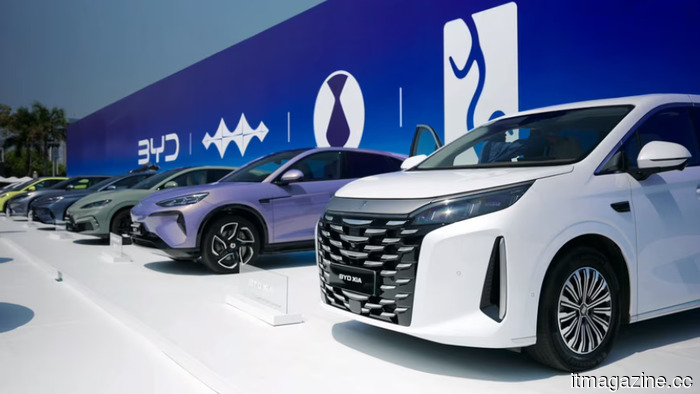 BYD has denied allegations that it breached Hungary's environmental regulations at its electric vehicle factory in Szeged.
Stella Li, the executive VP of BYD, stated that the company has adhered to all local regulations at its plant in Szeged, where Hungarian authorities are investigating claims of toxic soil.
BYD has denied allegations that it breached Hungary's environmental regulations at its electric vehicle factory in Szeged.
Stella Li, the executive VP of BYD, stated that the company has adhered to all local regulations at its plant in Szeged, where Hungarian authorities are investigating claims of toxic soil.
 Researchers at Wharton introduced the term 'cognitive surrender' to characterize the phenomenon where individuals allow AI to take over their thinking.
A study from Wharton revealed that individuals accept incorrect AI responses 80% of the time, especially with applications like Moot that allow five AI personas to weigh in on personal decisions.
Researchers at Wharton introduced the term 'cognitive surrender' to characterize the phenomenon where individuals allow AI to take over their thinking.
A study from Wharton revealed that individuals accept incorrect AI responses 80% of the time, especially with applications like Moot that allow five AI personas to weigh in on personal decisions.
 Nothing has canceled its upcoming budget-friendly phone, and the issue is more significant than you might realize.
The RAM shortage that thwarted Nothing's upcoming budget phone could lead to a noticeable increase in the price of your next budget Android device.
Nothing has canceled its upcoming budget-friendly phone, and the issue is more significant than you might realize.
The RAM shortage that thwarted Nothing's upcoming budget phone could lead to a noticeable increase in the price of your next budget Android device.
The creator of VLC, which has seen 6 billion downloads, is now aiming to link hundreds of millions of robots.
Jean-Baptiste Kempf, the creator of VLC, which has achieved 6 billion downloads, secured $5 million from Lightspeed for Kyber, an SDK designed for real-time control of remote machines.