

Odyssey AI secures $310 million, favors Amazon over Nvidia.
Odyssey, an AI laboratory focused on creating real-time ‘world models,’ has secured $310 million at a valuation of $1.45 billion. A more significant aspect of this funding round is the investor composition.
The Series B funding was led by Natural Capital, with participation from Amazon, AMD Ventures, Google’s GV, EQT, and the CIA-affiliated fund In-Q-Tel. As part of the agreement, AWS has become Odyssey’s preferred cloud provider and will supply its Trainium chips.
This is noteworthy, particularly because of the absence of one key player. Just four months prior, Nvidia’s venture arm, NVentures, supported Odyssey’s Series A. Nvidia is not involved in this Series B round.
Is this a defection, or simply a better opportunity?
Trainium represents Amazon’s attempt to compete with Nvidia’s dominance in AI computing, specifically designed for the fast and high-volume workloads required for real-time world simulations. Combining this with investment from AMD Ventures, a major competitor to Nvidia, suggests a directional shift away from the market leader.
“This round provides the necessary compute, infrastructure, and partners to advance the frontiers of general world models and to achieve a GPT-3 moment for the field,” stated co-founder and CEO Oliver Cameron.
However, it is important to note that this represents diversification rather than a complete split. As Tech Funding News highlighted, it remains uncertain whether the decision reflects genuine belief in Amazon’s chips or simply more favorable terms in a competitive market, and being the ‘preferred cloud’ provider does not equate to exclusivity.
Regardless, this shift occurs as buyers globally seek alternatives to Nvidia, from Chinese automakers developing their own chips to startups converting Nvidia GPUs into a standard commodity.
From self-driving technology to comprehensive simulations
Odyssey was founded in late 2023 by Cameron, a former executive at Cruise and Voyage, and Jeff Hawke, who was a founding engineer at the self-driving company Wayve. Their concept originated from the primary challenge of driverless cars: forecasting future events to enable machine action.
A world model aims to address that in a broader context, simulating continuous 3D environments based on physics and cause-and-effect rather than just text. A robotics company could execute thousands of training scenarios within Odyssey’s simulation instead of on a physical factory floor.
The team comprises approximately 55 employees, located in Palo Alto, London, and Zurich, with backgrounds from DeepMind, Tesla, Waymo, and Apple. Recent initiatives include Odyssey-2 Max for physics simulation and Agora-1, which enables multiple agents to operate within a shared environment.
A competitive and well-funded landscape
This funding illustrates the burgeoning excitement in the sector. Runway achieved a valuation of $5.3 billion following a $315 million round in February, Fei-Fei Li’s World Labs raised $230 million, Google DeepMind’s Genie model is already being utilized by Waymo, and Yann LeCun's new lab is reportedly seeking funding at a €3 billion valuation even before launching a product.
Odyssey’s bet is riskier than many: with around 55 employees and about $27 million raised prior to this round, it’s investing in a technology that has yet to prove its profitability. The involvement of In-Q-Tel, along with Odyssey’s own reference to defense as a potential application, underscores that whoever can convincingly simulate real-world scenarios will likely find clientele beyond gaming.
Other articles
 Token minimizing: companies limit employee use of AI as expenses increase.
Following a year of 'tokenmaxxing,' Meta, Uber, and AT&T are now placing limits on employee AI utilization, while Amazon has eliminated its usage leaderboard. Welcome to tokenminimizing.
Token minimizing: companies limit employee use of AI as expenses increase.
Following a year of 'tokenmaxxing,' Meta, Uber, and AT&T are now placing limits on employee AI utilization, while Amazon has eliminated its usage leaderboard. Welcome to tokenminimizing.
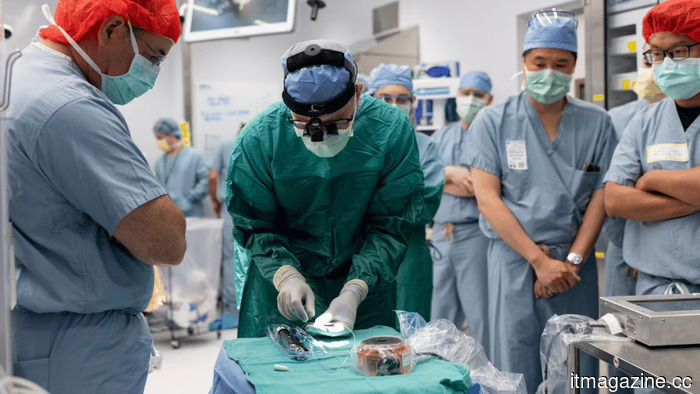 Paradromics has implanted a brain chip in its initial patient.
Paradromics, a competitor of Neuralink, has successfully implanted its Connexus brain chip in a woman who became speech-impaired due to motor neuron disease, marking her as the first patient in the FDA study.
Paradromics has implanted a brain chip in its initial patient.
Paradromics, a competitor of Neuralink, has successfully implanted its Connexus brain chip in a woman who became speech-impaired due to motor neuron disease, marking her as the first patient in the FDA study.
 Grok assisted in targeting 2,000 sites in Iran. Now, the resulting pollution is considered a matter of 'national security'.
The Pentagon claims that Grok assisted in hitting 2,000 targets in Iran and that its environmentally damaging data center is too important to shut down. Both of these assertions should concern us.
Grok assisted in targeting 2,000 sites in Iran. Now, the resulting pollution is considered a matter of 'national security'.
The Pentagon claims that Grok assisted in hitting 2,000 targets in Iran and that its environmentally damaging data center is too important to shut down. Both of these assertions should concern us.
 Enjoying summer with the Technopark
In the summer, you want to forget about worries as much as possible and, if possible, stop the rush by enlisting the help of a nice Electronics assistant and delegating as many everyday tasks as possible to them. Technopark, a retailer of premium quality technology, helped select products that will take care of your health, entertain you in your leisure time, and help you quickly and efficiently manage household chores.
Enjoying summer with the Technopark
In the summer, you want to forget about worries as much as possible and, if possible, stop the rush by enlisting the help of a nice Electronics assistant and delegating as many everyday tasks as possible to them. Technopark, a retailer of premium quality technology, helped select products that will take care of your health, entertain you in your leisure time, and help you quickly and efficiently manage household chores.
 CuspAI: Bezos supports $2.6 billion materials-AI startup
CuspAI, a materials-AI startup from Cambridge that started two years ago, is said to be securing $400 million in funding, spearheaded by Jeff Bezos's family office, at a valuation of $2.6 billion, according to the FT.
CuspAI: Bezos supports $2.6 billion materials-AI startup
CuspAI, a materials-AI startup from Cambridge that started two years ago, is said to be securing $400 million in funding, spearheaded by Jeff Bezos's family office, at a valuation of $2.6 billion, according to the FT.
 Grok assisted in targeting 2,000 locations in Iran. Now, the resulting pollution is considered a matter of 'national security.'
The Pentagon states that Grok assisted in targeting 2,000 sites in Iran, and asserts that its environmentally harmful data center is too crucial to shut down. Both of these assertions should raise concerns.
Grok assisted in targeting 2,000 locations in Iran. Now, the resulting pollution is considered a matter of 'national security.'
The Pentagon states that Grok assisted in targeting 2,000 sites in Iran, and asserts that its environmentally harmful data center is too crucial to shut down. Both of these assertions should raise concerns.
Odyssey AI secures $310 million, favors Amazon over Nvidia.
The world-models startup Odyssey AI secured $310 million at a valuation of $1.45 billion, with AWS and AMD identified as investors, months after receiving funding from Nvidia's venture capital.