
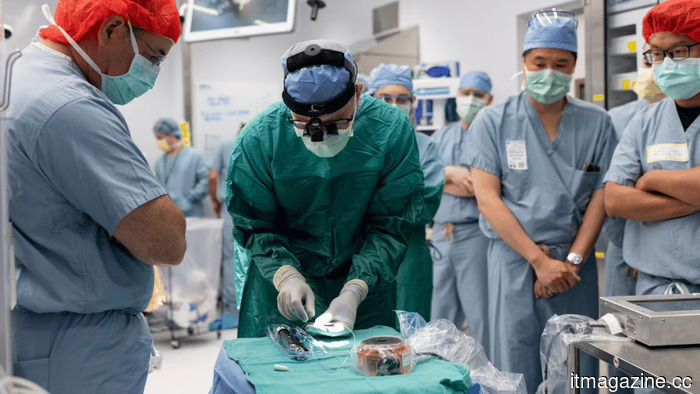
Paradromics has implanted a brain chip in its initial patient.
Neuralink has led the brain-chip narrative for the past two years, but it now faces significant competition with a new patient enter the scene. Paradromics, a neurotechnology firm based in Austin, has announced that it has successfully implanted its Connexus brain-computer interface in the first participant of its FDA-approved clinical trial. The participant, a woman from Michigan who has lost her ability to communicate clearly due to motor neuron disease, underwent the procedure at University of Michigan Health and will be monitored for six years.
Matt Angle, the founder and CEO, stated, “For individuals experiencing severe motor impairments, the ability to communicate is essential for agency, identity, and connection.”
How the speech chip functions
Connexus does not heal the body. Instead, when the patient attempts to speak, the implant captures the neural signals associated with that effort, and software converts these signals into text or synthesized speech on a computer.
The device itself is notable: it is the size of a dime and positioned on the brain's surface, equipped with 421 platinum-iridium microwires, each thinner than half a human hair. These wires connect to a transceiver implanted in the chest, which transmits data wirelessly through the skin.
Paradromics claims that it offers an industry-leading data rate, which indicates how much data it can extract from the brain each second. This is the company's first chronic implant, designed to remain in place. It follows a brief test in 2025, during which the device was placed and removed during another patient's surgery to demonstrate its ability to record safely.
The competitive landscape encompasses the ongoing race in speech-decoding technologies that are already restoring voices in research environments, with other players like Neuralink, Synchron, and Precision Neuroscience also in contention.
Important considerations
There are crucial caveats to note. This is merely one initial feasibility patient, the device has not yet been demonstrated to function, and significant results are expected to emerge over months and years rather than in a matter of days.
Additionally, Paradromics itself raises a broader issue. Its proposed roadmap extends beyond medical applications to include "direct AI interaction," advanced prosthetics, and "human enhancement." Angle contends that creating devices capable of enhancing human capabilities “doesn’t have to be ethically complicated” but “needs to be addressed."
For now, however, the focus is more straightforward and centered on helping an individual who cannot speak to express herself.
Other articles
 Google Messages may soon introduce a tool to help users identify AI-generated images in their conversations.
Google is integrating a C2PA image detection feature into Messages that will provide users with comprehensive labels regarding the creation process of a shared photo.
Google Messages may soon introduce a tool to help users identify AI-generated images in their conversations.
Google is integrating a C2PA image detection feature into Messages that will provide users with comprehensive labels regarding the creation process of a shared photo.
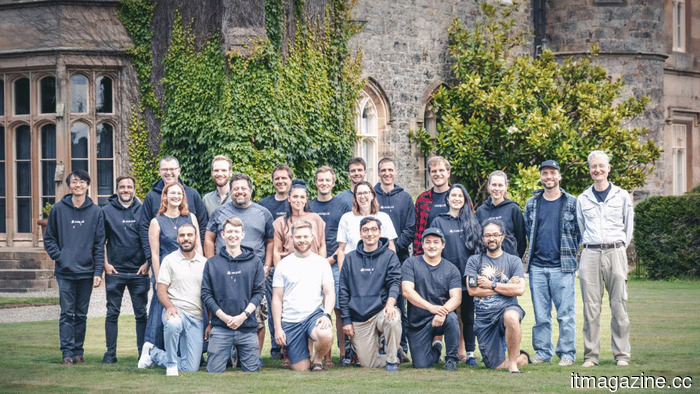 CuspAI: Bezos supports $2.6 billion materials-AI startup
CuspAI, a materials-AI startup from Cambridge that started two years ago, is said to be securing $400 million in funding, spearheaded by Jeff Bezos's family office, at a valuation of $2.6 billion, according to the FT.
CuspAI: Bezos supports $2.6 billion materials-AI startup
CuspAI, a materials-AI startup from Cambridge that started two years ago, is said to be securing $400 million in funding, spearheaded by Jeff Bezos's family office, at a valuation of $2.6 billion, according to the FT.
 Enjoying summer with the Technopark
In the summer, you want to forget about worries as much as possible and, if possible, stop the rush by enlisting the help of a good Elektronik and delegating as many everyday tasks as possible to him. Technopark, a retailer of premium quality technology, helped select products that will take care of your health, entertain you in your free time, and help you quickly and efficiently manage household chores.
Enjoying summer with the Technopark
In the summer, you want to forget about worries as much as possible and, if possible, stop the rush by enlisting the help of a good Elektronik and delegating as many everyday tasks as possible to him. Technopark, a retailer of premium quality technology, helped select products that will take care of your health, entertain you in your free time, and help you quickly and efficiently manage household chores.
 Token minimizing: companies limit employee use of AI as expenses increase.
Following a year of 'tokenmaxxing,' Meta, Uber, and AT&T are now placing limits on employee AI utilization, while Amazon has eliminated its usage leaderboard. Welcome to tokenminimizing.
Token minimizing: companies limit employee use of AI as expenses increase.
Following a year of 'tokenmaxxing,' Meta, Uber, and AT&T are now placing limits on employee AI utilization, while Amazon has eliminated its usage leaderboard. Welcome to tokenminimizing.
 Twenty, a cyber warfare startup, reaches a valuation of $1 billion following a $100 million fundraising round.
Twenty, a US-based cyber warfare startup that openly develops offensive cyber weapons, secured $100 million in funding led by Accel, achieving a valuation of $1 billion as Washington adopts an offensive stance.
Twenty, a cyber warfare startup, reaches a valuation of $1 billion following a $100 million fundraising round.
Twenty, a US-based cyber warfare startup that openly develops offensive cyber weapons, secured $100 million in funding led by Accel, achieving a valuation of $1 billion as Washington adopts an offensive stance.
 Grok assisted in targeting 2,000 locations in Iran. Now, the resulting pollution is considered a matter of 'national security.'
The Pentagon states that Grok assisted in targeting 2,000 sites in Iran, and asserts that its environmentally harmful data center is too crucial to shut down. Both of these assertions should raise concerns.
Grok assisted in targeting 2,000 locations in Iran. Now, the resulting pollution is considered a matter of 'national security.'
The Pentagon states that Grok assisted in targeting 2,000 sites in Iran, and asserts that its environmentally harmful data center is too crucial to shut down. Both of these assertions should raise concerns.
Paradromics has implanted a brain chip in its initial patient.
Paradromics, a competitor of Neuralink, has successfully implanted its Connexus brain chip in a woman who became speech-impaired due to motor neuron disease, marking her as the first patient in the FDA study.