

Grok assisted in targeting 2,000 sites in Iran. Now, the resulting pollution is considered a matter of 'national security'.
The Pentagon has stated that Grok assisted in targeting 2,000 sites in 96 hours, emphasizing that the environmentally harmful power plant supporting it is a crucial matter of national security. The issue stems from the linkage of these two claims in the same statement. This admission was not made through a press release or Pentagon briefing but was included in a statement submitted to a federal courthouse in Mississippi regarding air pollution. In the defense of Elon Musk’s xAI against a Clean Air Act lawsuit, the Pentagon’s chief digital and AI officer included the astonishing fact that Grok had facilitated the launch of over 2,000 munitions at 2,000 separate targets in Iran within just 96 hours, asserting that its ongoing operation was a top national security concern.
This revelation merits scrutiny because of its context. A government representative revealed that a consumer AI tool was used to carry out bombings in a foreign country—not to inform the public, but to ensure a data center remains operational. The connection between targeting and energy production was presented in the same affidavit because, from the administration's perspective, both issues are intertwined: Grok is vital for warfare, and warfare is vital for the nation, thus the power plant supplying Grok cannot be shut down, regardless of legal permit requirements.
This situation highlights two significant concerns surrounding military AI. The first is that a chatbot designed for social networking has been integrated into systems that kill. The second is that the owner of this chatbot has a role within the government influencing its application. Each problem is unsettling on its own, but together they illustrate a system wherein typical safeguards—legal, environmental, ethical—are compromised for the convenience of a single individual and his company.
To begin with the chatbot, Grok is identified in the filing as one of merely four AI models the Pentagon considers capable of supporting national security operations, and one of three approved for mission-critical functions in classified contexts. It integrates with the National Geospatial-Intelligence Agency’s Maven Smart System, an AI-driven platform that organizes intelligence data to assist officials in targeting decisions. Officials maintain that the AI does not create targets but highlights points of interest for human analysts to consider. It is claimed that humans remain involved in the decision-making process.
However, this oversight did not protect the children of Minab. On February 28, during initial airstrikes, a Tomahawk cruise missile struck the Shajarah Tayyebeh girls’ school in an Iranian town, resulting in numerous casualties—over a hundred of whom were children—marking it as one of the most lethal civilian incidents of the conflict, according to observers. A preliminary U.S. military investigation indicated that American forces were likely accountable and that the strike relied on outdated intelligence, utilizing target coordinates based on obsolete data that had not been verified against a current map. The school had remained a school all along.
This scenario illustrates the risks of utilizing AI in targeting decisions, which transcend the issue of whether a machine itself pulls the trigger. The danger is more nuanced and difficult to regulate against. An AI platform that prioritizes points of interest and pairs them with weapons does not eliminate human judgment; rather, it obscures it. Analysts are presented with a polished interface, a clear readout, and a target assigned a number by the system, fostering a tendency to trust it. This automation bias is not a flaw in such systems but rather a predictable consequence of designing AI to appear authoritative. When the foundational data is inaccurate, the interface disguises the error as precision until the projectile strikes.
Next, consider the second issue made unmistakable by the Mississippi court filing. The lawsuit, filed by the NAACP, alleges that xAI is operating numerous gas-powered turbines to supply energy to its data centers without the necessary permits as required by the Clean Air Act, focusing on a facility in Southaven, Mississippi, where the organization has identified 27 unlicensed turbines located near residences, schools, and places of worship in a predominantly Black community. Memphis, home to xAI’s Colossus supercomputer, ranked second in the U.S. for emergency room visits related to asthma in 2024, meaning these residents are exposed to the emissions from the operations.
The government’s response to the lawsuit did not involve justifying the nonexistent permits. Instead, it argued that the pollution was essential for wartime efforts. The Department of Justice requested a judge to dismiss the lawsuit, contending that shutting down the turbines would severely impair the Pentagon's operations. The data centers, according to the official, are strategically positioned to provide essential energy capacity during armed conflicts. In essence, the argument suggests that national security has become a sweeping justification; it overrides environmental regulations, dismisses concerns from affected families, and serves to uphold the infrastructure of a private company that lacks permits.
Here is where the conflict of interest becomes clear. Musk is not simply a vendor distanced from state operations; he occupies a unique position within this administration, with his companies deeply integrated into its security framework
Other articles
 Twenty, a cyber warfare startup, reaches a valuation of $1 billion following a $100 million fundraising round.
Twenty, a US-based cyber warfare startup that openly develops offensive cyber weapons, secured $100 million in funding led by Accel, achieving a valuation of $1 billion as Washington adopts an offensive stance.
Twenty, a cyber warfare startup, reaches a valuation of $1 billion following a $100 million fundraising round.
Twenty, a US-based cyber warfare startup that openly develops offensive cyber weapons, secured $100 million in funding led by Accel, achieving a valuation of $1 billion as Washington adopts an offensive stance.
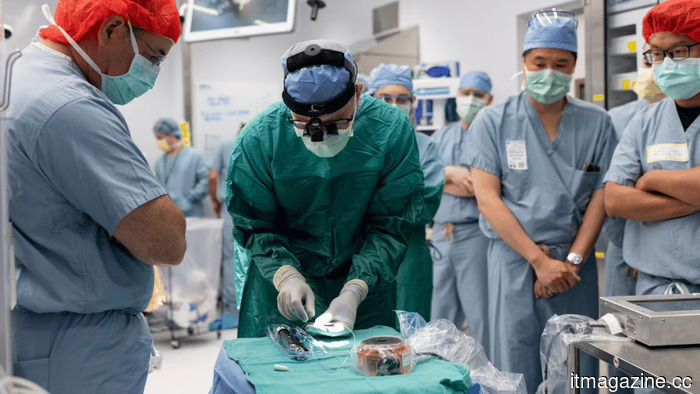 Paradromics has implanted a brain chip in its initial patient.
Paradromics, a competitor of Neuralink, has successfully implanted its Connexus brain chip in a woman who became speech-impaired due to motor neuron disease, marking her as the first patient in the FDA study.
Paradromics has implanted a brain chip in its initial patient.
Paradromics, a competitor of Neuralink, has successfully implanted its Connexus brain chip in a woman who became speech-impaired due to motor neuron disease, marking her as the first patient in the FDA study.
 CuspAI: Bezos supports $2.6 billion materials-AI startup
CuspAI, a materials-AI startup from Cambridge that started two years ago, is said to be securing $400 million in funding, spearheaded by Jeff Bezos's family office, at a valuation of $2.6 billion, according to the FT.
CuspAI: Bezos supports $2.6 billion materials-AI startup
CuspAI, a materials-AI startup from Cambridge that started two years ago, is said to be securing $400 million in funding, spearheaded by Jeff Bezos's family office, at a valuation of $2.6 billion, according to the FT.
 Google Messages may soon introduce a tool to help users identify AI-generated images in their conversations.
Google is integrating a C2PA image detection feature into Messages that will provide users with comprehensive labels regarding the creation process of a shared photo.
Google Messages may soon introduce a tool to help users identify AI-generated images in their conversations.
Google is integrating a C2PA image detection feature into Messages that will provide users with comprehensive labels regarding the creation process of a shared photo.
 Enjoying summer with the Technopark
In the summer, you want to forget about worries as much as possible and, if possible, stop the rush by enlisting the help of a nice Electronics assistant and delegating as many everyday tasks as possible to them. Technopark, a retailer of premium quality technology, helped select products that will take care of your health, entertain you in your leisure time, and help you quickly and efficiently manage household chores.
Enjoying summer with the Technopark
In the summer, you want to forget about worries as much as possible and, if possible, stop the rush by enlisting the help of a nice Electronics assistant and delegating as many everyday tasks as possible to them. Technopark, a retailer of premium quality technology, helped select products that will take care of your health, entertain you in your leisure time, and help you quickly and efficiently manage household chores.
 Beats Studio Buds receive a crucial update addressing a concerning microphone issue.
The recent firmware update for Apple's Beats Studio Buds addresses a Bluetooth microphone issue related to pairing mode, providing owners with a valid reason to verify if version 1B211 has been installed on their earbuds.
Beats Studio Buds receive a crucial update addressing a concerning microphone issue.
The recent firmware update for Apple's Beats Studio Buds addresses a Bluetooth microphone issue related to pairing mode, providing owners with a valid reason to verify if version 1B211 has been installed on their earbuds.
Grok assisted in targeting 2,000 sites in Iran. Now, the resulting pollution is considered a matter of 'national security'.
The Pentagon claims that Grok assisted in hitting 2,000 targets in Iran and that its environmentally damaging data center is too important to shut down. Both of these assertions should concern us.