
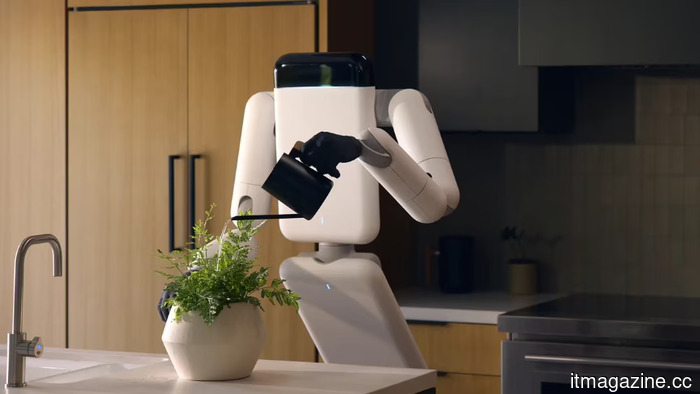
Genesis AI believes that wheels will outperform legs in the robot race.
TL;DRGenesis AI introduced Eno, a wheeled robot with agile hands and a foundational model named GENE, aiming to be a more affordable and practical alternative to humanoid robots. The French-American startup has secured $105 million in seed funding and intends to deploy units by the end of 2026.
On Tuesday, as the robotics sector continues to invest heavily in machines designed to walk like humans, Genesis AI launched a robot that intentionally does not follow this trend. Eno is a wheeled robot equipped with a foldable tower and skilled hands, backed by a foundational model that its developers claim enables human-level manipulation. This represents a clear departure from the common belief in the industry that effective robots must mimic human appearance and movement.
The stakes against Genesis are vast. Figure AI boasts a private valuation of $39 billion and has started deploying its humanoid Figure 03 in a Catalyst Brands warehouse, managing logistics for the parent company of JCPenney and Brooks Brothers. Hyundai and Boston Dynamics aim to produce 30,000 Atlas humanoids annually by 2028 for use in automobile factories in Georgia. In Norway, 1X Technologies sold out its initial production run of 10,000 home robots in just five days after starting preorders.
The trend is also growing in China, where over 150 companies pursue a market that yielded around 14,000 units in 2025. However, only 23% of consumers expressed satisfaction, illustrating a disparity between supply-side expectations and demand-side reality that Genesis believes justifies its strategy.
"The toughest challenge in robotics is not locomotion," noted Zhou Xian, co-founder and CEO of Genesis AI, in a discussion with Business Insider. "It's manipulation—the ability to handle objects with the finesse and flexibility of a human hand." This challenge has drawn significant investment elsewhere, such as from the Chinese robot-hand manufacturer Linkerbot, which is aiming for a $6 billion valuation based on the strength of its dexterous grippers, shipping over 1,000 units monthly.
Zhou, a PhD graduate from Carnegie Mellon, established Genesis alongside Théophile Gervet, a prior researcher at Mistral. The company operates from offices in Paris and San Francisco, employing around 60 staff members. Eno's wheeled design stems directly from this assessment, as wheels are more economical to manufacture, easier to stabilize, and safer around people than bipedal legs, which still present unsolved engineering challenges on a commercial scale. The downside is that Eno cannot ascend stairs, but Genesis argues this limitation is seldom a drawback for its targeted applications in logistics, manufacturing, healthcare, and hospitality.
In contrast to many robotics firms that rely on teleoperation—where a human operator remotely controls the robot as its sensors log movements at a cost of up to $6,000 per hour—Genesis has created a sensor glove. This glove establishes a direct mapping between a human's hand, the glove, and the robot's hand. The company states the gloves cost about $300 per pair, making them roughly 100 times cheaper than traditional teleoperation systems while yielding up to five times more usable training data per session.
This data informs GENE-26.5, the foundational model showcased by Genesis in May. In a public demonstration, a single model utilizing the same hardware performed tasks such as cooking, solving a Rubik's cube, playing the piano, and assembling wire harnesses.
Genesis is not alone in challenging the humanoid paradigm. Sunday Robotics has raised $165 million in a Series B funding round at a $1.15 billion valuation for Memo, a wheeled home robot trained using data from sensor gloves worn in over 500 homes. Meanwhile, German startup Sereact is developing a "robot brain" that integrates with existing industrial systems. Its Cortex model powers more than 200 deployed systems for companies like BMW, Daimler Truck, and PepsiCo, bypassing the form-factor debate altogether.
On the other hand, Agility Robotics' bipedal Digit has quietly become the only humanoid robot generating revenue from paying customers, having transported over 100,000 totes within a GXO Logistics warehouse. This gap between Digit's milestone and the industry's lofty valuations illustrates a significant narrative.
The logistics market, which Genesis aims to target, is already competitive. Amazon has invested over €10 billion in expanding its European fulfillment network and recently introduced Proteus, a warehouse robot that operates via simple verbal instructions.
Genesis has raised $105 million in seed funding, co-led by Eclipse Ventures and Khosla Ventures, with participation from notable figures such as Eric Schmidt, Xavier Niel, MIT robotics professor Daniela Rus, and former Intel Labs head Vladlen Koltun. As noted by Eclipse partner Charly Mwangi, "Even in the most automated industries, the robot-to-human ratio rarely exceeds 1:30."
The company plans to commence production and customer deployments by the end of 2026, focusing initially on logistics and
Other articles
 CyCognito advances AI penetration testing beyond just vulnerability assessments as the attack surfaces of enterprises change.
CyCognito enhances its exposure management platform by introducing ongoing AI penetration testing that replicates multi-step attack sequences throughout enterprise infrastructure, revealing contextual risks overlooked by traditional CVE-based scanners.
CyCognito advances AI penetration testing beyond just vulnerability assessments as the attack surfaces of enterprises change.
CyCognito enhances its exposure management platform by introducing ongoing AI penetration testing that replicates multi-step attack sequences throughout enterprise infrastructure, revealing contextual risks overlooked by traditional CVE-based scanners.
 Limitless Labs secures $20 million to introduce AI to manufacturing facilities.
Israel's Limitless Labs secured $20 million in funding, co-led by Dell and Square Peg, for their 'Physical AI' technology in CNC manufacturing. They are already programming components for Blue Origin and Formula 1.
Limitless Labs secures $20 million to introduce AI to manufacturing facilities.
Israel's Limitless Labs secured $20 million in funding, co-led by Dell and Square Peg, for their 'Physical AI' technology in CNC manufacturing. They are already programming components for Blue Origin and Formula 1.
 The Arch Linux AUR has been affected by malware aimed at obtaining developer credentials.
Attackers compromised more than 1,500 packages in the Arch Linux AUR to introduce a credential-stealing malware. While the official repositories remain secure, the trust model has been affected.
The Arch Linux AUR has been affected by malware aimed at obtaining developer credentials.
Attackers compromised more than 1,500 packages in the Arch Linux AUR to introduce a credential-stealing malware. While the official repositories remain secure, the trust model has been affected.
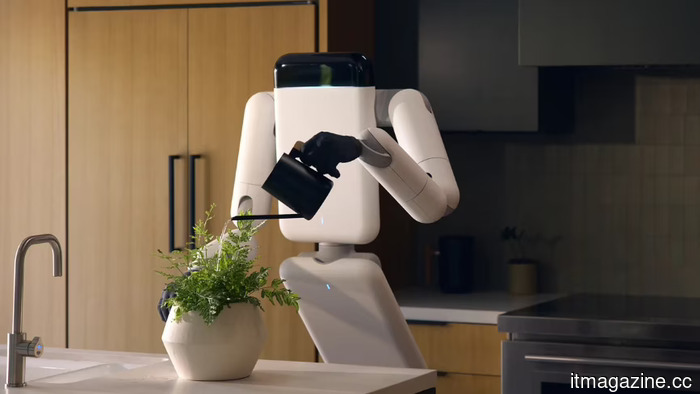 Genesis AI believes that wheels outperform legs in the robot race.
Genesis AI introduced Eno, a wheeled robot developed using $300 sensor gloves, challenging the humanoid approach supported by $39 billion firms Figure AI and Boston Dynamics.
Genesis AI believes that wheels outperform legs in the robot race.
Genesis AI introduced Eno, a wheeled robot developed using $300 sensor gloves, challenging the humanoid approach supported by $39 billion firms Figure AI and Boston Dynamics.
 Executives from major tech companies enlist in the Army Reserve amid rising concerns over conflict.
Cloudflare, Sutter Hill, and former Reddit executives are now part of the Pentagon's Detachment 201, joining the CTOs from Palantir and Meta. Ethics monitors are seeking clarification.
Executives from major tech companies enlist in the Army Reserve amid rising concerns over conflict.
Cloudflare, Sutter Hill, and former Reddit executives are now part of the Pentagon's Detachment 201, joining the CTOs from Palantir and Meta. Ethics monitors are seeking clarification.
 Arch Linux AUR affected by malware aimed at stealing developer credentials.
Attackers compromised more than 1,500 packages in Arch Linux's AUR to insert a credential stealer. The official repositories remain secure, but the trust model has been affected.
Arch Linux AUR affected by malware aimed at stealing developer credentials.
Attackers compromised more than 1,500 packages in Arch Linux's AUR to insert a credential stealer. The official repositories remain secure, but the trust model has been affected.
Genesis AI believes that wheels will outperform legs in the robot race.
Genesis AI introduced Eno, a wheeled robot developed using $300 sensor gloves, which contests the humanoid approach supported by $39 billion Figure AI and Boston Dynamics.