
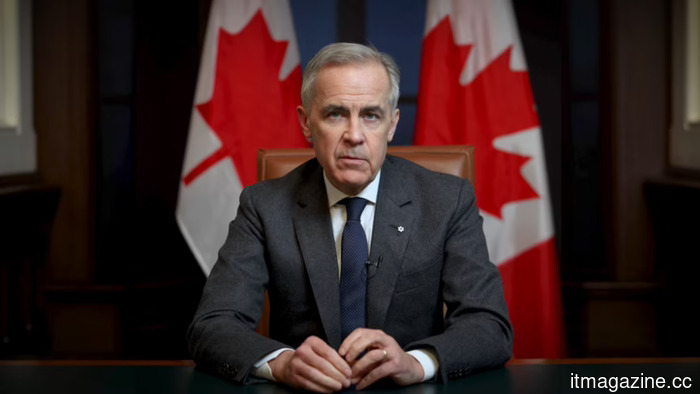
Carney of Canada likens the Anthropic closure to the 2008 financial crisis and issues a warning regarding AI.
TL;DRPM Carney indicates that the ban on the Anthropic model highlights the risks of over-reliance on AI, likening it to the systemic financial linkages witnessed in 2008 ahead of the G7.
On Sunday, Canadian Prime Minister Mark Carney stated that the US export ban, which led to Anthropic ceasing operations of Fable 5 and Mythos 5, illustrates the dangers of relying on a limited number of significant AI models. Addressing reporters during his visit to Ireland, Carney presented the halt as a cautionary tale about systemic weaknesses rather than a failure of any specific company.
“The current situation with Mythos and Fable is a manifestation of the risks associated with over-dependence on certain models,” Carney remarked. “No one has acted improperly in this case, but we would be at fault if we simply accept this without learning from it and do not pursue diversification.”
The former central banker then drew a strong comparison to the financial crisis of 2008. Carney, who previously served as governor of both the Bank of Canada and the Bank of England before venturing into politics, stated, “we face similar model risks” and advocated for redundancy and diversity in AI systems, echoing the regulatory principles imposed on the banking sector following the collapse of Lehman Brothers.
This analogy holds significance due to Carney's credentials; he was the governor of the Bank of Canada during the 2008 crisis and became the first non-British governor of the Bank of England, where he dedicated six years to enhancing the resilience of the financial system. His warning that concentrated dependence on AI mirrors the systemic interconnections that nearly led to the banking system's downfall draws from personal experience rather than mere rhetoric.
Carney noted there is a “good flow of information” between Canada and the US regarding AI and acknowledged that the US government has recognized “some risks” associated with Anthropic’s latest models. However, he focused more on the broader structural lessons rather than the specific conflict between Anthropic and the US Commerce Department.
His remarks come just days ahead of the G7 summit in Évian-les-Bains, France, set to take place from June 15 to 17, where AI governance features prominently on the agenda. Anthropic’s Dario Amodei, OpenAI’s Sam Altman, and Google DeepMind’s Demis Hassabis are scheduled to participate in a working lunch with G7 leaders on Wednesday. Carney mentioned he has already had discussions about AI with French President Emmanuel Macron.
“We need to make progress” in AI, Carney stated, but cautioned that “there will not be a mission accomplished banner following the G7.” This implies that Canada aims to advocate for concrete commitments towards AI diversification at Évian, rather than just symbolic gestures.
Canada has been active on this front; on June 4, Carney unveiled “AI for All,” a national AI strategy worth $2.3 billion that encompasses sovereign computing infrastructure, a national supercomputer, and initiatives aiming to boost business AI adoption from 12% to 60% by 2034. This strategy clearly identifies reliance on foreign cloud services as a vulnerability.
The Anthropic suspension has now provided Carney with a timely, relevant example to reference at the G7. A decision by the US government to implement export controls against a single AI firm has restricted access to its most advanced models for all users outside the US, including allies. For G7 countries that are developing their economies based on AI capabilities they don’t control, the ramifications are significant.
Carney’s trip to Ireland also resulted in a bilateral agreement between Canada and Ireland focused on AI cooperation, technology collaboration, and food security. With Ireland currently holding the presidency of the Council of the European Union, it represents a vital partner for Canada in enhancing relationships with Europe regarding AI, defense, and critical minerals.
A broader trend is gaining momentum; earlier this month, the EU released a tech sovereignty package aimed at reducing dependence on US cloud services. India has proposed a $5 billion sovereign AI fund following the Anthropic suspension.
Britain’s Cosine is mobilizing BT, HSBC, and BAE to establish a sovereign frontier model. Carney’s comparison to 2008 suggests he views these actions as early steps in a structural shift rather than isolated responses.
Other articles
 De Beers invests in blockchain technology as the demand for lab-grown diamonds increases.
GIA has purchased a 30% stake in Tracr, the blockchain provenance platform from De Beers, amidst a decline in natural diamond prices and an increase in market share for lab-grown diamonds.
De Beers invests in blockchain technology as the demand for lab-grown diamonds increases.
GIA has purchased a 30% stake in Tracr, the blockchain provenance platform from De Beers, amidst a decline in natural diamond prices and an increase in market share for lab-grown diamonds.
 Digital Trends Computex 2026 Publisher Awards
Computex 2026 was filled with AI PCs, massive monitors, gaming handhelds, and innovative desktop concepts, but several products stood out amidst the clutter.
Why Apple developed a third-party AI system for Siri and chose not to showcase it at WWDC.
The beta version of Apple's iOS 27 includes an Extensions framework for Claude, Gemini, and ChatGPT integrated within Siri, although this functionality was not highlighted during the WWDC 2026 keynote.
Digital Trends Computex 2026 Publisher Awards
Computex 2026 was filled with AI PCs, massive monitors, gaming handhelds, and innovative desktop concepts, but several products stood out amidst the clutter.
Why Apple developed a third-party AI system for Siri and chose not to showcase it at WWDC.
The beta version of Apple's iOS 27 includes an Extensions framework for Claude, Gemini, and ChatGPT integrated within Siri, although this functionality was not highlighted during the WWDC 2026 keynote.
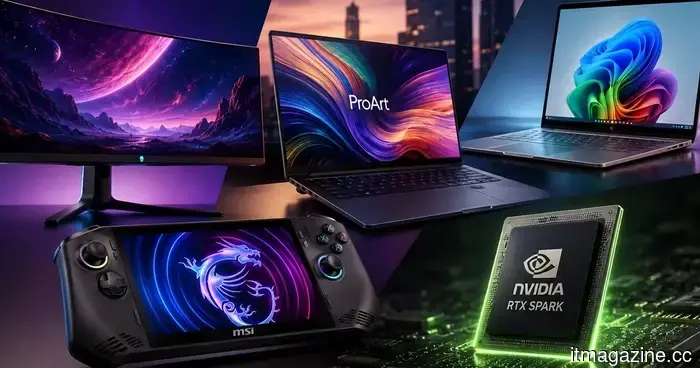 From handheld devices to monitors, these were the most significant transformations at Computex 2026.
Following an in-depth experience at Computex 2026, four tech categories distinctly emerged for transforming monitors, portable gaming, creator laptops, and ARM computing through significant innovations.
From handheld devices to monitors, these were the most significant transformations at Computex 2026.
Following an in-depth experience at Computex 2026, four tech categories distinctly emerged for transforming monitors, portable gaming, creator laptops, and ARM computing through significant innovations.
 Honor Magic V6 review: I had my doubts about this stylish foldable, but it exceeded all expectations.
The Honor Magic V6 stands out as the most well-rounded large foldable device available. It is the first to achieve both IP68 and IP69 ratings, features the finest camera system among large foldables, and delivers battery life that outmatches many traditional smartphones. The only drawbacks are the crease and a complex performance setup, but these do not detract significantly from the overall recommendation.
Honor Magic V6 review: I had my doubts about this stylish foldable, but it exceeded all expectations.
The Honor Magic V6 stands out as the most well-rounded large foldable device available. It is the first to achieve both IP68 and IP69 ratings, features the finest camera system among large foldables, and delivers battery life that outmatches many traditional smartphones. The only drawbacks are the crease and a complex performance setup, but these do not detract significantly from the overall recommendation.
 FINQ's AI-managed ETFs subtly surpass Wall Street in early 2026.
FINQ's two AI-managed ETFs, AIUP and AINT, have surpassed the S&P 500 in performance since their debut on NYSE Arca in February 2026, achieving returns of 15.30% and 27.13% respectively, compared to the benchmark's 10.07%.
FINQ's AI-managed ETFs subtly surpass Wall Street in early 2026.
FINQ's two AI-managed ETFs, AIUP and AINT, have surpassed the S&P 500 in performance since their debut on NYSE Arca in February 2026, achieving returns of 15.30% and 27.13% respectively, compared to the benchmark's 10.07%.
Carney of Canada likens the Anthropic closure to the 2008 financial crisis and issues a warning regarding AI.
PM Carney highlighted that the shutdown of Fable 5 and Mythos 5 illustrates the risks associated with excessive dependence on a limited number of AI models, likening it to the systemic threats posed in 2008.