
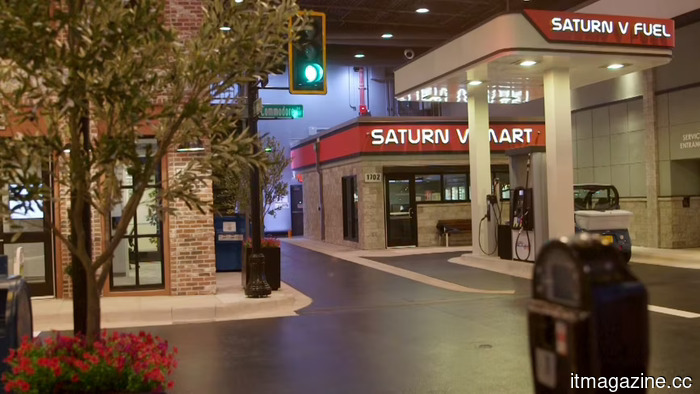
The FBI constructed a simulated town to prepare agents for cyberattacks. This town includes a hospital, an electricity provider, and 200 servers.
**Summary:** The FBI has created a 22,000 sq ft replica town at its Huntsville, Alabama campus to train agents on live cyberattacks. This facility includes a hospital, residences, and 200 servers, and has trained over 1,400 individuals since its launch in February 2025.
The FBI has announced a 22,000-square-foot replica town located on its Huntsville, Alabama campus, designed to prepare law enforcement for simulating and investigating actual cyberattacks. The Kinetic Cyber Range, which opened in February 2025, has provided training for more than 1,400 students, including agents from the FBI and representatives from various federal and local agencies.
The facility is equipped with fully furnished homes, a hotel, a gas station, a grocery store, a courthouse, a hospital, and a power company. It includes roads and traffic signals. Each building is outfitted with functional devices and systems that simulate those found in a typical US community while ensuring that simulated attacks do not leave the premises.
The range has a data center housing over 200 physical servers, with some operating on Windows and others on Linux, which reflect the environments that investigators encounter during breach responses and search operations. Dave Beachboard, the program manager for the range, described the conditions investigators need to prepare for as “cold, cramped, noisy, dark, and miserable.”
This training is crucial, especially as the FBI’s 2025 Internet Crime Report recorded a historic $20.9 billion in cybercrime losses in the US, marking a 26% increase from the previous year. Ransomware has been identified as the primary ongoing threat to critical infrastructure. The Kinetic Cyber Range allows agents to practice responding to ransomware attacks, such as when a hospital's systems go offline, requiring decisions that prioritize patient safety alongside technical ones.
Additionally, the facility instructs investigators in digital forensics, focusing on the technique of accessing encrypted devices to obtain data for investigations. The methods employed are contentious, as they rely on vulnerabilities that remain undisclosed to companies like Apple or Google, circumventing the protections those firms establish for users.
This facility is part of a larger complex at the FBI's Huntsville campus, which has become the agency’s center for technical and cyber operations. By creating a full community environment rather than a single server room, the FBI aims to train agents to recognize the ripple effects of cyberattacks, such as how a breach at a power company could impact a nearby hospital and the wider pressures created by a ransomware demand.
The timing of this announcement is intentional, as advancements in AI have made vulnerability discovery more efficient and affordable, enabling autonomous agents to identify zero-day vulnerabilities within hours for less than $1,000. Concurrently, state-sponsored hacking groups are modernizing their methods. In response, the FBI aims to train investigators under the most realistic conditions possible, building one simulated town at a time.
Other articles
 Windows 11 now locates files when you enter just two characters instead of three.
Microsoft's June Patch Tuesday update enables Windows Search to locate files using only two characters and prioritizes local files over web results and Copilot suggestions.
Windows 11 now locates files when you enter just two characters instead of three.
Microsoft's June Patch Tuesday update enables Windows Search to locate files using only two characters and prioritizes local files over web results and Copilot suggestions.
 The US government has recently put a stop to Anthropic's most advanced AI models.
Anthropic has restricted access to Fable 5 and Mythos 5 following a US government directive that expressed national security worries regarding potential jailbreaks and cyber abuse.
The US government has recently put a stop to Anthropic's most advanced AI models.
Anthropic has restricted access to Fable 5 and Mythos 5 following a US government directive that expressed national security worries regarding potential jailbreaks and cyber abuse.
 Final Fantasy VII Revelation was developed over three years due to the retention of 95% of the team.
FF7 Revelation was completed in 3 years instead of the typical 5 or more because 95% of the development team from Rebirth remained. This highlights a key lesson in an industry that is losing talent.
Final Fantasy VII Revelation was developed over three years due to the retention of 95% of the team.
FF7 Revelation was completed in 3 years instead of the typical 5 or more because 95% of the development team from Rebirth remained. This highlights a key lesson in an industry that is losing talent.
 Users of the Galaxy S25 are finally receiving some of the One UI 8.5 AI features that were previously missing.
With the June update, Galaxy S25 users are finally receiving Prioritize Notifications, Summarize Notifications, and File Summaries, after these features were omitted in the initial One UI 8.5 release.
Users of the Galaxy S25 are finally receiving some of the One UI 8.5 AI features that were previously missing.
With the June update, Galaxy S25 users are finally receiving Prioritize Notifications, Summarize Notifications, and File Summaries, after these features were omitted in the initial One UI 8.5 release.
 Final Fantasy VII Revelation was developed over a span of three years, primarily because 95% of the team remained intact.
FF7 Revelation was completed in 3 years rather than the typical 5 or more because 95% of the development team remained from Rebirth. In an industry struggling with talent retention, this is an important takeaway.
Final Fantasy VII Revelation was developed over a span of three years, primarily because 95% of the team remained intact.
FF7 Revelation was completed in 3 years rather than the typical 5 or more because 95% of the development team remained from Rebirth. In an industry struggling with talent retention, this is an important takeaway.
 Windows 11 now locates files with just two characters instead of requiring three.
Microsoft's June Patch Tuesday update enables Windows Search to locate files using only two characters and prioritizes local files over web results and Copilot suggestions.
Windows 11 now locates files with just two characters instead of requiring three.
Microsoft's June Patch Tuesday update enables Windows Search to locate files using only two characters and prioritizes local files over web results and Copilot suggestions.
The FBI constructed a simulated town to prepare agents for cyberattacks. This town includes a hospital, an electricity provider, and 200 servers.
The FBI's Kinetic Cyber Range is a 22,000 square foot replica town located in Huntsville, featuring homes, a hospital, and a data center. It recreates ransomware scenarios on live systems.